Advantages of bulk buying boxes for movers and businesses
TL;DR:
- Bulk buying boxes in large quantities cuts costs by up to 40% and enhances supply stability. It improves operational efficiency, reduces environmental impact, and simplifies packing through standardized sizes and quality. Flexible payment and storage options make bulk procurement accessible for individuals and small businesses.
Bulk buying boxes is defined as purchasing packaging materials in large quantities to reduce per-unit cost and improve supply reliability. The advantages of bulk buying boxes extend well beyond simple savings: unit costs drop by up to 40% compared to retail prices, with bulk cardboard boxes ranging from £0.30 to £1.20 per unit. That price gap is significant whether you are moving house once or running a removal company with weekly jobs. Operational benefits follow closely, from fewer supply interruptions to faster packing times and a measurable reduction in transport emissions.
1. What are the core cost benefits of bulk buying boxes?
The most direct advantage of purchasing boxes in bulk is the reduction in cost per unit. Bulk cardboard boxes cost between £0.30 and £1.20 per unit, compared to significantly higher retail prices for individual boxes. That gap compounds quickly across a full house move or a business packing operation.
The savings go further than the box price itself. Buying in bulk reduces the frequency of orders, which cuts transport costs and lowers the administrative burden of repeated purchasing. Fewer purchase orders mean less time spent on procurement and fewer delivery slots to coordinate.
Branded moving kits sold at self-storage facilities carry a 30–50% mark-up over standard market prices. Strategic bulk purchasing saves individuals over 60% on total moving material costs compared to buying those kits. That figure puts bulk buying in a different category from a minor discount to a genuinely transformative cost decision.
| Box type | Typical unit cost (retail) | Typical unit cost (bulk) |
|---|---|---|
| Small single-wall box | £1.80–£2.50 | £0.30–£0.60 |
| Medium double-wall box | £2.80–£3.80 | £0.70–£1.00 |
| Large double-wall box | £3.50–£5.00 | £0.90–£1.20 |
Pro Tip: Order your full estimated box count in one go rather than topping up mid-move. A single bulk order from Storageremovalboxes locks in the lower unit price and avoids a second delivery charge.
2. How bulk buying improves operational efficiency and supply chain stability
Bulk purchasing is a structured supply planning practice, not simply a way to spend less money. Aligning packaging inventory with actual demand minimises production or moving-day interruptions and stabilises supply chains. For a removal company running multiple jobs per week, running out of boxes mid-job is a serious operational failure.
Reactive buying, where you purchase boxes as you need them, creates unpredictable lead times and price exposure. Structured bulk procurement removes both problems. You know what you have, you know what it cost, and you can plan around it.
Standardised box sizes also improve warehouse and vehicle efficiency. When every box in a consignment shares the same dimensions, stacking becomes predictable and vehicle cargo space is used more fully. That directly reduces loading time and the risk of load shift during transit.
“Bulk buying should be regarded as a structured supply planning practice that stabilises operations and improves quality consistency, rather than just a means of saving money.” Logistics specialists at CJK Packaging, 2026.
Key operational gains from bulk box procurement:
- Fewer stockouts, which means fewer delays on moving day or in production
- Consistent box quality across every job, reducing damage claims
- Simplified inventory management with fewer SKUs to track
- Predictable stacking that maximises vehicle cargo space and cuts loading time
- Reduced supplier contact and fewer invoices to process
3. What are the environmental advantages of bulk packaging purchases?
Bulk packaging reduces the number of individual deliveries required to supply the same volume of materials. Fewer deliveries cut transport emissions and reduce packaging waste, which directly supports sustainability goals for businesses and individuals alike. One consolidated lorry delivery replaces five separate van drops, and the carbon difference is not trivial.
Secondary packaging waste also falls sharply with bulk orders. Retail boxes arrive wrapped in plastic, placed in outer cartons, and padded with void fill. Bulk shipments use far less of all three. The result is less material going to landfill before you have even started packing.
Bulk orders also open the door to a tiered sourcing approach. Combining new double-walled boxes for fragile items with recycled or reused boxes for lighter goods reduces both cost and resource consumption. This approach fits neatly into circular economy principles, where materials stay in use for as long as possible.
Environmental benefits of bulk packaging purchases:
- Consolidated deliveries reduce vehicle movements and fuel use
- Less secondary packaging per unit compared to retail purchasing
- Opportunity to include recycled boxes for low-risk items within the same order
- Reduced resource consumption through longer material lifecycles
- Lower overall carbon footprint per box delivered
Pro Tip: Ask Storageremovalboxes about their recyclable double-walled box range. Using these for fragile items and supplementing with reused boxes for books or linen is the most cost-effective and environmentally sound packing strategy available.
4. Practical packing and moving benefits of buying boxes in bulk
Uniform box dimensions are the practical advantage that most buyers overlook. Standardised box dimensions purchased in bulk enable predictable stacking that maximises vehicle utilisation and reduces load damage during transport. When every box is the same size, you can fill a removal van like a puzzle with known pieces rather than guessing.
Consistent quality matters equally. When all boxes come from the same bulk order, the wall thickness, board grade, and weight rating are uniform. That removes the guesswork about which box can safely hold your cast iron cookware and which cannot.
Expert movers recommend a tiered approach to box selection within a bulk order. Use heavy-duty double-walled boxes for fragile, heavy, or high-value items. Reserve standard boxes for clothing, bedding, and books. This approach, applied to moving box packs from a single supplier, keeps quality consistent while matching box strength to actual need.
Packing speed also increases when box types are uniform. Packers do not need to assess each box before use. They know the dimensions, they know the weight limit, and they can work through a room without stopping to check. For removal companies, that time saving across multiple jobs adds up to a meaningful reduction in labour costs.
- Select two or three standard box sizes to cover all item categories
- Assign each size a specific use (small for heavy items, large for light bulky goods)
- Order the full quantity of each size in one bulk purchase
- Stack by size group in the vehicle to maximise load stability
- Unpack in reverse order at the destination for faster room-by-room sorting
5. How to manage upfront costs and storage when buying in bulk
The two most common objections to bulk buying are the upfront payment and the storage space required. Both are real concerns, but both have practical solutions that have become more accessible in recent years.
Flexible payment plans and storage options increasingly allow staged procurement without large upfront payments. This removes the cashflow barrier that previously made bulk buying impractical for individuals or small businesses with limited working capital.
Weekly draw-down models allow businesses to reserve a large batch of boxes while paying only for smaller regular quantities as they are needed. The supplier holds the stock, the buyer avoids a large one-off payment, and the unit price stays at the bulk rate. This model is particularly well suited to removal companies with variable weekly job volumes.
Practical strategies for managing bulk buying barriers:
- Use draw-down procurement to spread cost without losing the bulk price
- Source recycled boxes locally for light items to reduce the volume of new stock needed
- Order in phases aligned to your moving or job schedule rather than all at once
- Use a dedicated storage area or a self-storage unit to hold surplus boxes between jobs
- Partner with a supplier like Storageremovalboxes that offers reliable UK-wide delivery to reduce the need for large on-site stock
For individuals moving house, the simplest approach is to order the full quantity two to three weeks before moving day. Most homes have enough space to store flat-packed boxes in a spare room or garage for that period. The cost saving justifies the minor inconvenience of temporary storage.
Key takeaways
Bulk buying boxes delivers the greatest value when treated as a planned procurement decision rather than a last-minute purchase, combining per-unit cost savings of up to 40% with operational, environmental, and practical packing benefits.
| Point | Details |
|---|---|
| Cost savings are substantial | Bulk unit prices range from £0.30 to £1.20, saving up to 40% versus retail. |
| Supply chain stability improves | Structured bulk procurement eliminates stockouts and moving-day delays. |
| Environmental impact falls | Consolidated deliveries cut transport emissions and secondary packaging waste. |
| Uniform dimensions aid efficiency | Standardised box sizes improve stacking, vehicle loading, and packing speed. |
| Cashflow barriers are solvable | Draw-down models and flexible payment plans make bulk buying accessible to small businesses and individuals. |
Why bulk buying boxes changed how I think about moving logistics
The first time I watched a removal team run out of boxes halfway through a three-bedroom house clearance, I understood the real cost of reactive purchasing. The job stopped for two hours while someone drove to a retail outlet and paid full price for a dozen boxes. The client was unhappy, the crew was idle, and the day’s margin evaporated.
Bulk buying is not about hoarding. It is about removing a variable from a process that already has enough variables. When you know your boxes are there, the right sizes, the right quality, and enough of them, everything else moves faster.
The environmental argument has also shifted my thinking. I used to view consolidated deliveries as a logistics convenience. Now I see them as a genuine contribution to lower emissions per job. For businesses that run ten or twenty moves a month, that adds up to a meaningful reduction in their carbon footprint.
My advice to small businesses is to start with a draw-down model if cashflow is tight. Reserve a batch, draw down weekly, and track your actual usage for two months. You will quickly see your average box consumption per job, and that data will tell you exactly what to order in bulk next time. For individuals, the maths is simpler: one bulk order before moving day will almost always cost less than buying boxes in stages from a retail source. The packaging for moving category at Storageremovalboxes is a good place to benchmark what bulk pricing looks like in practice.
— Adrian
Storageremovalboxes: bulk packing boxes for every move
Storageremovalboxes supplies a full range of double-walled moving boxes, packing kits, and protective materials designed for house removals, self-storage, and commercial logistics across the UK.
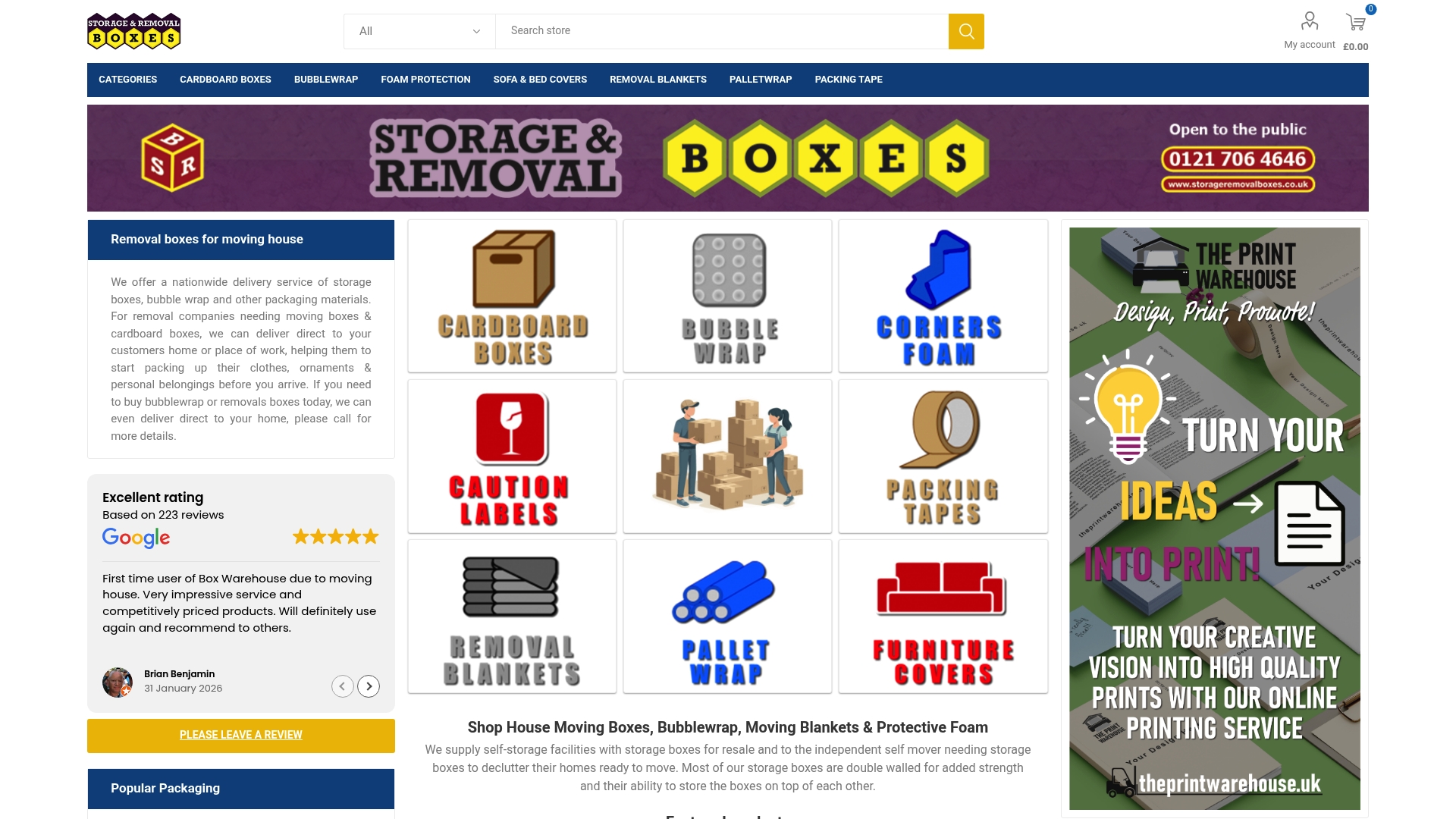
The packing boxes range covers everything from small postal boxes to large removal boxes, all available in quantities suited to bulk orders. Stock levels are maintained for reliable nationwide delivery, so you are not waiting on a back-order when moving day is approaching. The team at Storageremovalboxes can advise on the right box sizes and quantities for your specific move or business volume. If you want to understand how box grades and dimensions affect protection, the industry standards for packing guide sets out the key specifications clearly.
FAQ
How much can I save by buying boxes in bulk?
Bulk cardboard boxes cost between £0.30 and £1.20 per unit, compared to significantly higher retail prices, representing savings of up to 40% per unit. Individuals switching from branded moving kits can save over 60% on total moving material costs.
What box sizes should I buy in bulk for a house move?
A combination of small, medium, and large double-walled boxes covers most household moves. Small boxes suit heavy items like books, medium boxes handle kitchenware, and large boxes are best for light bulky goods like bedding and clothing.
How do I store bulk boxes before my move?
Flat-packed boxes take up very little space. A spare room, hallway, or garage can hold enough boxes for a full house move for two to three weeks before moving day without significant disruption.
Can small businesses benefit from bulk box purchasing?
Small businesses benefit directly through lower unit costs, fewer purchase orders, and more stable supply. Draw-down procurement models allow businesses to access bulk pricing without committing to a large upfront payment or holding excessive stock.
Are bulk-bought boxes better for the environment?
Consolidated bulk deliveries reduce vehicle movements and transport emissions compared to multiple smaller orders. Bulk packaging also generates less secondary packaging waste per unit, supporting sustainability goals for both businesses and individuals.