Choose the right moving box sizes for a smoother move
TL;DR:
- Choosing the right box size ensures safety, protection, and efficient stacking during a move.
- Small, medium, and large boxes are designated for dense, versatile, and bulky lightweight items respectively.
- Proper packing techniques and adherence to weight limits prevent damage and simplify the moving process.
Picking the right box sizes for a house move sounds straightforward until you’re standing in a half-packed living room, wondering why your books weigh a tonne and your duvet won’t fit anywhere sensible. The wrong box choice leads to broken valuables, strained backs, and removal crews refusing to lift overloaded crates. Get it right, though, and your move becomes faster, safer, and far less stressful. This guide walks you through everything you need to know about matching box sizes to your belongings, from the basic criteria to special cases like fragile items and smaller rental properties.
Table of Contents
- How to choose the right moving box size: The essential criteria
- Small, medium, and large boxes: Ideal uses and dimensions
- Comparison table: Which box for which item?
- Safe packing, lifting and loading: Common mistakes and expert advice
- Special cases: Small moves, rentals, and fragile items
- Why one-size-fits-all is a myth: Lessons from professional movers
- Find your perfect box kit for a stress-free move
- Frequently asked questions
Key Takeaways
| Point | Details |
|---|---|
| Match weight to box size | Heavier belongings always go in smaller boxes to reduce damage and injury risk. |
| Mix box sizes for efficiency | Using a variety of box sizes makes stacking easier and maximises van space. |
| Stay under 25kg per box | Keep all packed boxes below 25kg so professional movers will accept them. |
| Double-wall for fragile items | For delicate or valuable items, select double-walled boxes for extra protection. |
How to choose the right moving box size: The essential criteria
Before you order a single box, it helps to understand the logic behind size selection. The goal is not simply to fit as much as possible into each box. It is to balance weight, protection, and stackability so that nothing breaks and nobody gets hurt.
The most important rule is weight. Safe manual handling guidance consistently recommends keeping boxes under 25kg, and many removal firms will refuse to lift anything heavier. As a practical benchmark, heavy items under 25kg should always go into smaller boxes, while larger boxes are reserved for light, bulky contents only. This single principle prevents most moving injuries and box failures.
Box material matters just as much. Single-walled cardboard suits lighter loads and short moves. Double-walled boxes, which have two layers of corrugated board, handle heavier or fragile items far better and resist crushing when stacked. If you are moving anything breakable or storing boxes for more than a day or two, double-walled is always the better choice.
Here is a quick checklist of criteria to apply before choosing a box size:
- Item density: Dense items like books, tools, and tins need small boxes to stay within safe weight limits
- Item fragility: Fragile pieces need snug-fitting boxes with minimal movement inside
- Item shape: Awkward or bulky items such as lampshades need larger boxes with room to wrap
- Stacking plan: Uniform box sizes stack more efficiently in a van, reducing shifting during transit
- Removal firm requirements: Many professional movers will not carry boxes exceeding 25kg
“The golden rule of packing is simple: heavy things in small boxes, light things in large boxes. Ignore it and you will regret it on moving day.”
Pro Tip: Before sealing any box, lift it a few centimetres off the floor. If you cannot hold it comfortably for 30 seconds, it is too heavy. Redistribute the contents before you tape it shut.
Choosing the right material and size from the outset saves you from repacking on the day, which is one of the most time-consuming and demoralising things that can happen during a move.
Small, medium, and large boxes: Ideal uses and dimensions
Now that you understand the criteria, it is time to look at the three standard sizes and what each one does best.
Small boxes typically measure around 305 x 305 x 305 mm (12 x 12 x 12 inches). They are the workhorses of any move. Books, tinned food, tools, records, and anything else that is dense and heavy belongs here. A small box packed with books will already approach its safe weight limit, which is exactly why the size exists. You can carry it without straining, and it stacks neatly.
Medium boxes measure around 457 x 457 x 406 mm (18 x 18 x 16 to 18 inches) and are the most versatile option available. They suit pots, pans, toys, shoes, small appliances, electronics, and mixed household loads. Most households use more medium boxes than any other size, and for good reason: they balance capacity with manageable weight.
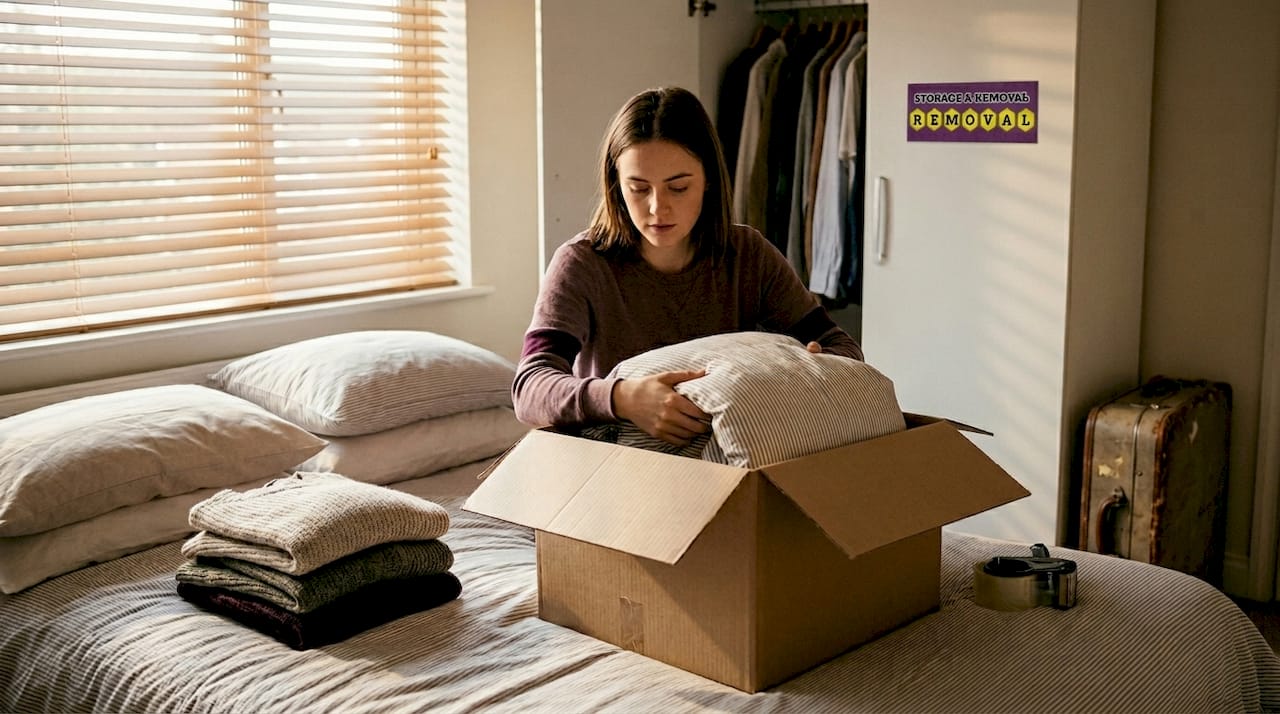
Large boxes are typically 457 x 457 x 610 mm (18 x 18 x 24 inches) and exist purely for light, voluminous items. Bedding, pillows, towels, lampshades, cushions, and winter coats are ideal candidates. Large boxes for bulky items should never be filled with anything heavy, as the box base will give way and the contents will be at risk.
Here is a quick-reference summary:
| Box size | Typical dimensions | Best for | Max recommended weight |
|---|---|---|---|
| Small | 305 x 305 x 305 mm | Books, tools, tins, records | 20 to 23 kg |
| Medium | 457 x 457 x 406 mm | Kitchenware, toys, electronics | 25 to 30 kg |
| Large | 457 x 457 x 610 mm | Bedding, pillows, lampshades | Up to 20 kg |
Pro Tip: Order more medium boxes than you think you need. Most people underestimate how many medium-sized loads a typical three-bedroom house generates. Running out mid-pack is a genuine headache.
Understanding these three sizes gives you a solid foundation. Most moves only require a combination of small and medium boxes, with a handful of large ones for soft furnishings.
Comparison table: Which box for which item?
With the sizes clear, the next step is matching your actual belongings to the right box. This is where many people go wrong, usually by defaulting to whatever box is nearest rather than thinking about weight and fit.
The table below maps common household items to their ideal box size, along with weight guidance and packing notes.
| Household item | Recommended box | Weight guidance | Packing note |
|---|---|---|---|
| Books | Small | 18 to 23 kg max | Stack flat or upright, never overfill |
| Kitchen crockery | Medium | Under 25 kg | Wrap each piece in paper or bubble wrap |
| Clothes (folded) | Medium or large | Keep light | Fill voids with socks or soft items |
| Bedding and pillows | Large | Under 20 kg | Compress lightly, do not overstuff |
| Tools and hardware | Small | Under 20 kg | Wrap sharp edges |
| Toys and games | Medium | Under 25 kg | Disassemble large items where possible |
| Fragile glassware | Small or medium | Under 20 kg | Use double-walled boxes and plenty of padding |
| Towels and linens | Large | Under 20 kg | Ideal filler for gaps around fragile items |
| Small appliances | Medium | Under 25 kg | Use original packaging if available |
As a useful benchmark, small boxes hold 18 to 23 kg safely, medium boxes up to 25 to 30 kg, and large boxes should stay under 20 kg regardless of contents.
The most common mistake is packing books into large boxes. A large box of books can easily exceed 40 kg, which is dangerous to lift and almost guaranteed to split the base. Similarly, fragile items should never go into soft-sided bags or loosely packed large boxes where they can shift and collide.
Browsing the full range of moving box options before you start packing helps you plan your quantities and avoid last-minute shortages. Knowing how many of each size you need is just as important as knowing which size to use.
Key mistakes to avoid:
- Putting heavy items in large boxes
- Leaving too much empty space, which causes collapse under stacking
- Mixing fragile and heavy items in the same box
- Forgetting to label boxes with both contents and destination room
Safe packing, lifting and loading: Common mistakes and expert advice
Even with the right box sizes selected, poor packing technique can undo all your planning. Here are the most important steps to follow for a safe, efficient move.
- Pack heaviest items at the bottom of each box, with lighter items on top
- Fill all voids using bubble wrap, crumpled paper, or soft clothing to prevent shifting
- Seal every box firmly with quality packing tape, running at least two strips along the base seam
- Label every box on at least two sides with the room destination and a brief contents note
- Test the weight by lifting each box slightly before taping shut
- Stack boxes by size in the van, with heaviest at floor level and lighter boxes on top
One of the most costly errors is ignoring the weight limit. Boxes over 25 kg may be refused by professional movers, leaving you to repack on moving day under time pressure. That is a situation nobody wants.
“A well-packed box should feel solid, not floppy. If the sides bow outward or the base sags, it is either overfilled or the wrong size for the contents.”
Double-walled boxes are worth using for anything fragile or heavy. The extra layer of corrugated board significantly increases crush resistance, which matters when boxes are stacked two or three high in a removal van. For house moving box selection, double-walled options are the professional standard.
Pro Tip: Use the “shake test” before sealing. If you can hear or feel contents moving, add more padding. Movement inside a box is the primary cause of breakage during transit.
For removal box advice tailored to your specific move, it is always worth checking what removal firms recommend before you commit to a box order.
Special cases: Small moves, rentals, and fragile items
Not every move involves a four-bedroom house and a full removal lorry. Smaller moves, rental properties, and collections of fragile valuables all require a slightly different approach.
For flat moves and rental properties, the priority is usually efficiency and cost. You are likely working with less space, fewer helpers, and possibly a van hire rather than a full removal service. In these situations, small and medium boxes are your best friends. They are easier to carry up and down stairs, fit more easily into lifts, and stack neatly in smaller vehicles. Avoid ordering too many large boxes for a flat move as they quickly become unwieldy in tight spaces.
For fragile or irreplaceable items, the approach is different again:
- Use small or medium double-walled boxes for maximum rigidity
- Wrap each item individually in bubble wrap or foam protectors
- Place heavier wrapped items at the bottom, lighter ones on top
- Mark boxes clearly with fragile labels on all four sides and the top
- Never stack other boxes directly on top of fragile-labelled boxes
Budget-conscious movers can save money by ordering a moving box pack that includes a pre-selected mix of sizes suited to different property types. These kits take the guesswork out of quantities and often work out cheaper than buying individual boxes.
Pro Tip: For a one-bedroom flat, a starter kit with around ten small, ten medium, and five large boxes usually covers most needs. Scale up proportionally for larger properties.
Specialist containers such as wardrobe boxes (which include a hanging rail) are worth considering for suits, dresses, and delicate garments that would otherwise need to be folded.
Why one-size-fits-all is a myth: Lessons from professional movers
Here is something most moving guides will not tell you: the movers who do this every day never use just one box size. Not because they have unlimited budget, but because they know that variety is what makes a van load safe and efficient.
Think of loading a removal van like a game of Tetris. Varied box sizes allow you to fill gaps, create stable layers, and minimise the shifting that causes damage in transit. A van packed exclusively with large boxes will have more wasted space and more movement. A van packed with a thoughtful mix locks together far more securely.
The other lesson professionals carry is that the 25 kg limit is not a suggestion. It is a practical boundary that protects both the mover and the contents. Injuries from overloaded boxes cost time, money, and sometimes much worse. Experienced crews will simply refuse to lift anything that feels unsafe, and rightly so.
For safe box stacking advice that goes beyond the basics, it is worth understanding how stacking order affects both van space and box integrity. The planning you do before you pack is what separates a smooth move from a chaotic one.
Find your perfect box kit for a stress-free move
Now that you know exactly which box sizes suit which items, the next step is making sure you have the right supplies ready before moving day arrives.
At StorageRemovalBoxes.co.uk, we supply strong, double-walled moving boxes in every size, along with pre-packed moving box kits tailored to different property sizes. Whether you need a compact starter pack for a studio flat or a full kit for a large family home, we have options to suit every move. Our large double wall boxes are built to handle bulky, light loads without buckling, and we offer nationwide delivery so everything arrives before you need it. Start with the right boxes and your move will thank you for it.
Frequently asked questions
What is the best size box for moving books?
Use a small box no larger than 18 inches in length, keeping the total weight under 23 kg to prevent strain and avoid base failure during lifting.
How heavy should a moving box be for safe lifting?
Most removal professionals recommend staying under 25 kg per box, as anything heavier risks injury and may be refused by your removal crew.
Are double-walled boxes necessary for a home move?
For heavy or fragile items, double-walled boxes provide significantly better crush resistance and are the preferred choice of most professional removal firms.
Should I use large boxes for all my clothes and bedding?
Large boxes work well for light, bulky items like bedding and cushions, but always check the weight stays under 20 kg to keep them manageable and prevent the base from giving way.