Choose the right removal box sizes for stress-free moving
TL;DR:
- Using appropriately sized boxes prevents damage, makes packing safer, and improves loading efficiency.
- Different box sizes are suited for specific items, with small for heavy items and large for bulky lightweight goods.
- Proper planning and labelling of box sizes streamline the move, reducing stress and transit damage.
Grabbing whatever boxes you can find from the supermarket and hoping for the best is one of the most common mistakes UK movers make. The truth is, using the wrong size removal box is a leading cause of breakages, strained backs, and wasted van space. Getting your box sizes right from the start saves you money, protects your belongings, and makes the whole process faster and far less stressful.
Table of Contents
- Why box size matters in every move
- Common removal box sizes and their best uses
- How to estimate the number and mix of boxes you need
- Maximising efficiency: Packing tips for every box size
- Why box size choices are the hidden key to a smooth move
- Make your next move stress-free with the right boxes
- Frequently asked questions
Key Takeaways
| Point | Details |
|---|---|
| Box size impacts safety | Using the right size boxes prevents breakages and back strain during your move. |
| Different items need different boxes | Books go in small boxes, clothes in large ones—matching box to item keeps things secure. |
| Estimate box numbers in advance | Plan your box order room by room, with extras for last-minute additions. |
| Double-walled boxes protect valuables | Use strong, reinforced boxes for fragile or heavy belongings. |
| Mixing sizes maximises efficiency | A combination of box sizes saves space and speeds up every stage of moving. |
Why box size matters in every move
Most people treat removal boxes as a commodity. A box is a box, right? Wrong. The size of the box you choose for each item directly affects how safe that item will be during transit, how easy the box is to carry, and how efficiently your van gets loaded.
Heavy items packed into oversized boxes are a recipe for disaster. When books, crockery, or tools rattle around in a box that is too big, they shift during transport and collide with each other. The result is chips, cracks, and breakages that could easily have been avoided. As the principle goes, appropriate box sizing prevents damage to transported goods and contributes to secure logistics operations.
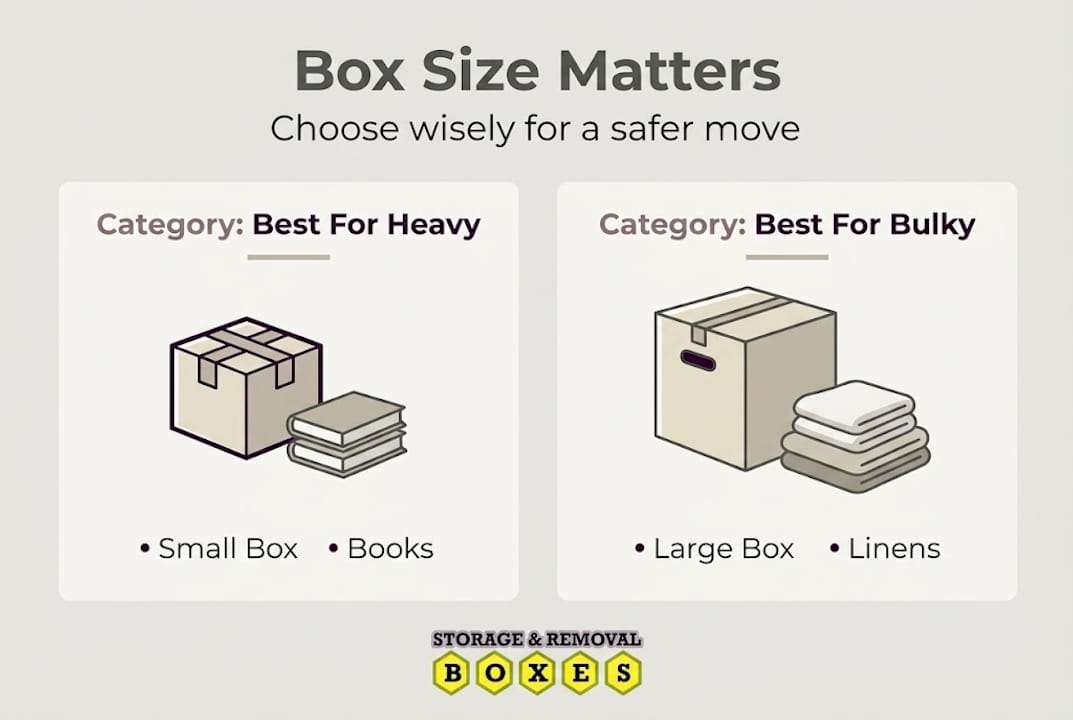
On the other side of the problem, packing light, bulky items like duvets or cushions into small boxes wastes space and means you end up with far more boxes than you need. The key is matching the item to the box, not forcing the box to fit the item.
Here is what the right approach looks like in practice:
- Small boxes for dense, heavy items such as books, tins, and tools
- Medium boxes for kitchen items, toys, and small appliances
- Large boxes for lightweight but bulky items like bedding, pillows, and clothing
- Specialist boxes for mirrors, TVs, and wardrobes
Good choosing moving box sizes practice also maximises how efficiently your removal van gets packed. Uniform, well-filled boxes stack neatly, reduce movement during transit, and mean fewer trips. Professional removal companies know this well, which is why they always arrive with a carefully planned mix of sizes rather than a random collection of whatever was available.
“The single biggest packing mistake we see is people using large boxes for everything. They end up with boxes they cannot lift and items that have moved around and broken. Size selection is not optional; it is fundamental.”
Pro Tip: Before you start packing a single item, walk through each room and mentally sort your belongings into heavy, medium, and light categories. This takes ten minutes and will shape your entire box order.
For further guidance on shipping box selection tips, it is worth understanding that the same principles used in professional logistics apply directly to house removals.
Common removal box sizes and their best uses
Understanding why the right size matters, let us look at the most commonly used box sizes and what they are best suited for.
In the UK, removal boxes tend to follow fairly consistent sizing conventions, though dimensions can vary slightly between suppliers. The three core sizes you will encounter are small, medium, and large, each designed with specific contents in mind. Box sizes influence organisation, loading space optimisation, and reduce transport costs when used correctly.
Here is a quick-reference table to help you plan:
| Box size | Approximate dimensions | Ideal contents | Approximate weight limit |
|---|---|---|---|
| Small | 18 x 18 x 10 inches | Books, files, tins, tools, fragile items | Up to 15kg |
| Medium | 18 x 18 x 12 inches | Kitchen items, toys, small appliances, ornaments | Up to 20kg |
| Large | 18 x 18 x 20 inches | Bedding, pillows, clothing, lampshades | Up to 15kg (light items only) |
| Extra large | 18 x 18 x 30 inches | Duvets, large cushions, very light bulky items | Up to 10kg |
A few important points to note from this table. Large boxes have a lower practical weight limit than medium boxes, because the whole point of a large box is to hold volume, not mass. Packing a large box with heavy kitchen items is the kind of mistake that leads to a box splitting at the bottom and a very unhappy moving day.
Small double walled boxes are the workhorses of any move. They are strong enough to hold dense items without buckling, and small enough that even a fully loaded box remains manageable to carry. For anything fragile or valuable, double-walled construction is not a luxury; it is a necessity.
Medium moving boxes are the most versatile size and typically make up the largest proportion of any move. Kitchen cupboards, children’s toys, bathroom products, and small electrical items all fit comfortably and safely in a medium box.
Large moving boxes are ideal when you need to move bulky but lightweight items efficiently. A large box filled with duvets and pillows takes up the same van space as a heavy box of books but is far easier and safer to handle.
Common misuses to avoid:
- Mixing heavy and light items in the same large box, which creates uneven weight distribution
- Under-filling boxes, which causes them to collapse when stacked
- Over-filling boxes, which stresses the seams and makes lids bow outward
- Reusing old, weakened boxes from previous moves or supermarkets, which may look fine but have compromised structural integrity
How to estimate the number and mix of boxes you need
Now that you know which sizes serve which purpose, let us figure out how many you will actually need for your move.
The most common mistake at this stage is underestimating. People look around their home and think, “It is not that much stuff.” Then moving day arrives and they run out of boxes halfway through the kitchen. Always overestimate slightly, because unused boxes can be flattened and stored or returned, but running short on moving day is genuinely stressful.
Here is a practical step-by-step approach to estimating your box needs:
- Count your rooms and assign a rough category to each: heavy contents (study, garage), mixed contents (kitchen, living room), or light contents (bedrooms, linen cupboard).
- Walk through each room and count items rather than eyeballing. Open cupboards and wardrobes. People consistently forget what is inside them.
- Apply the standard ratios for your home size. A typical two-bedroom move requires approximately 20 small boxes, 15 medium boxes, and 10 large boxes. A three-bedroom home typically needs around 30 small, 25 medium, and 15 large.
- Account for specialist items. Flat-screen TVs, large mirrors, paintings, and hanging wardrobes all need dedicated boxes or covers. Do not try to squeeze these into standard boxes.
- Add a buffer of 10 to 15 percent on top of your estimate. Industry standards for box sizing in professional removal services consistently recommend this buffer to account for last-minute discoveries and awkward items.
For box quantity planning, it also helps to think about your lifestyle honestly. Are you a minimalist with clear surfaces and tidy cupboards, or do you have collections, hobbies, and years of accumulated belongings? A minimalist two-bedroom flat might need far fewer boxes than a family two-bedroom home with a garage full of tools and a loft full of seasonal items.
Pro Tip: Pack a “last out, first in” box of essentials: kettle, mugs, phone charger, toilet roll, and a change of clothes. Label it clearly and load it into the van last so it comes off first at your new home. This one habit makes the first evening in a new house dramatically more comfortable.
Understanding packaging protection pointers from logistics professionals reinforces a key truth: the box is only as good as the planning that went into choosing it.
Maximising efficiency: Packing tips for every box size
Estimating your boxes is half the challenge. Now let us focus on how to pack them safely and effectively.
The way you fill, seal, and label each box matters as much as the size you choose. A perfectly sized box, poorly packed, will still result in damage. Here is how to get it right for each size category.
For small boxes:
- Pack books spine-down to protect their binding
- Wrap each fragile item individually in bubble wrap before placing it in the box
- Fill any gaps with crumpled paper or foam peanuts to prevent shifting
- Seal with two strips of tape along the bottom seam and one along each side join
For medium boxes:
- Place heavier items at the bottom and lighter items on top
- Use soft items like tea towels or clothing to cushion gaps around kitchen items
- Never leave a medium box more than three-quarters full if it contains fragile items
- Aim for a firm, stable feel when you shake the box gently; nothing should rattle
For large boxes:
- Reserve these strictly for lightweight, bulky items
- Bedding and clothing can be compressed slightly to maximise space
- Always seal large boxes thoroughly; their size makes them more vulnerable to lid stress during stacking
The weight rule is critical and worth stating plainly: proper box sizing reduces damage risk and ensures a secure logistics operation, but no box should exceed 20kg. Beyond that weight, the risk of injury to the person carrying it increases sharply, and the box itself is more likely to fail at the seams or handles.
For medium size packing tips, the golden rule is balance: balanced weight, balanced contents, and balanced filling. A medium box that is perfectly packed feels solid, lifts cleanly, and stacks without wobbling.
Labelling is non-negotiable. Write the destination room, the general contents, and the box size on at least two sides. When boxes are stacked in a van or storage unit, you can only see one face at a time. Labelling multiple sides means you can always read the box without moving it.
A useful statistic worth noting: removal industry data consistently shows that the majority of transit damage occurs not because boxes are weak, but because they are incorrectly filled or the wrong size for their contents. Strength alone does not protect your belongings; correct sizing and packing technique do.
Why box size choices are the hidden key to a smooth move
Here is something most moving guides will not tell you plainly: the biggest source of stress and damage on moving day is not using cheap boxes. It is using the wrong size boxes, even strong, expensive ones.
We have seen this pattern repeat across dozens of moves. Someone invests in quality double-walled boxes, packs everything carefully, and still ends up with broken items and an exhausted moving crew. The culprit, almost every time, is size mismatch. Heavy items in large boxes. Fragile items rattling around with too much space. Bulky items crammed into boxes that are too small and impossible to seal properly.
The persistent myth is that box strength solves everything. It does not. A heavy-duty large box filled with books will still fail, because the weight exceeds what the base can support over a long journey with road vibration. Appropriate box sizing prevents damage to transported goods far more reliably than box strength alone.
What genuinely sets professional movers apart is not the brand of box they use. It is their instinct for matching size to item, and their discipline in packing order. They know that our experience with medium boxes shows medium boxes are the most frequently misused, either overfilled with heavy items or used as a catch-all for awkward objects that should go in specialist packaging.
The practical wisdom here is simple but rarely followed: spend as much time planning your box sizes as you do buying them. A well-planned mix of small, medium, and large boxes, matched precisely to your belongings, will outperform a van full of identical large boxes every single time. Size selection is a skill, and like any skill, it improves with intention and practice.
Make your next move stress-free with the right boxes
Armed with insider knowledge and practical tips, here is how you can get everything you need for your next move in one place.
At StorageRemovalBoxes.co.uk, you can browse just moving boxes by size and order exactly the mix you need without guesswork. Whether you are moving a studio flat or a five-bedroom house, our double-walled boxes are built to handle the real demands of a UK move. For a fully planned approach, our safe, organised move kits bundle the right quantities of each size together with bubble wrap and packing essentials. If you have very large or bulky items to move, our extra-large double wall boxes offer the volume you need without compromising on structural strength. Order online with nationwide delivery across the UK.
Frequently asked questions
What size removal boxes are best for books and heavy items?
Small, sturdy double-walled boxes are safest for books and heavy items, keeping weights manageable and reducing the risk of box failure or injury during carrying.
How many moving boxes do I need for a 3-bedroom house?
Plan for about 30 small, 25 medium, and 15 large boxes for a typical 3-bedroom home, though box sizes influence organisation and exact numbers will vary depending on how much you have accumulated over the years.
Can I use large boxes for everything to make moving faster?
No. Overfilled large boxes are significantly harder to lift and far more likely to split at the seams; mixing sizes is both safer and more efficient, as proper box sizing reduces damage throughout the move.
What is the benefit of double-walled removal boxes?
Double-walled boxes provide an extra layer of structural strength that protects fragile or valuable items from impact and compression during transit, because appropriate box sizing prevents damage most effectively when combined with robust construction.
Why do professionals insist on labelling box size and contents?
Labelling both the size and contents on multiple sides of each box makes stacking safer in the van, helps movers prioritise which boxes go where, and speeds up unpacking considerably once you arrive at your new home.