Essential removal supplies for a safer, smoother move

TL;DR:
- Choosing quality packing supplies and detailed labeling reduces moving stress and damage risk.
- Proper assessment of belongings and property size guides the selection of appropriate boxes and padding.
- Starting packing early and using curated kits ensures a smoother, more organized relocation process.
Choosing the right removal supplies is one of the most underestimated decisions you’ll make during a house move. Pick the wrong boxes or skip the padding, and you’re gambling with your most valued possessions. Go too cheap on tape, and a box base gives way on the stairs. The choices you make before a single item is wrapped will shape whether moving day feels manageable or chaotic. This article walks you through everything you need to assess, compare, and select the right packing materials for a safe, stress-free relocation anywhere in the UK.
Key Takeaways
| Point | Details |
|---|---|
| Calculate supply needs | Estimating box quantity and types prevents last-minute shortages and helps budget accurately. |
| Choose quality over price | Sturdy boxes and proper protection reduce the risk of breakage and make the move less stressful. |
| Don’t forget extras | Strong tape, labels and pens are essential for an organised, efficient move. |
| Mix packing materials | Use a combination of boxes, bubble wrap, and foam for versatile and secure packing. |
| Use comparison tables | Review supply strengths and costs side-by-side to make the best choices for your move. |
How to assess your removal supply needs
Before you order a single roll of bubble wrap, take stock of what you’re actually moving. The size of your home is the most obvious starting point, but it’s not the only factor. A minimalist in a three-bedroom house might need far fewer boxes than a collector in a one-bedroom flat. Be honest about what you own.
Property size gives you a rough baseline. A typical 3-bedroom house needs 40 to 60 boxes, with a packing supplies budget of £80 to £150, rising to £100 to £250 if you include professional packing services. That’s a useful benchmark, but your actual needs will depend on how much you’ve accumulated and how fragile your belongings are.
Think carefully about the nature of what you’re moving:
- Fragile items such as crockery, glassware, and artwork need specialist padding and double-walled boxes.
- Electronics including TVs, monitors, and gaming consoles benefit from foam corner protectors and anti-static wrap.
- Books and files are heavy; small, sturdy boxes prevent overloading and back injuries.
- Clothing and soft furnishings can go into wardrobe cartons or vacuum storage bags to save space.
- Valuables and antiques deserve the most robust protection you can give them.
Storage duration also matters. If your belongings are going into a self-storage unit for several weeks or months, you’ll need materials that protect against moisture, dust, and compression over time. That changes your choices around box quality and internal padding.
Budget realistically from the start. Underestimating your supply needs and running short on moving day is one of the most common and avoidable stressful situations. Order more than you think you need. Unused boxes can often be returned or recycled.
Pro Tip: Browse home moving packs to get a curated selection matched to your home size, rather than guessing quantities from scratch. Pre-assembled moving box packs take the guesswork out of your shopping list entirely.
Boxes, cartons and crates: foundation of every move
Once you’ve sized up your needs, start with the most essential supply of all: the boxes themselves. Not all boxes are equal, and using the wrong type for the wrong item is a recipe for damage.
Single-wall boxes are lighter and cheaper, suitable for soft items like clothing, towels, and bedding. They’re fine for low-risk contents that won’t be stacked under heavy loads. Double-wall boxes, on the other hand, are built with two layers of corrugated cardboard. They’re significantly more rigid, handle stacking far better, and are the sensible choice for anything fragile, heavy, or high-value.
Specialty cartons solve specific problems that standard boxes can’t:
- Wardrobe cartons have a hanging rail built in, so clothes travel crease-free without needing to be folded.
- Book boxes are compact and reinforced for heavy loads.
- Dish packs have dividers to keep plates and glasses separated and cushioned.
- Picture and mirror cartons are flat and padded for artwork and frames.
Here’s a quick-reference guide to help you plan quantities based on property size:
| Property size | Estimated boxes needed | Recommended box type |
|---|---|---|
| Studio or 1-bed flat | 15 to 25 boxes | Mix of small and medium |
| 2-bedroom house | 30 to 40 boxes | Medium and large, some specialty |
| 3-bedroom house | 40 to 60 boxes | Full mix including double-wall |
| 4-bedroom house or larger | 60 to 80+ boxes | Heavy-duty double-wall throughout |
For a mid-sized move, the medium house removal pack provides a well-balanced selection. If you’re moving from a larger property, the extra large removal kit covers the volume you’ll need without multiple separate orders.
Pro Tip: Use sturdy plastic crates for your most fragile or high-value items. Unlike cardboard, crates don’t buckle when stacked and offer rigid protection that no amount of tape can replicate with a standard box.
Protective materials: bubble wrap, foam and padding options
With your boxes sorted, the next priority is what goes inside them. Protective materials are what stand between your belongings and the bumps, jolts, and vibrations of a removal lorry. Many people underestimate how much movement occurs during transit, even on a short local move.
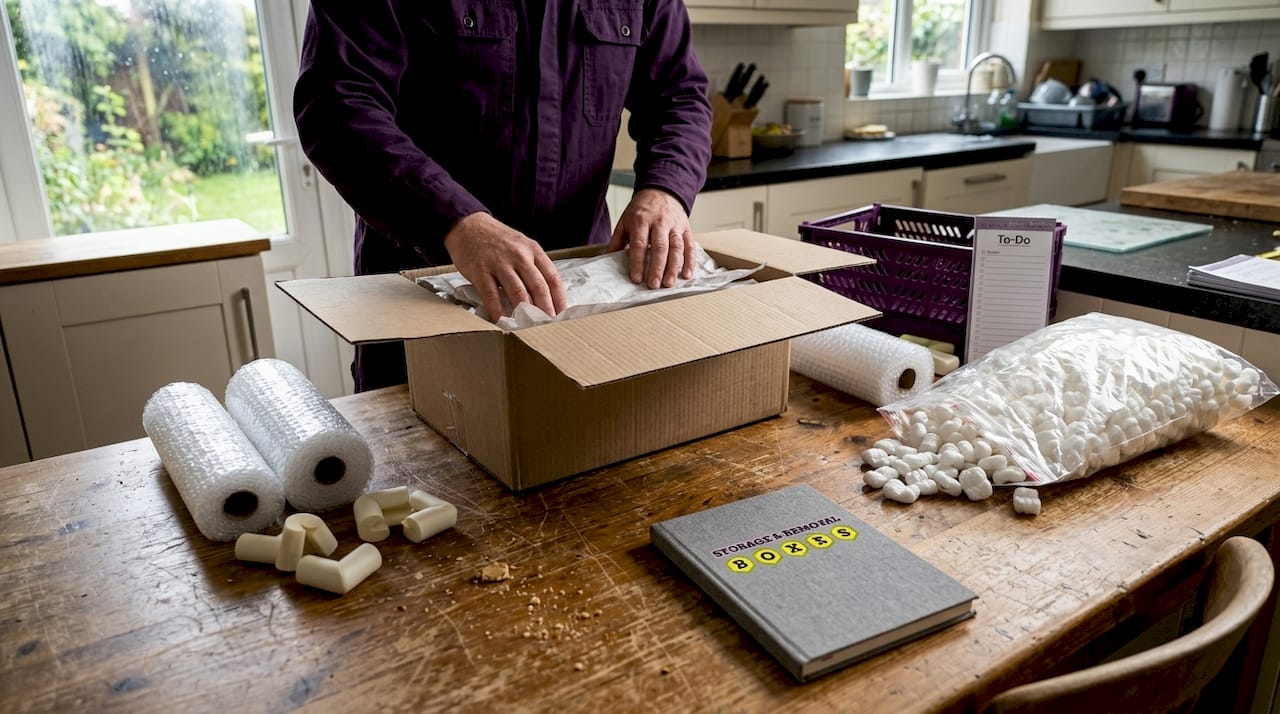
Bubble wrap is the most versatile cushioning material available. Small-bubble wrap is ideal for wrapping individual items like mugs, ornaments, and picture frames. Large-bubble wrap provides more air cushioning and works well for heavier fragile items. Wrap each item individually, not in groups, and secure with tape so the wrap doesn’t unravel mid-transit.
Foam corner protectors are particularly useful for furniture edges, frames, and electronics. They absorb impact at the most vulnerable points of an item and are reusable, making them good value across multiple moves or storage periods.
Packing paper (unprinted newsprint) is excellent for wrapping non-fragile items and filling void space inside boxes. It’s cheaper than bubble wrap and prevents items from shifting around. Never use printed newspaper directly on items, as the ink transfers and can stain.
For larger furniture, the choice comes down to moving blankets versus foam padding:
- Moving blankets are thick, quilted covers that wrap around sofas, wardrobes, and dining tables. They protect against scratches and scuffs during loading and transit.
- Foam padding sheets offer similar surface protection but are thinner and better suited to flat-packed furniture or items being stored long-term.
The removals kits available from Storage Boxes & Removal Boxes include a combination of these materials, so you’re not left piecing together protection from multiple sources. Most breakages during a move occur when fragile items are packed with insufficient internal padding, not because boxes were dropped. That’s an important distinction: even careful handling can’t compensate for a poorly padded box.
Pro Tip: Layer packing paper at the bottom of every box before placing items inside. That base layer absorbs shock from below, which is where most impact occurs when boxes are set down.
Tapes, labelling and handy extras
Beyond the big items, smaller supplies are the unsung heroes that make packing and unpacking smooth. It’s easy to overlook these until you’re standing in a half-packed kitchen with no tape left and a removal van arriving in two hours.
Here’s a step-by-step approach to getting your finishing supplies right:
- Choose the correct tape. Standard brown packing tape is fine for lighter boxes. For heavier loads, use reinforced or extra-wide tape that won’t split under pressure. Cheap tape peels away from cardboard in cold or damp conditions, which is a genuine risk during UK winters.
- Tape every seam. Don’t just seal the top of a box. Run tape along every bottom seam and any joins on the sides. A box that opens from below is a disaster waiting to happen.
- Label every box clearly. Write the destination room and a brief contents description on at least two sides of each box. One label on top isn’t enough if boxes are stacked.
- Use permanent marker pens. Ballpoint pens fade and smudge. A thick, permanent marker is visible from a distance and won’t rub off during handling.
- Add fragile warnings. Printed fragile labels or warning tape make it immediately clear to anyone handling a box that extra care is needed. These are inexpensive and genuinely effective.
- Keep a tape dispenser to hand. A handheld tape gun speeds up packing dramatically. Struggling with a roll of tape while trying to seal a box is one of those small frustrations that adds up over a long packing day.
According to standard removal planning guidance, systematic labelling is one of the highest-impact habits you can adopt for a smoother move. It costs almost nothing but saves enormous time when you’re unpacking and trying to locate specific items.
Pro Tip: Assign a colour to each room in your new home and use matching coloured tape or sticker dots on boxes. At a glance, your removal team will know exactly where each box belongs without needing to read a single label.
Quick comparison of key removal supplies
To help you decide what deserves priority in your budget and shopping list, here’s a summary comparison of the main supplies you’ll be choosing between.
| Supply type | Best for | Protection level | Cost-effectiveness |
|---|---|---|---|
| Single-wall boxes | Soft items, clothing, bedding | Low to moderate | High |
| Double-wall boxes | Fragile, heavy, or high-value items | High | Moderate to high |
| Plastic crates | Valuables, electronics, long-term storage | Very high | Lower upfront, reusable |
| Bubble wrap | Fragile items, glassware, ornaments | High | Moderate |
| Foam corner protectors | Furniture edges, frames, screens | Moderate | High (reusable) |
| Packing paper | Void fill, wrapping non-fragile items | Low to moderate | Very high |
| Moving blankets | Large furniture, appliances | Moderate | High (reusable) |
| Reinforced tape | All box sealing | Essential | Very high |
As removal planning guides consistently show, the combination of double-wall boxes and adequate internal padding delivers the best overall protection for the cost. Skimping on either tends to result in damage that costs far more to replace than the supplies themselves.
The truth most moving guides miss about removal supplies
Here’s something most moving checklists won’t tell you: the supplies themselves are rarely the problem. The problem is the mindset people bring to choosing them.
Most people approach removal supplies the way they approach buying bin bags: they look for the cheapest option that seems adequate. That works fine for bin bags. It does not work for a move that involves your television, your grandmother’s china, or your laptop. Cheap single-wall boxes from a supermarket car park are not the same as purpose-built double-wall removal cartons. They look similar. They are not similar.
We’ve seen it repeatedly: someone saves £20 on boxes and then watches a box collapse under the weight of books stacked on top. The replacement cost of even one damaged item almost always exceeds whatever was saved on supplies. Quality removal materials are not a luxury. They’re insurance.
The second thing guides miss is the importance of packing early. Starting your packing two to three weeks before moving day, rather than the night before, changes everything. You pack more carefully. You label more clearly. You notice what you’ve forgotten to order before it’s too late. The house moving box pack options we offer are designed to be ordered well in advance, giving you time to pack methodically rather than frantically.
The third overlooked factor is labelling discipline. People label the top of boxes and nothing else. Then boxes get stacked, the top is invisible, and nobody knows what’s inside or where it goes. Label three sides minimum. Include the room destination and a brief contents note. This single habit will save you hours of confusion on unpacking day.
The real lesson: removal supplies matter, but how you use them matters more. Buy quality, start early, and label everything. That combination beats any single product choice every time.
Find the right removal supplies for your move
With a clear understanding of what to look for, it’s time to make your move simpler by sourcing the right products from a trusted supplier.
At Storage Removal Boxes Ltd, we’ve built our range specifically for UK home movers. Whether you’re relocating a studio flat or a five-bedroom family home, you’ll find everything in one place. Start with our double wall removal boxes for the strongest possible protection, browse our full range of moving boxes in every size, or go straight to our home moving packing kits for a complete, curated solution matched to your property size. All products are made from recyclable materials, delivered nationwide, and backed by expert support if you need help choosing the right combination for your move.
Frequently asked questions
How many moving boxes will I need for a 2-bedroom house?
Most 2-bedroom homes require around 30 to 40 boxes, depending on how much you own and how efficiently you pack. If you have a lot of books, kitchenware, or accumulated possessions, lean towards the higher end of that range.
What’s the average budget for removal supplies?
Expect to spend between £80 and £150 on supplies for an average-sized home, excluding packing services. Adding professional packing can push that figure to between £100 and £250 in total.
Are removal supply kits worth it?
Kits can be convenient and cost-effective if they’re tailored to your home size, so check the contents and quantities carefully before purchasing. A well-matched kit saves time and often works out cheaper than buying individual items separately.
What is the best way to protect fragile items?
Combine bubble wrap, foam corner protectors, and double-walled boxes for maximum protection. Always add a layer of packing paper at the base of the box before placing anything fragile inside.
Should I buy extra packing supplies?
It’s always best to have a few spare boxes and extra rolls of tape to avoid running short on moving day. Any unused materials can be recycled or returned, so there’s very little downside to ordering slightly more than you think you’ll need.