Hazard warning signs: UK compliance guide for 2026

TL;DR:
- Hazard warning signs are legally required safety tools with standardized design, placement, and maintenance in UK workplaces. They must follow strict visual standards and are supported by documented risk assessments that justify their use and position. Proper training and regular inspections are essential to ensure signs remain effective and compliant, preventing legal and reputational risks.
A hazard warning sign is a triangular safety sign with a yellow background and black pictogram, designed to alert people to potential dangers in workplaces and public settings. In the UK, these signs are not optional. The Health and Safety (Safety Signs and Signals) Regulations 1996 set out precise legal requirements for their design, placement, and use. Whether you manage a construction site, a warehouse, or a storage facility, understanding what these signs mean, where to put them, and how to maintain them is a legal duty, not a best practice.
What are the design and legal requirements for a hazard warning sign?

A hazard warning sign must follow a strict visual format. BS EN ISO 7010 specifies a yellow equilateral triangle with a black pictogram at its centre and a black border. This format is not decorative. It exists so that anyone, regardless of language, can identify a warning at a glance.
The UK uses four distinct sign categories, each with its own shape and colour. Knowing the difference prevents confusion and keeps you legally protected.
| Sign type | Shape | Colour | Purpose |
|---|---|---|---|
| Hazard or warning | Triangle | Yellow background, black pictogram | Alerts to potential danger |
| Prohibition | Circle with diagonal bar | Red and white | Forbids a specific action |
| Mandatory | Circle | Blue background, white pictogram | Requires a specific action |
| Safe condition | Rectangle | Green background, white pictogram | Indicates safe routes or exits |
Standardised colours and shapes allow immediate recognition in emergencies. That speed of recognition is the entire point. A sign that requires reading or interpretation has already failed its purpose.
Non-compliance with these design standards is not a minor administrative issue. Displaying a sign that deviates from BS EN ISO 7010, or omitting required signage entirely, breaches the Health and Safety at Work Act 1974. Regulators treat this as a criminal matter, not a civil one.
The regulations have evolved over time to align with European and international standards, but the core principle has remained constant: hazard signage must be consistent, universally recognisable, and legally mandated where a risk exists.
How does risk assessment determine which signs you need?
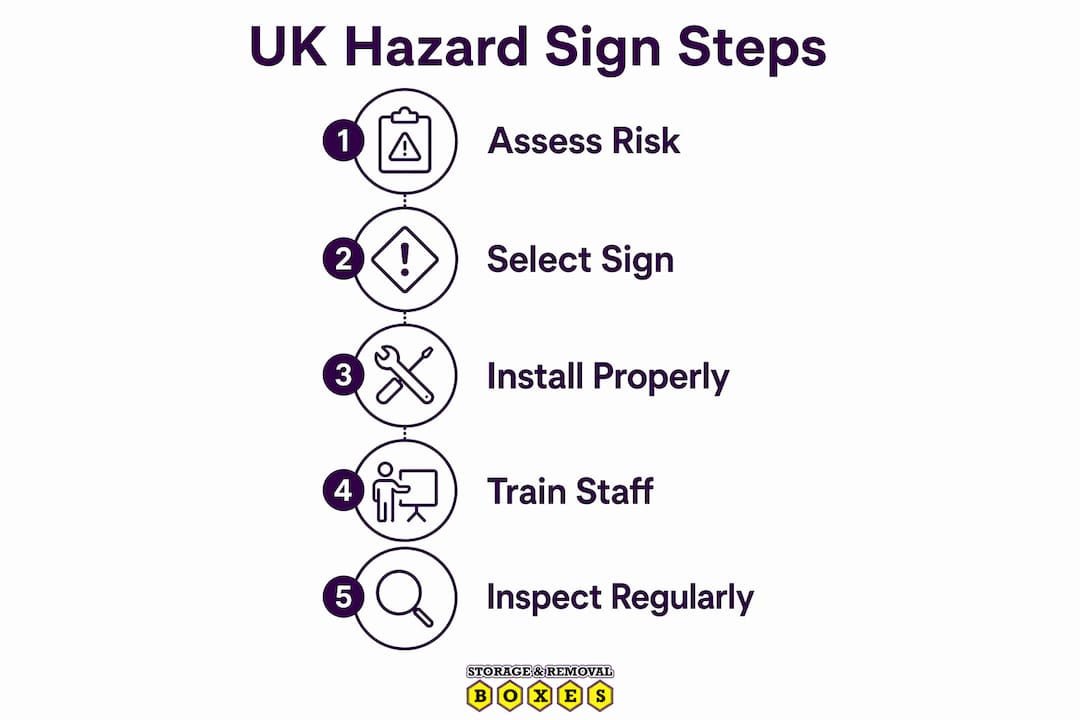
Risk assessment is the legal foundation for every signage decision. Under the Management of Health and Safety at Work Regulations 1999, employers must carry out suitable and sufficient risk assessments to identify hazards and decide on appropriate controls.
Signage sits at the bottom of the control hierarchy. Physical measures come first: eliminate the hazard, substitute a safer process, or install a physical guard. Signs are a supplementary control, not a substitute for these measures. Placing a “Caution: wet floor” sign instead of fixing a leaking pipe is non-compliant. It also exposes you to significant liability if someone is injured.
A documented risk assessment justifies your signage choices legally and practically. It records what hazard exists, why it cannot be fully eliminated, and why a sign is the appropriate remaining control. Without that documentation, you cannot demonstrate compliance to an inspector or an insurer.
The assessment also determines placement. A sign must be visible before a person enters the hazard zone, not after. That sounds obvious, but poorly positioned signs are one of the most common findings in workplace safety audits.
- Identify all hazards in the area through a physical walkthrough.
- Assess the likelihood and severity of harm for each hazard.
- Apply physical controls first: guards, barriers, process changes.
- Document why residual hazards still require signage.
- Select the correct sign type and pictogram from BS EN ISO 7010.
- Record the assessment and review it whenever conditions change.
Pro Tip: Review your risk assessments every time you change a process, introduce new equipment, or alter the layout of a space. Outdated assessments are treated as no assessment at all by enforcement officers.
Construction sites carry additional obligations. The Construction (Design and Management) Regulations 2015 layer further requirements on top of the standard signage rules, making documented risk assessment even more critical on building sites.
What are common types of hazard warning signs and where are they used?
Hazard identification signs cover a wide range of dangers across many industries. BS EN ISO 7010 defines pictograms for each hazard type, ensuring that the same symbol means the same thing in a factory, a hospital, or a public car park.
Common warning signs include:
- Electrical hazard: A lightning bolt inside a triangle. Used near switchgear, live cables, and electrical panels.
- Slippery surface: A figure slipping. Found in kitchens, wet rooms, and building entrances.
- Hot surface: A hand near a flame or heated object. Common in manufacturing and catering.
- Flammable materials: A flame symbol. Required wherever combustible liquids or gases are stored.
- Toxic substances: A skull and crossbones. Used in chemical storage, laboratories, and some agricultural settings.
- Biohazard: The three-lobed biohazard symbol. Mandatory in healthcare, research, and waste management environments.
These signs appear across construction, manufacturing, healthcare, transport, and public areas. Each setting may also require signs from other categories alongside hazard warnings. A construction site might display mandatory blue signs requiring hard hats, prohibition signs banning unauthorised entry, and green safe condition signs marking the first aid point, all within the same zone.
The distinction matters because mixing up sign types creates confusion. A blue circle is not a warning. A yellow triangle is not an instruction. Red circular signs with diagonal bars indicate prohibitions, while blue circles denote mandatory actions. Using the wrong format undermines the entire system of instant recognition that the regulations are built upon.
For businesses involved in logistics and warehousing, worker safety protocols often require a combination of hazard signs, mandatory PPE signs, and handling labels working together to communicate risk at every stage of the supply chain.
How do you maintain signs and train staff effectively?
Displaying a sign is the beginning of compliance, not the end. Signs must be kept clean, clearly visible, and correctly positioned at all times. A faded, obscured, or damaged sign provides no legal protection and no practical safety benefit.
Effective maintenance and training cover several areas:
- Visibility: Position signs at eye level and ensure they are not blocked by equipment, shelving, or temporary structures.
- Lighting: Signs must remain legible under poor lighting conditions. Photoluminescent signs are appropriate in areas where power failure is a risk.
- Cleanliness: Wipe down signs regularly, particularly in environments with dust, grease, or chemical vapour.
- Condition: Replace cracked, faded, or peeling signs immediately. A damaged sign is a non-compliant sign.
- Audit schedule: Conduct a formal sign audit at least annually, and after any significant change to the workplace layout or processes.
Training is equally non-negotiable. Employers must provide instruction ensuring that every employee understands the meaning and implications of the signs in their specific workplace. Displaying signs without verifying comprehension is insufficient under UK law. New starters, agency workers, and contractors all require induction training that covers hazard signage.
Pro Tip: Keep a sign register: a simple log of every sign on site, its location, its condition, and the date of its last inspection. This document is invaluable during a regulatory audit and takes less than an hour to create.
For businesses that also handle packaging and logistics, applying standardised warning labels to boxes and pallets extends the same principles of hazard communication beyond fixed signage into the supply chain.
What are the consequences of failing to comply with sign regulations?
Non-compliance with hazard signage regulations carries serious consequences across three areas: legal, financial, and reputational.
On the legal side, failure to implement required signage is a criminal offence under the Health and Safety at Work Act 1974. The Health and Safety Executive can issue improvement notices, prohibition notices, and prosecute individuals and organisations. Directors and managers can face personal liability, not just the business entity.
The financial consequences extend beyond fines. Insurers routinely investigate the circumstances of workplace accidents. If an incident occurs in an area where required signage was absent or non-compliant, the insurer may refuse to pay out on the claim. That exposure can be catastrophic for a small business.
Non-compliance with signage legislation under the Health and Safety at Work Act 1974 and the Safety Signs and Signals Regulations 1996 can lead to criminal prosecution, regulatory enforcement action, and the refusal of insurance claims following workplace accidents. The reputational damage from a publicised prosecution often outlasts the financial penalty by years.
Reputational harm is the consequence that businesses most consistently underestimate. A prosecution is a matter of public record. Clients, partners, and potential employees can find it. The cost of fitting the correct signs is a fraction of the cost of a single enforcement action, let alone a contested insurance claim or a civil lawsuit from an injured worker.
Key takeaways
Hazard warning signs are legally mandated, precisely designed safety tools that must be backed by documented risk assessments, correct placement, and verified staff training to be effective and compliant.
| Point | Details |
|---|---|
| Design is legally fixed | BS EN ISO 7010 specifies yellow triangles with black pictograms; deviation from this standard is non-compliant. |
| Signs supplement controls | Signage is a last resort after physical hazard elimination; using signs as a primary control breaches UK regulations. |
| Risk assessment is the foundation | A documented assessment under the 1999 Regulations justifies every signage decision legally and practically. |
| Maintenance and training are mandatory | Signs must be clean, visible, and understood by all staff; displaying signs without training is insufficient under law. |
| Non-compliance has criminal consequences | Absent or incorrect signage can lead to prosecution, voided insurance claims, and lasting reputational damage. |
Signs as part of a system, not a solution in themselves
I have spent years reviewing safety management systems across warehousing, construction, and logistics, and the same mistake appears repeatedly. A business identifies a hazard, puts up a yellow triangle, and considers the matter closed. That is not safety management. That is paperwork.
The regulations are designed around a hierarchy for good reason. Physical controls protect people even when they are distracted, rushing, or unfamiliar with the site. A sign only works if the person reads it, understands it, and acts on it. All three conditions have to be met simultaneously. In a busy warehouse at the end of a shift, that is a fragile chain.
What I have found actually works is treating signage as the final layer of a system, not the first response to a hazard. When a client asks me whether they need a sign, my first question is always: “What have you already done to reduce or remove the hazard?” If the answer is nothing, the sign comes later, after the physical controls are in place.
Training is the other area where businesses consistently cut corners. Showing a new employee a laminated sheet of sign meanings during induction is not training. Training is checking that they can identify a biohazard sign in context, explain what it means, and describe what they should do when they see one. That takes ten minutes and it is the difference between a sign that works and a sign that decorates a wall.
The businesses that get this right treat their sign register, their risk assessments, and their training records as living documents. They update them when processes change, when new hazards emerge, and when staff turn over. That discipline is what keeps people safe and keeps regulators satisfied.
— Adrian
Practical labelling and packaging from Storageremovalboxes
Safe hazard communication does not stop at fixed wall signs. When you are moving, storing, or shipping goods, the same principles apply to every box and parcel that leaves your hands.

Storageremovalboxes supplies a range of packing materials for safe moves that include pre-printed warning labels designed to communicate handling requirements clearly. Products such as this-way-up caution stickers and handle-with-care labels apply the same logic as workplace hazard signage: clear, standardised visual communication that protects contents and people alike. For removal companies, storage facilities, and individuals moving home, these labels are a practical and affordable way to extend safe handling practices from the warehouse to the doorstep.
FAQ
What shape and colour is a hazard warning sign?
A hazard warning sign is an equilateral triangle with a yellow background, black pictogram, and black border. This format is defined by BS EN ISO 7010 and mandated by the Health and Safety (Safety Signs and Signals) Regulations 1996.
Are hazard warning signs a legal requirement in UK workplaces?
Yes. Where a significant risk remains after physical controls have been applied, the Health and Safety (Safety Signs and Signals) Regulations 1996 require appropriate signage. Failure to display required signs is a criminal offence.
Can a sign replace a physical safety control?
No. Signage is legally classified as a supplementary control. Under the Management of Health and Safety at Work Regulations 1999, physical hazard elimination or reduction must come first. A sign alone does not constitute adequate risk management.
How often should hazard signs be inspected and replaced?
Signs should be inspected at least annually and after any change to the workplace layout or processes. Any sign that is faded, damaged, or obscured must be replaced immediately to maintain compliance and effectiveness.
Do staff need training on hazard signs?
Yes. Employers are legally required to provide instruction ensuring all employees understand the meaning and implications of every safety sign in their workplace. Displaying signs without verifying comprehension is insufficient under UK law.