Household packing: essential guide for moving and storage
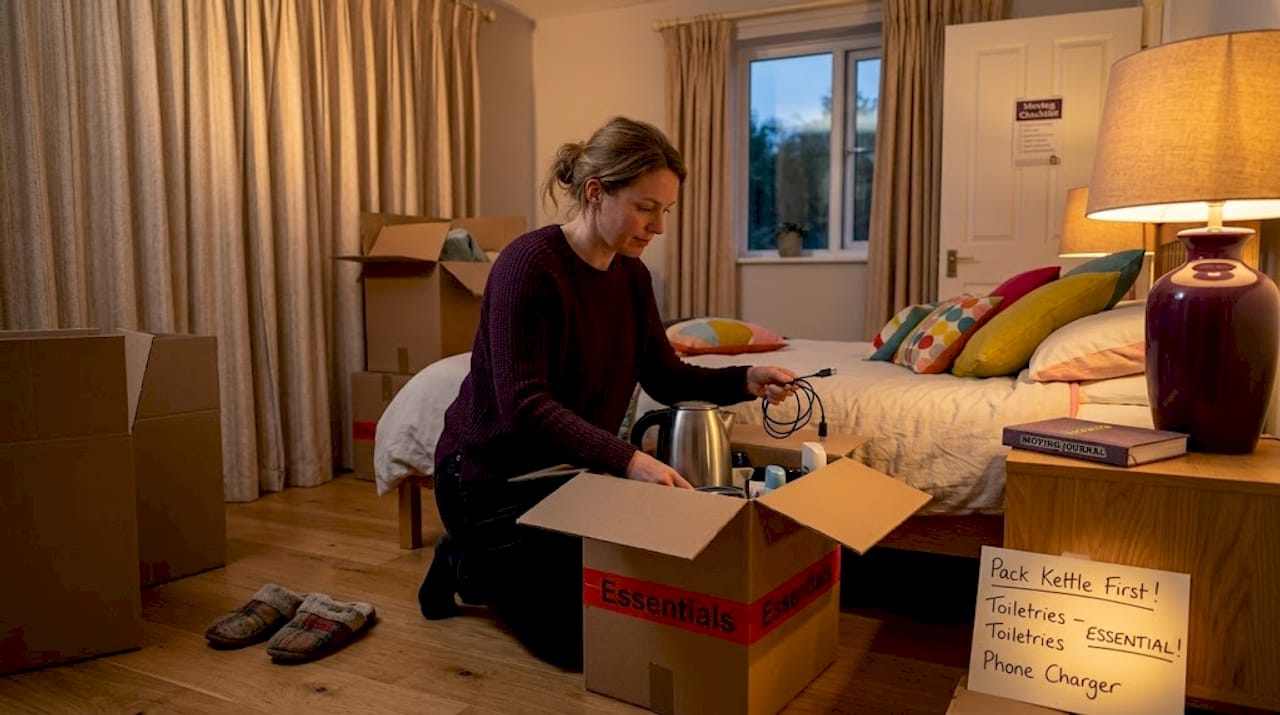
- Household packing involves carefully preparing belongings with the right materials to prevent damage during transport or storage. Starting 6 to 8 weeks early with organized labeling and appropriate containers ensures a smoother move and effective long-term storage. Using quality packing materials, proper techniques, and strategic storage layout minimizes damage, saves time, and reduces overall stress.
Most people assume household packing means grabbing whatever boxes are nearby and filling them up. It doesn’t. What is household packing, really? It’s the disciplined process of preparing household items securely for transport or storage, using the right containers, wrapping materials, and labelling systems to prevent damage and make life easier at the other end. Done well, it protects your belongings, speeds up unpacking, and saves you from costly replacements. Done poorly, it turns moving day into a disaster. This guide covers everything you need to know, from when to start to how storage packing differs from moving packing.
Table of Contents
- Key takeaways
- Core principles of household packing before a move
- Choosing the right packing materials
- Techniques for packing household items safely
- Moving versus storage: key packing differences
- Packing strategies for self-storage units
- My honest perspective on household packing
- Get the right packing materials from Storageremovalboxes
- FAQ
Key takeaways
| Point | Details |
|---|---|
| Start early, not last minute | Begin packing 6 to 8 weeks before moving day, starting with rooms you use least. |
| Match box size to item weight | Use small boxes for heavy items and large boxes for light ones to prevent injury and box failure. |
| Label on multiple sides | Write contents and destination room on at least two sides so labels stay visible when boxes are stacked. |
| Moving and storage need different approaches | Moving prioritises short-term protection; storage requires moisture control and long-term preservation. |
| An inventory is not optional | Tracking what is in each box, especially for storage, saves hours of frustration during retrieval. |
Core principles of household packing before a move
The single most important decision you make about packing is when to start. Expert moving advice confirms that starting too late is the most common cause of stress during a move. A 6 to 8 week lead time is the standard recommendation for most households, and it exists for good reason. When you give yourself that runway, you can pack methodically rather than frantically.
Here is a practical timeline to work backwards from moving day:
- Six to eight weeks out: Pack storage areas, attics, garages, and rooms you use infrequently. Seasonal items, books, and decorations go first.
- Four to five weeks out: Move through spare bedrooms, guest rooms, and hobby spaces. These areas are easy to pack without disrupting daily life.
- Two to three weeks out: Tackle the living room, dining room, and main bedroom wardrobes. Keep a small set of everyday clothes accessible.
- One week out: Pack the home office, bathroom non-essentials, and begin clearing the kitchen of appliances and pantry items you won’t use.
- Final two days: Pack daily essentials last, including toiletries, a change of clothes, phone chargers, and basic kitchen items you need right up to moving day.
The essentials box deserves special mention. This is a box or bag you pack last and load into your personal vehicle rather than the removal lorry. It contains everything you need for the first 24 hours in your new home. Without it, you will find yourself tearing through tape at midnight looking for a toothbrush.
Pro Tip: Label your essentials box with bright tape or a large marker so it is never accidentally loaded onto the removal lorry. Treat it as carry-on luggage for your move.
Choosing the right packing materials
Your materials are the foundation of safe household packing. The instinct to reuse old supermarket boxes is understandable, but those boxes were not designed for the weight and handling involved in a move. Proper packing materials include purpose-made cardboard boxes in several sizes, plastic bins, bubble wrap, acid-free packing paper, strong tape, and permanent markers for labelling.
Here is what to keep in mind when selecting your materials:
- Box sizes matter more than you think. Small boxes (roughly 30 x 30 x 30 cm) are for heavy items like books, crockery, and tinned food. Large boxes are for bulky but lightweight items like duvets, cushions, and lampshades.
- Double-wall boxes offer significantly better protection than single-wall for anything fragile or heavy. They resist crushing when stacked.
- Bubble wrap is your best friend for fragile items, but packing paper works well for filling voids and wrapping non-fragile items without adding excessive cost.
- Strong packing tape applied across all seams, not just the centre seam, keeps boxes from splitting under weight.
- Plastic bins with lids are better suited to long-term storage than cardboard because they resist moisture and pests.
- Permanent markers in black make labelling clear and legible. Write the contents and destination room on at least two visible sides.
For those who prefer not to source materials individually, a home removal pack bundles the most commonly needed items together. These kits are sized for different property types and take the guesswork out of how much you actually need.
Pro Tip: Order slightly more boxes than you think you need. Running out mid-pack and waiting for delivery is a time cost most people don’t anticipate until it happens.
Techniques for packing household items safely
Good technique is what separates a box that arrives intact from one that becomes an expensive mess. The mechanics of packing are straightforward but often ignored.
- Wrap fragile items individually. Each plate, glass, and ornament should be wrapped separately in bubble wrap or packing paper before being placed in a box. Never nest unwrapped items.
- Pack plates vertically, not flat. Plates stacked flat bear the full weight of everything above them. Packed on their sides like records, they distribute pressure more effectively and break far less often.
- Line the bottom of every box with crumpled packing paper. This creates a cushioning layer that absorbs shock during loading and transit.
- Fill every void. Gaps inside boxes allow contents to shift during transit. Crumpled paper, rolled bubble wrap, or even clean towels work well to fill space. A well-packed box should not rattle when you gently shake it.
- Never overfill. A box lid that won’t close flat signals that the box is overloaded. Overloaded boxes bow at the sides and fail at the seams.
- Keep box weights manageable. A practical guide is to keep boxes under 20 kg so that label visibility and box stability are maintained and no one injures their back during loading.
Different rooms need different thinking. In the kitchen, pack appliances in their original boxes where possible, and wrap cable leads with the appliance rather than loose. In the bedroom, wardrobe boxes with hanging rails keep clothes wrinkle-free and save you folding time at the other end. In the living room, take apart flat-pack furniture where you can and wrap shelving units in moving blankets or thick paper to protect corners and surfaces.
Moving versus storage: key packing differences
The goal of packing for a move and packing for storage sound similar. They are actually quite different exercises. The key distinction is that moving packing focuses on short-term protection and ease of access on arrival, while storage packing is about long-term preservation against moisture, dust, and pests.
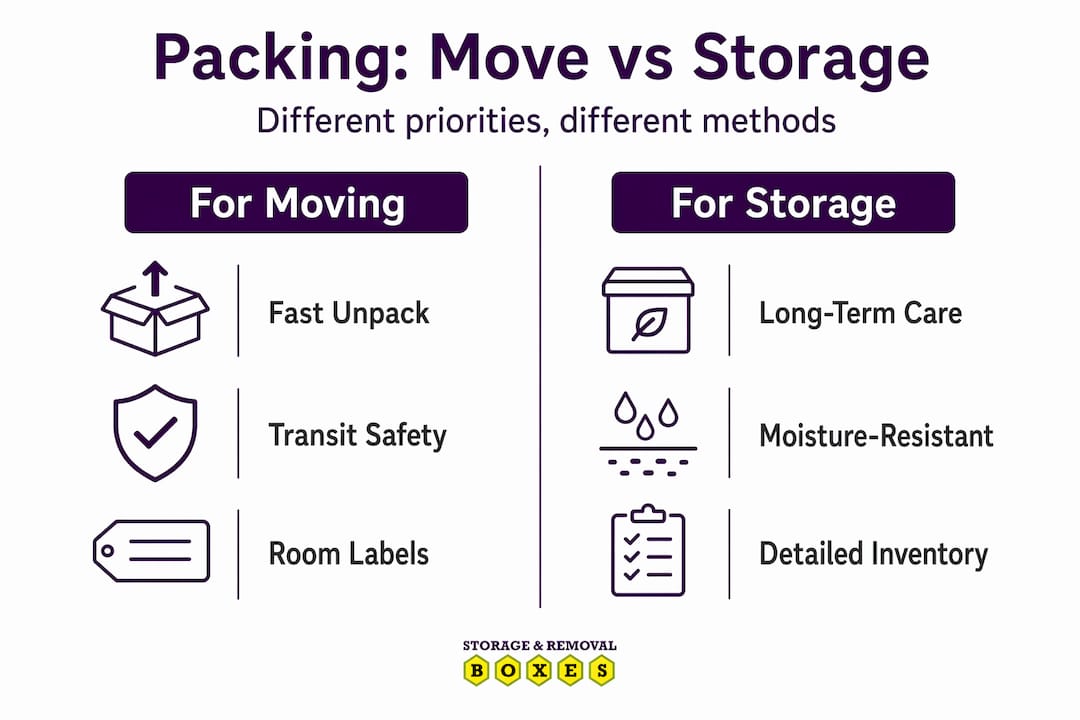
| Factor | Packing for moving | Packing for storage |
|---|---|---|
| Primary concern | Safe transit and quick access | Long-term preservation and protection |
| Container choice | Cardboard boxes adequate for most items | Plastic bins preferred for moisture resistance |
| Labelling detail | Room and contents summary | Full contents list and retrieval priority |
| Stacking approach | Heavy at base, stable for lorry transit | Heavy at back and base, aisles left clear |
| Moisture control | Less critical | Desiccants and elevation required for long-term storage |
| Time horizon | Days to weeks | Months to years |
For storage, cardboard boxes left directly on a concrete floor will absorb moisture over time. Wooden pallets or plastic shelving keep your boxes off the ground. Long-term storage also demands that wood furniture is wrapped in breathable cloth rather than plastic sheeting, which traps moisture and causes warping or mould.
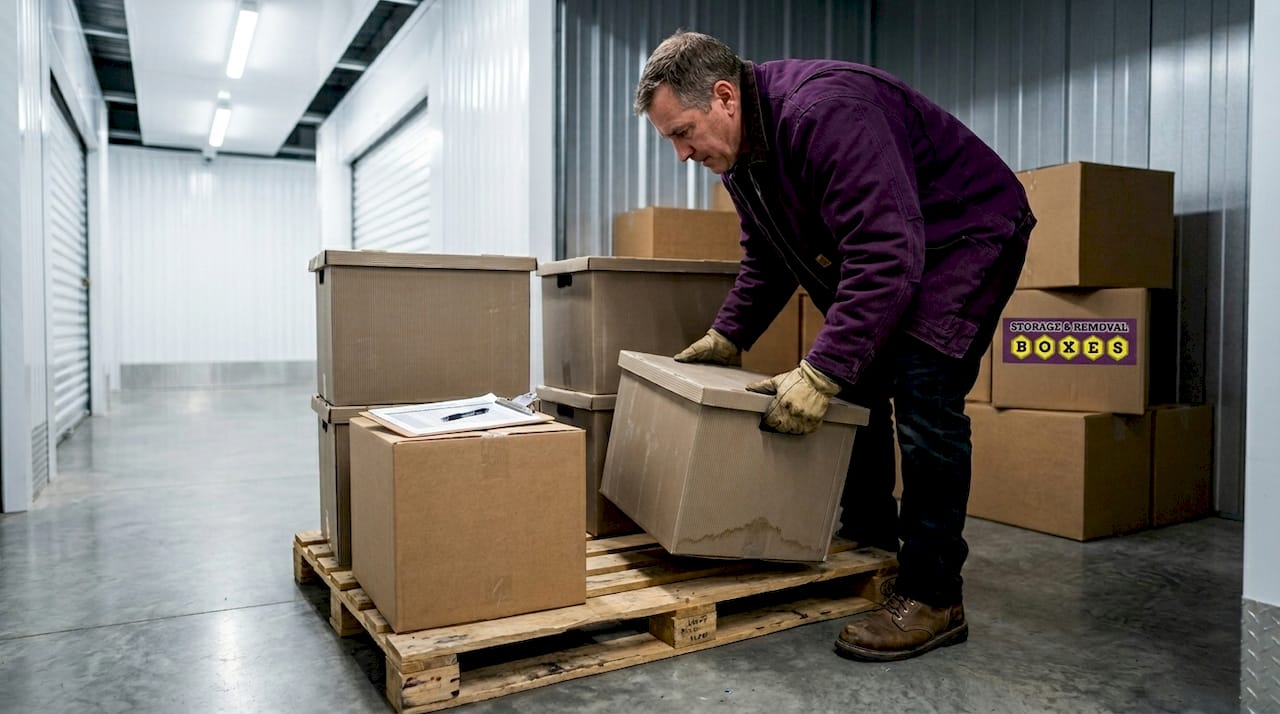
One detail many people overlook is the labelling system. For a short move, writing the room name on a box is enough. For storage, you need a contents list specific enough that you can find something without opening every box. Numbering boxes and maintaining a simple spreadsheet or written inventory is not overkill. It is the difference between a 10-minute retrieval and an hour of frustration.
Packing strategies for self-storage units
Arranging a storage unit well from the start saves significant time every time you need to retrieve something. The layout deserves as much thought as the packing itself.
- Plan before you load. Sketch out where categories of items will go. Furniture along the back and sides, boxes in front, frequently accessed items near the door.
- Load large furniture first. Place large furniture pieces against the back and side walls. Disassemble what you can to maximise usable floor space.
- Use metal shelving units. Shelving dramatically increases the vertical space you can use and keeps boxes accessible without unstable stacking.
- Stack boxes by weight. Heaviest boxes go at the bottom, lighter ones on top. This protects contents and creates a stable column.
- Face all labels towards the aisle. A good inventory system depends on being able to read labels without moving boxes.
- Leave a central aisle. Loading a unit so tightly that you cannot walk through it means removing half the contents every time you need something at the back.
For self-storage specifically, you can find professional guidance on storage unit arrangement to help you plan a layout that genuinely works for months of use.
Pro Tip: Take a photograph of your storage unit once fully loaded, with box labels visible where possible. This reference image alone can save you considerable time during retrieval visits.
My honest perspective on household packing
I’ve spent years watching people approach moving and storage with the same blind spot: they treat packing as the last thing to think about and the first thing to rush through. That calculus is backwards.
In my experience, the people who have the smoothest moves are not the ones who hired the biggest lorry or found the cheapest removal firm. They are the ones who started packing six weeks early, labelled every single box properly, and resisted the temptation to throw random items together because they were running out of time.
The labelling point is worth pressing on. I’ve seen boxes labelled “miscellaneous” or “kitchen stuff” cause genuine distress when someone is trying to find their child’s medication or their work laptop the morning after a move. Labelling is not bureaucracy. It is the thing that makes the whole exercise worthwhile.
On the storage side, I think moisture damage is consistently underestimated. People assume that because a storage unit is indoors, their belongings are protected. They are not, not without taking active steps. Desiccants, breathable wrapping, and elevation off the floor are not optional extras for long-term storage. They are the baseline.
One last thing: if you are weighing up doing everything yourself versus using professional packing services, consider a hybrid approach. Pack low-risk rooms yourself and let professionals handle fragile items and specialist pieces. That combination often delivers the best outcome at a reasonable cost.
Get the right packing materials from Storageremovalboxes
When your packing is only as good as the materials you use, cutting corners on boxes and wrapping is a false economy.
Storageremovalboxes stocks everything you need for a well-organised move or self-storage setup, all in one place. Their tall double-wall removal boxes are built for bulky items and heavy loads, offering the kind of structural strength that standard supermarket boxes cannot match. For labelling, a dedicated box marker pen writes clearly on cardboard and stays legible throughout transit and storage. If you want a fully sorted solution, their removal packing kits bundle boxes, tape, bubble wrap, and more into a single order sized for your property. Nationwide delivery means your materials arrive before your packing even begins. Browse the full range at Storageremovalboxes and get everything sorted in one order.
FAQ
What is household packing?
Household packing is the process of preparing your belongings for transport or storage by selecting the right boxes, wrapping items appropriately, filling voids to prevent shifting, and labelling each box clearly. It goes well beyond simply putting things into boxes.
When should I start packing for a house move?
You should start packing 6 to 8 weeks before moving day, beginning with storage areas and least-used rooms and finishing with daily essentials in the final days.
What is a household packing kit?
A household packing kit is a pre-assembled bundle of packing materials, typically including boxes in multiple sizes, packing tape, bubble wrap, and packing paper, designed to cover the needs of a full home removal without requiring individual sourcing.
How does packing for storage differ from packing for a move?
Packing for storage prioritises long-term preservation using moisture-resistant containers, detailed inventory lists, and protective measures like desiccants, whereas moving packing focuses on short-term protection and quick access on arrival.
Should I use small or large boxes for heavy items?
Always use small boxes for heavy items such as books and crockery, and reserve large boxes for lightweight but bulky items like duvets and cushions. This prevents box failure and reduces the risk of injury during handling.