How to move bulky items safely and efficiently
TL;DR:
- Proper planning, measuring, disassembling, and using the right tools are essential to move bulky furniture safely and efficiently. Adequate route preparation, team coordination, and secure loading prevent damage and injury during a house move. Starting disposal early and employing professional help for heavy or complex items can save time, effort, and costs.
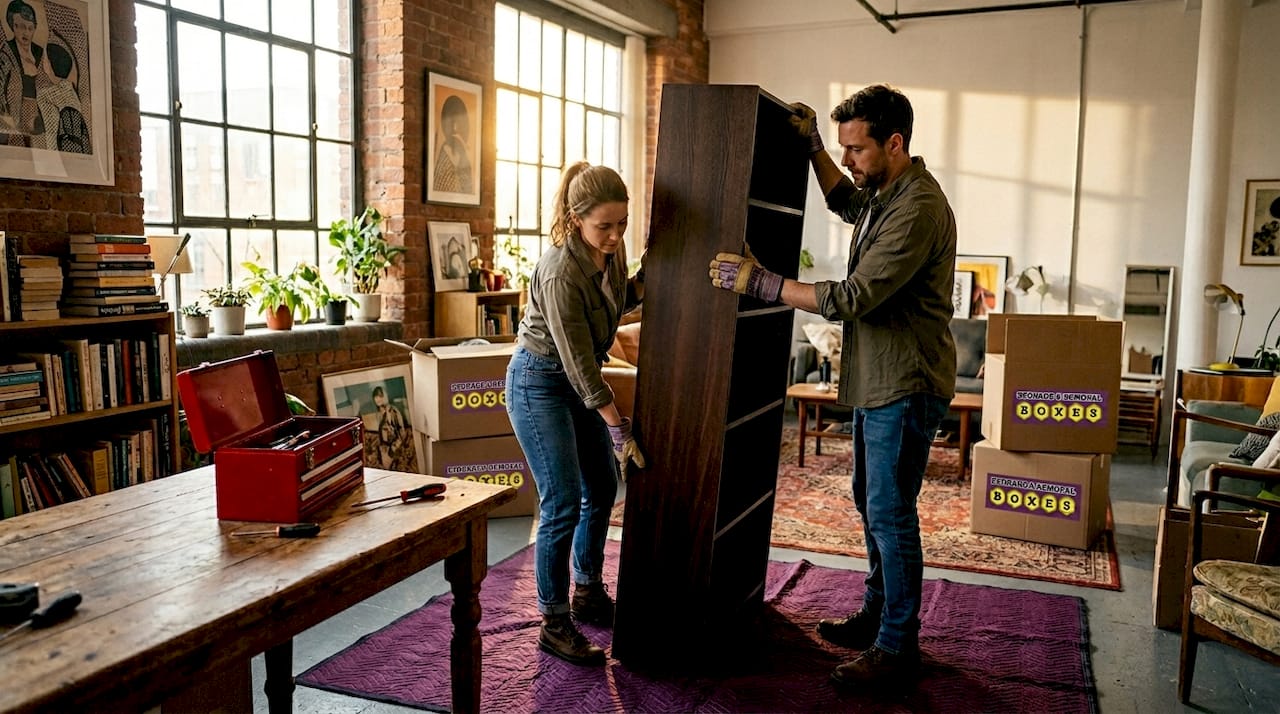
Moving bulky items is where most home moves go wrong. A sofa wedged in a stairwell, a scratched oak dresser, a pulled back muscle before the lorry has even left the drive. Knowing how to move bulky items properly means thinking before you lift: measuring, planning, gathering the right tools, and working with your team rather than against the furniture. This guide covers every stage of the process, from preparation and safe manual handling to loading the vehicle and managing disposal logistics, so you arrive at your new home with your belongings and your body intact.
Table of Contents
- Key takeaways
- How to move bulky items: preparation is everything
- Tools and equipment that make a real difference
- Safe lifting and team coordination
- Loading, transporting, and unloading
- Managing bulky item disposal
- My honest lessons from years of bulky moves
- Get the right materials from Storageremovalboxes
- FAQ
Key takeaways
| Point | Details |
|---|---|
| Measure everything first | Check both the item’s dimensions and every doorway, corridor, and stairwell on the route before moving anything. |
| Empty and disassemble | Removing drawer contents reduces weight by roughly one-third, making pieces far safer to carry. |
| Use sliders and dollies | Rolling or sliding heavy items protects your back and your floors far better than brute lifting alone. |
| Secure loads in transit | Heavy items loaded first and strapped down prevent shifting and damage during the journey. |
| Plan disposal in advance | Local bulky waste collections have strict limits and timing rules, so schedule pickups before moving day. |
How to move bulky items: preparation is everything
The single biggest cause of damage and injury during a house move is starting to lift before finishing thinking. Proper route planning clears the majority of problems before they arise. Spend an afternoon on these steps and you will save hours of frustration.
Measure the item and the route. Tape measure in hand, record the height, width, and depth of every bulky piece. Then measure every doorway, corridor, stair width, and landing on the path from the item’s current position to the removal lorry. Measuring item and pathway dimensions before you start prevents the classic scenario: a wardrobe that fits the room perfectly but cannot exit through the door.
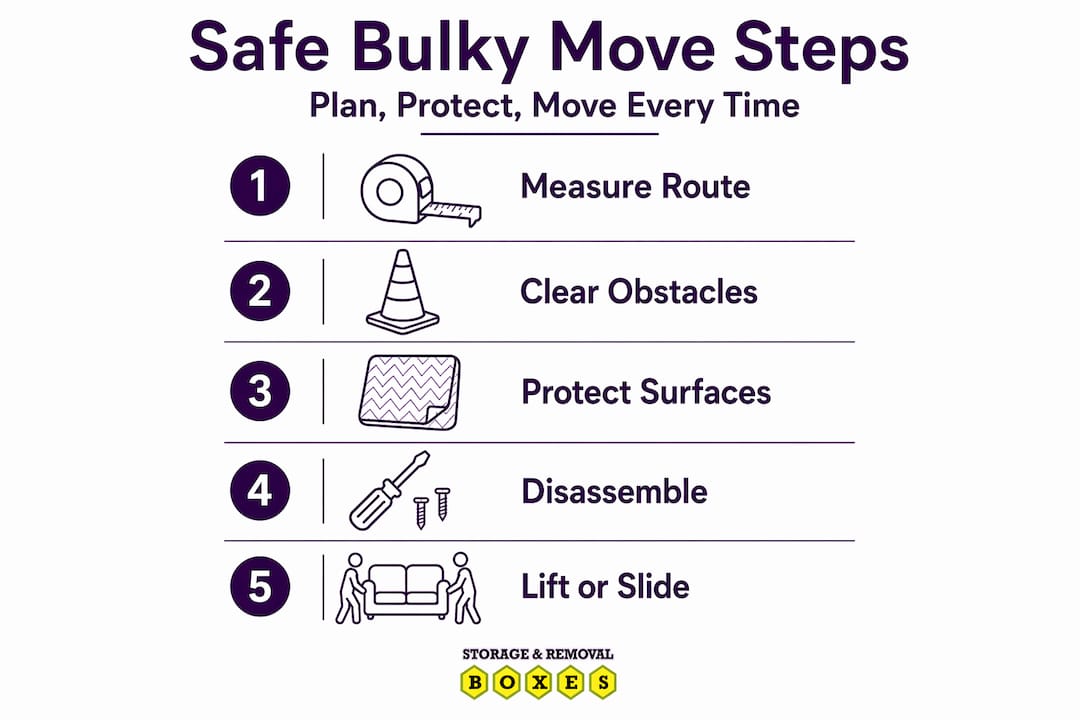
Clear the path completely. Remove rugs, loose cables, pot plants, and any clutter from every corridor and room on the route. Pay particular attention to the area immediately outside the front door and any steps leading to the drive.
Protect floors and walls. Lay moving blankets, thick cardboard, or old carpet offcuts along the route. Doorframes are especially vulnerable. A sheet of cardboard taped over a painted doorframe costs nothing and prevents scuffs that would come out of your deposit.
Assess disassembly. Can the legs come off the sofa? Does the wardrobe separate into carcass, doors, and top panel? Many pieces of flat-pack and quality joinery furniture disassemble with a screwdriver and an Allan key. Smaller components are always easier to carry and far less likely to get stuck.
Pro Tip: Take photographs of any disassembled furniture joints before you take them apart. You will thank yourself when you are reassembling at the other end with no instructions and tired arms.
When you have completed these steps, you have effectively moved the furniture in your mind before touching it physically. That mental rehearsal catches most problems before they become expensive ones. For a broader overview of packing and moving safely in UK homes, the Storageremovalboxes guide covers complementary techniques worth reviewing alongside this checklist.
Tools and equipment that make a real difference
There is a reason professional removal crews do not simply grab both ends and heave. They use equipment that makes the job repeatable, predictable, and much kinder to backs and floors. Here is a comparison of the core tools and what each one actually does for you.
| Tool | Best use | Key benefit |
|---|---|---|
| Furniture sliders | Smooth and carpeted floors | Move items without lifting, protecting floor surfaces |
| Four-wheel dolly | Large appliances and wardrobes | Stable platform for rolling very heavy pieces |
| Hand truck / sack trolley | Fridges, washing machines, stacked boxes | Tilts and rolls on two wheels, tight in corridors |
| Lifting straps | Two-person carries on stairs | Distributes weight across shoulders and hips |
| Moving blankets | All bulky furniture | Protects surfaces from scratches and dings |
| Plastic stretch wrap | Drawers, doors, and glass panels | Keeps components closed and scratch-free |
Furniture sliders and lifting straps are two tools that reduce physical strain significantly. Sliders sit under each corner of the item and let you push rather than lift. On carpet, felt-base sliders work best. On hard floors, use plastic-base sliders. Lifting straps thread under the furniture and loop over each mover’s forearms, transferring load from the lower back to the larger muscle groups of the legs and shoulders.
Moving blankets deserve special mention. A good quality blanket is thick enough to absorb impact against a doorframe and soft enough to protect lacquered wood and glass. The large moving blankets available from Storageremovalboxes measure 200 x 250 cm, which is generous enough to wrap a double wardrobe door completely.
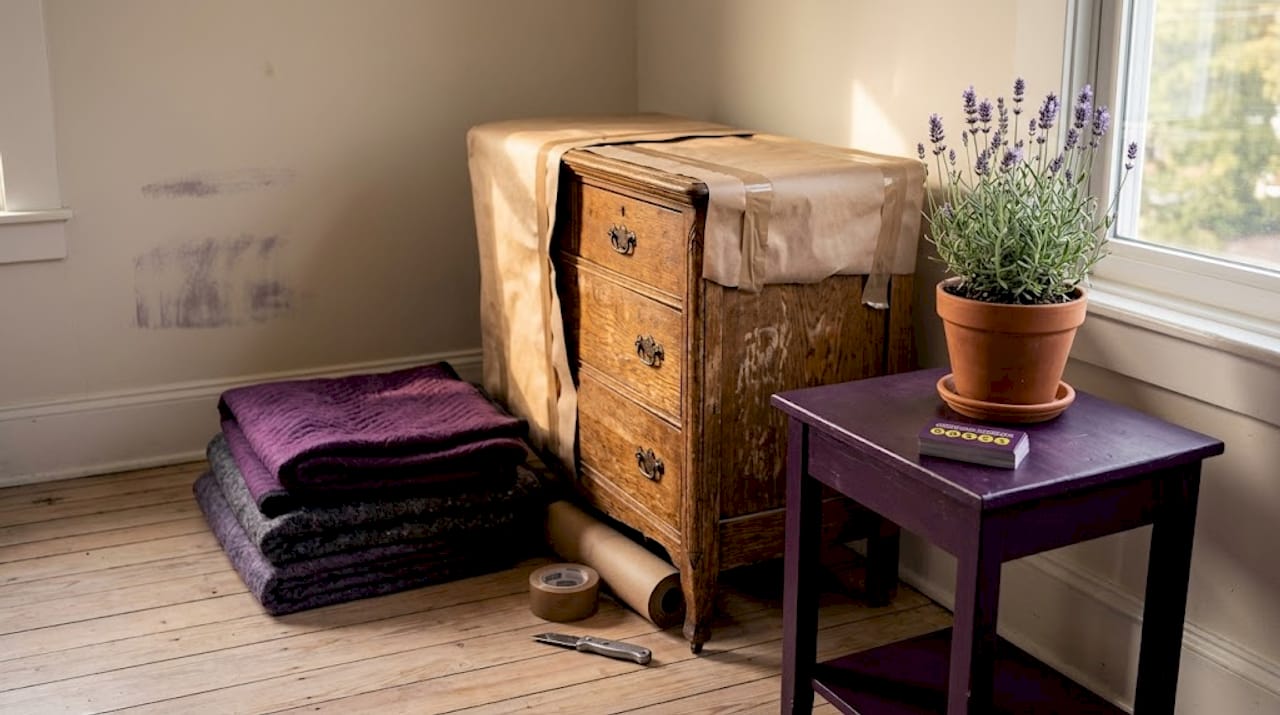
Pro Tip: Wrap plastic stretch film around moving blankets once they are in place on a piece of furniture. The film keeps the blanket from slipping during the carry and removes the need for tape that might mark the surface.
You can find a full range of house moving tools including ratchet strapping, bungees, and packing knives through Storageremovalboxes, which stocks everything you need in one place rather than several trips to different shops.
Safe lifting and team coordination
Good technique and clear communication prevent most moving injuries. Follow these steps every time you lift or carry a bulky item with a partner.
- Empty and lighten the load. Emptying dresser drawers reduces the item’s weight by roughly one-third. Remove books from bookcases, clothes from wardrobes, and anything loose from inside cupboards before moving them.
- Position yourselves correctly. Stand as close to the item as possible with feet shoulder-width apart. One person takes each end, or for very wide items, one person per side.
- Lift with your legs, not your back. Bend at the knees, keep your spine straight and your core engaged. Push upward through your heels as you rise. Never twist at the waist while holding weight.
- Use the high-low carry method on stairs. The person going downstairs holds the item at chest height while the person going upstairs holds it at waist height. This keeps the piece level and prevents the item tipping forward and crushing the lower carrier.
- Agree on verbal signals before you start. Decide on “ready, lift” and “set it down” calls before you pick anything up. Moving in silence is how fingers get trapped and furniture gets dropped.
- Call for additional help when needed. Two people can manage most sofas and beds. Three or four people are safer for a large American-style fridge or a grand piano. There is no shame in recruiting a neighbour for half an hour.
- Take breaks. Fatigue causes accidents. Put the item down on a flat surface rather than holding it while you rest.
Professional movers treat bulky item handling as a workflow: measure the path, protect the floors, and favour sliding or rolling over lifting wherever possible. Adopting that same mindset, even for a single move, changes the experience entirely.
Loading, transporting, and unloading
Getting the furniture out of the house is only half the job. How you load and transport it determines whether it arrives in the same condition.
- Load heavy items first. Washing machines, large wardrobes, and sofas go in at the rear of the lorry against the cab wall. This keeps the vehicle balanced and gives lighter items somewhere stable to rest against.
- Fill gaps to prevent shifting. A wardrobe that can slide even ten centimetres during a roundabout will hit the side of the lorry with force. Fill voids with boxes, rolled blankets, or bags of soft furnishings.
- Use a loading ramp for appliances. A stair dolly or appliance trolley with a ramp attachment makes the transition from ground to lorry floor manageable for two people rather than requiring four.
- Strap everything down. Ratchet straps running across the load and anchored to the lorry’s D-rings are not optional. They are the difference between furniture that arrives intact and furniture that arrives as a pile of components.
- Unload in reverse order. The last item in should be the first item out. Take your time on the unload. Moving fatigue is at its highest at this point and most final-stage damage happens here.
- Check for damage immediately. Walk around each piece as it comes off the lorry. If something has been scratched or broken, document it with photographs before unpacking further.
For guidance on wrapping furniture for moving, the Storageremovalboxes resource explains exactly which materials to use for different surfaces and why the order of wrapping matters.
Managing bulky item disposal
Not everything you own is worth moving. Bulky item disposal is a genuine part of the moving process and it has more rules than most people expect.
Most UK local authorities offer a bulky waste collection service, but the details vary significantly by area. Some councils collect free of charge; others charge per item or per visit. Most impose a limit on how many items you can book per collection. Certain programmes limit collections to three large items plus fifteen boxes in a single visit, which means one booking is rarely enough for a full clearout.
Timing rules are equally strict. Items placed at the kerb are typically allowed out no earlier than 4 PM the evening before collection and must be at the kerb by 4 AM on collection day. Putting items out too early can result in a fine or a missed collection.
| Disposal option | Best for | Key consideration |
|---|---|---|
| Council bulky waste collection | Large furniture and white goods | Book in advance; quantity limits apply per visit |
| Charity donation | Good-condition sofas, beds, appliances | Collect within agreed timeframe; item must be usable |
| Freecycle or Facebook Marketplace | Items with resale or reuse value | Coordinate collection before your move-out date |
| Hire a clearance firm | Large volumes or time-critical removals | Cost involved but handles everything in one visit |
| Skip hire | Mixed waste and broken items | Permits required in most areas for roadside skips |
Staging items across multiple collections or donation appointments is often the most practical approach when you have more to dispose of than one visit allows. Start booking four to six weeks before your move date, not the week before.
My honest lessons from years of bulky moves
I have helped with enough house moves, my own and others’, to have made most of the classic mistakes at least once. Here is what I actually know, as opposed to what sounds sensible in theory.
The route planning step genuinely saves the day. I thought I knew my own hallway well enough not to measure it. I did not. A chest of drawers spent forty-five minutes at the top of the stairs before we conceded that the legs needed to come off. That one measuring tape check, which I skipped, would have saved nearly an hour.
The disassembly lesson took me longer to learn than it should have. I used to resist taking furniture apart because it felt like admitting defeat. Now I disassemble almost everything that can be disassembled. Emptying drawers and disassembling furniture reduces shifting load and risk in ways that feel minor until you are halfway up a staircase.
Sliders changed how I think about furniture moving entirely. The first time I used them on a heavy oak sideboard, I moved it across a room in thirty seconds by myself. That used to require two people and significant effort.
On disposal: the biggest mistake I see people make is leaving it too late. Book your council collection the moment you know your move date. And if you are uncertain whether to move or dispose of a piece, the answer is almost always to dispose of it. Transport costs and effort add up fast.
Finally, professional help is not a last resort. For anything above 100 kilograms or any item that needs to go up more than one flight of stairs, call a removal company. The cost is almost always less than a physio appointment.
— Adrian
Get the right materials from Storageremovalboxes
Protecting bulky items starts before you lift them. Storageremovalboxes supplies everything you need to move large furniture and heavy appliances safely, from thick moving blankets and plastic stretch wrap to ratchet straps and double-walled removal boxes built to handle serious weight. Whether you are wrapping a wardrobe or packing an armchair for transit, having the right materials makes the difference between items that arrive intact and items that do not.
Browse the full range of packing materials for moving at Storageremovalboxes, including ready-made moving packs sized for different households, or explore the moving packs range to find a bundle that covers your whole move in one order. Nationwide delivery is available, so your materials arrive before moving day does.
FAQ
How should I lift heavy furniture without injuring myself?
Bend at the knees, keep your back straight, and push upward through your legs rather than your lower back. Use lifting straps to distribute weight across your shoulders and hips when carrying with a partner on stairs.
What is the best way to move a sofa through a narrow doorway?
Tilt the sofa onto its end vertically and pivot it through the doorway if the height allows. If not, remove the legs first to reduce the width, and use furniture sliders to ease it through without dragging.
How many items can I put out for bulky waste collection?
Limits vary by council, but many programmes allow three large items per collection visit, sometimes with a set number of additional boxes. Book in advance and check your local authority’s specific rules before putting anything out.
Why should I pack bulky items carefully rather than just wrapping loosely?
Loose wrapping shifts during transit and offers little real protection. Wrapping snugly with moving blankets and securing with stretch film stops surfaces rubbing against each other, which is where most scratches and chips occur on larger pieces.
When should I hire professional movers instead of doing it myself?
Hire professionals for items exceeding around 100 kilograms, for multi-storey carries, or for specialist pieces such as pianos, large appliances, or antique furniture. The cost is almost always less than the risk of injury or damage.