Industry standards for packing: your 2026 guide

- Industry standards specify mandatory and voluntary guidelines that ensure packaging protects goods during transport, storage, and handling. Proper compliance depends on understanding which standards apply to your product, transport mode, and market, with EU PPWR and ISO 11607 shaping regulations from 2026 onward. Businesses that proactively align packaging with these standards benefit from reduced damages, regulatory approval, cost savings, and a competitive edge.
Industry standards for packing are the mandatory and voluntary guidelines that define how packaging must perform to protect goods during transport, storage, and handling. These frameworks span UN certifications for hazardous materials, ISTA and ASTM protocols for general distribution, ISO 11607 for sterile medical devices, and the EU’s Packaging and Packaging Waste Regulation (PPWR). Whether you are moving house, shipping pharmaceuticals, or exporting industrial goods, understanding which standards apply to your situation is the difference between a compliant, damage-free delivery and a costly, avoidable failure. This guide covers the core frameworks, how they differ, and how to apply them in practice.
What are the main industry standards for packing?
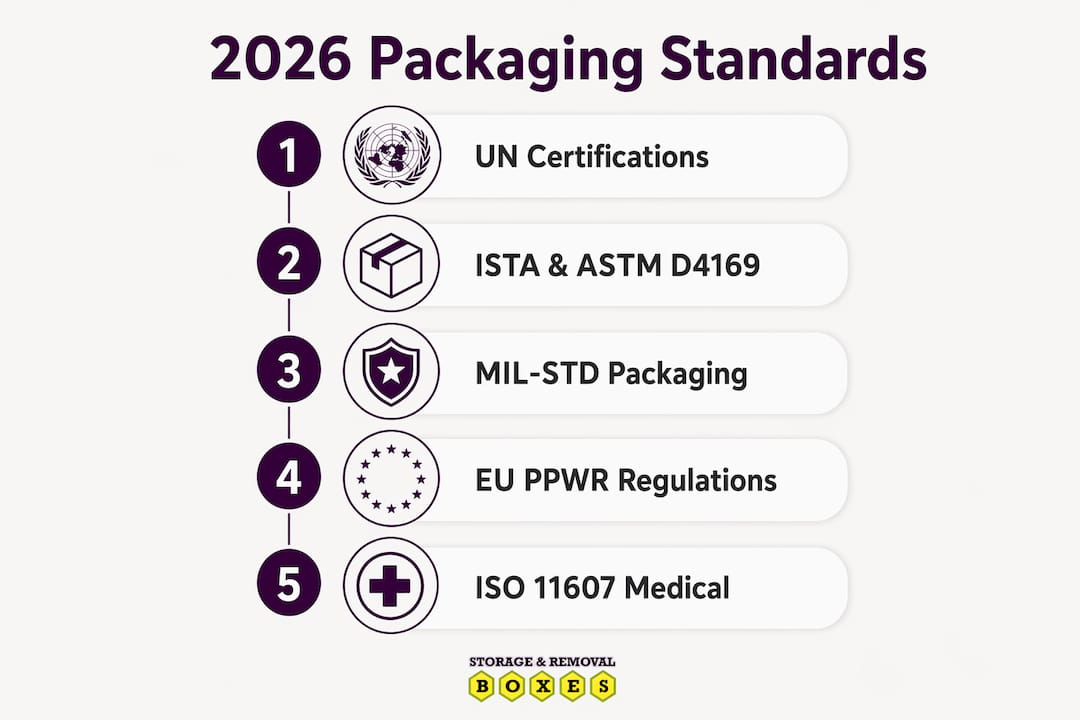
Packing standards are not a single checklist. They form a combination of frameworks that vary by shipment type, product risk, and regulatory context. The four most widely applied systems are UN certifications, ISTA, ASTM D4169, and MIL-STD.
UN packaging certifications
UN certifications govern the transport of hazardous and fragile goods. The three most common designations are UN 4G (corrugated cardboard), UN 4H (plastic), and UN 1A (steel drums). UN 4G and 4H certifications are tested against drop, stack, and vibration conditions, and tighter compliance with these standards has been shown to reduce Dead On Arrival rates by 30 to 50 per cent. That figure matters because it translates directly into fewer insurance claims, fewer returns, and lower total logistics costs.
ISTA and ASTM D4169
ISTA 3A and ASTM D4169 are the two dominant protocols for general distribution testing. ISTA 3A is a prescriptive, retailer-aligned protocol that simulates the specific stresses of parcel delivery, including drops, vibration, and compression. ASTM D4169 is more flexible: it offers a menu of hazard tests that can be sequenced to match real distribution conditions across road, rail, air, and sea. ISTA certifies labs and protocols directly, which is why retailers such as Amazon mandate ISTA 6-series compliance for their own fulfilment network. ASTM, by contrast, is the preferred framework for pharmaceutical and medical packaging where diagnostic flexibility matters more than retailer alignment.
MIL-STD military packaging
MIL-STD-810 sets environmental test methods for defence and government supply chains. It covers shock, extreme temperature, humidity, sand, and mould resistance. These requirements often become contractual obligations for suppliers, meaning failure to comply can disqualify a business from tendering entirely. MIL-STD is rarely relevant for consumer goods, but it is worth knowing because its test methods are increasingly referenced in industrial and aerospace packaging specifications.
Pro Tip: Before selecting a testing protocol, identify whether your primary obligation is retailer compliance (ISTA), regulatory compliance (UN/DOT), or market access (ISO/EU). Mixing up the purpose of each standard is the most common and most expensive mistake in packaging validation.
| Standard | Primary use | Testing approach |
|---|---|---|
| UN 4G / 4H / 1A | Hazardous goods transport | Prescriptive pass/fail tests |
| ISTA 3A | Parcel delivery, retail | Prescriptive, retailer-aligned |
| ASTM D4169 | General and pharma distribution | Flexible, diagnostic sequences |
| MIL-STD-810 | Defence and government supply | Environmental extremes |
| ISO 11607 | Sterile medical devices | Material and process validation |
How do EU PPWR and ISO 11607 affect packaging regulations?
Two regulatory frameworks are reshaping packing guidelines in 2026 more than any others: the EU Packaging and Packaging Waste Regulation and ISO 11607 for medical devices.
EU PPWR 2025/40
EU Regulation 2025/40 applies to all packaging placed on the EU market, whether empty or filled, from August 2026. It mandates recyclability and reuse targets, harmonised technical documentation under Annex VII, and declarations of conformity. Documentation must be retained for five to ten years, and compliance information must be accessible to regulators and consumers via QR codes or labels. This is not simply a product design requirement. PPWR compliance is effectively a supply chain management project, requiring businesses to coordinate technical files, supplier declarations, and consumer-facing disclosures across their entire packaging portfolio.
The progressive phases of PPWR mean that businesses exporting to the EU cannot treat this as a future concern. Documentation obligations begin in 2026, and companies that have not started building their compliance infrastructure now will face significant disruption.
ISO 11607 for sterile medical devices
ISO 11607 is split into two parts. Part 1 covers material requirements, including compatibility with sterilisation processes, storage conditions, and aseptic presentation. Part 2 covers manufacturing process validation, including forming, sealing, and assembly. Both parts are recognised by the FDA and the EU Medical Device Regulation, making compliance a prerequisite for market access in the two largest medical device markets in the world.
Validation testing under ISO 11607 includes the ASTM F88 peel test, bubble leak testing (ASTM F2096), dye penetration, and accelerated ageing protocols. Material and process validation must both be completed and documented before a sterile device can be placed on the market. Skipping either component is not a minor oversight. It is a regulatory non-compliance that can result in product recall or market withdrawal.
Which packing standard is right for your goods?
Choosing the correct quality standards for packing depends on three variables: the nature of the goods, the transport mode, and the compliance obligation driving the requirement.
For hazardous materials, the starting point is always the UN classification of the substance. 49 CFR Part 173 in the United States requires that all closures prevent leakage and that packaging authorisation matches the specific goods type, distinguishing between liquids and solids. A common and costly error is assuming that a UN-rated outer box covers all inner contents automatically. It does not. UN packaging authorisation must match the specific hazardous goods type, and using a box tested with liquids to ship solids requires separate verification.
For general consumer goods and e-commerce, ISTA 3A is the practical default for parcel shipments. If your retailer is Amazon, Walmart, or a similar large platform, check their specific vendor compliance requirements. Amazon’s ISTA 6-series mandate is a direct contractual obligation, not a suggestion. ASTM D4169 suits businesses that need to test across multiple transport modes or that operate in pharmaceutical and medical supply chains where flexible diagnostic testing is more appropriate than a fixed protocol.

For medical devices, ISO 11607 is non-negotiable if you are selling into the EU or US markets. For defence and government contracts, MIL-STD-810 will typically be specified in the tender documentation.
Pro Tip: When assessing which standard applies, start with the end market, not the product. The compliance obligation is defined by where the goods are sold and who the buyer is, not by what the product is made of.
The table below summarises the decision logic:
| Goods type | Recommended standard | Key driver |
|---|---|---|
| Hazardous materials | UN 4G / 4H / 1A, 49 CFR Part 173 | Regulatory and safety |
| Parcel and e-commerce | ISTA 3A or ISTA 6-series | Retailer mandate |
| Pharma and medical | ASTM D4169, ISO 11607 | Regulatory and market access |
| Defence and government | MIL-STD-810 | Contractual obligation |
| EU market (all goods) | EU PPWR 2025/40 | Environmental regulation |
How to apply best practices in packaging compliance
Applying industry packing compliance in practice requires more than selecting the right standard. It requires a structured approach to testing, documentation, and supplier management.
Define acceptance criteria before testing. Standards describe procedures, not pass or fail outcomes specific to your product. Packaging validation projects must establish clear acceptance criteria before testing begins, because without them, a failed test result has no defined consequence and risk management becomes guesswork.
Validate suppliers and laboratories. For ASTM methods, particularly in medical and pharmaceutical packaging, the testing laboratory must be qualified and the supplier’s materials must be validated against your specific sterilisation and storage conditions. Choosing an unqualified lab to save cost is a false economy that will surface during regulatory audit.
Build your documentation infrastructure now. For businesses selling into the EU, PPWR documentation obligations are active from August 2026. Technical files, declarations of conformity, and supplier records must be in place before that date, not assembled retrospectively.
Design for circularity. Circular economy principles require packaging to be reusable, repairable, or recyclable, with mixed materials avoided where possible. This is now a regulatory requirement under PPWR, not a voluntary sustainability commitment. Packaging designed for circularity also reduces Total Cost of Ownership by lowering waste disposal costs and extended producer responsibility levies.
Audit your inner packaging assumptions. The most frequent compliance error in hazardous goods shipping is assuming that a compliant outer box covers all inner contents. It does not. Each layer of packaging in a dangerous goods consignment must be assessed and authorised separately.
For practical guidance on selecting materials that meet these requirements, the essential packing materials guide from Storageremovalboxes covers the key choices for UK moves and storage.
Key takeaways
Effective packing compliance requires matching the correct standard to the goods type, transport mode, and end market before any testing or procurement begins.
| Point | Details |
|---|---|
| Standards vary by context | UN, ISTA, ASTM, ISO 11607, and MIL-STD each serve different goods types and compliance purposes. |
| EU PPWR is active from 2026 | Documentation, recyclability targets, and declarations of conformity are mandatory for all EU market packaging. |
| Inner packaging is not covered automatically | UN-rated outer packaging does not extend authorisation to inner contents without separate verification. |
| Define acceptance criteria first | Testing without pre-defined pass or fail criteria produces results that cannot support risk management or regulatory audit. |
| Circularity is now regulatory | Reusability and recyclability requirements under PPWR affect packaging design decisions, not just waste disposal. |
Why the complexity of packing standards is actually an opportunity
I have spent years working with businesses that treat packing standards as a compliance burden to be minimised. That instinct is understandable, but it is wrong. The businesses that invest in understanding their packaging obligations early consistently outperform those that treat standards as a last-minute checklist.
The growing overlap between performance standards like ISTA and ASTM, environmental regulations like PPWR, and product-specific frameworks like ISO 11607 means that packaging decisions now sit at the intersection of logistics, sustainability, and market access. A business that gets this right has a genuine competitive advantage. Its products arrive undamaged, its documentation survives regulatory scrutiny, and its packaging costs fall over time as circular design reduces waste and EPR levies.
The most common mistake I see is siloed thinking. A logistics team selects packaging for drop performance. A sustainability team redesigns it for recyclability. A regulatory team then discovers the new design is not compliant with the relevant UN certification. The result is expensive rework and delayed market entry. The solution is to involve packaging specialists at the design stage, not after the fact.
The phased nature of PPWR is also worth taking seriously. The documentation obligations that begin in August 2026 are the foundation for stricter recyclability and reuse targets that follow in subsequent years. Businesses that build their compliance infrastructure now will find the later phases manageable. Those that wait will face compounding pressure.
For anyone sourcing materials for a move or storage project, the principles are the same at a smaller scale. Choosing strong packing materials that meet recognised performance criteria is not overcaution. It is the straightforward application of the same logic that governs industrial packaging.
Packing materials that meet the standard, ready to order
Storageremovalboxes supplies packing materials designed for the demands of UK house moves, self-storage, and logistics. The range includes double-walled moving boxes in multiple sizes, bubble wrap rolls, foam protectors, packing tape, and complete removal kits sized for different households. All products are made from recyclable materials, supporting the circular economy principles now embedded in EU and UK packaging regulations. Whether you need a single box or a bulk order for a commercial removal, Storageremovalboxes offers nationwide delivery and expert guidance to help you choose correctly. Browse the full range of compliant packing materials and packaging for moving to find the right solution for your 2026 move.
FAQ
What are packaging standards and why do they matter?
Packaging standards are mandatory or voluntary guidelines that define how packaging must perform to protect goods during transport and storage. They matter because non-compliance can result in product damage, regulatory penalties, or loss of market access.
Which standard applies to hazardous goods shipments?
Hazardous goods require UN-certified packaging such as UN 4G for cardboard or UN 4H for plastic, with the authorisation matched to the specific goods type. In the US, 49 CFR Part 173 governs shipper responsibilities for closures and packaging selection.
What does EU PPWR require from 2026?
EU Regulation 2025/40 requires all packaging on the EU market to meet recyclability and reuse targets, with Annex VII technical documentation and declarations of conformity retained for five to ten years from August 2026.
When should I use ISTA versus ASTM D4169?
ISTA 3A suits parcel and retail shipments where retailer compliance is the primary driver. ASTM D4169 suits pharmaceutical, medical, or multi-modal shipments where flexible, diagnostic test sequences are needed rather than a fixed protocol.
Does a UN-rated box cover everything inside it?
No. UN packaging authorisation applies to the specific combination of outer packaging and goods type for which it was tested. Shipping solids in a box tested with liquids, for example, requires separate verification and may not be compliant without it.