Labels printed: your complete guide for 2026

TL;DR:
- Printed labels are essential tools across industries for organization, branding, and compliance. Selecting the right material, adhesive, and printing method improves durability, efficiency, and legal adherence for different environments. Proper application and testing help avoid costly errors and ensure reliable delivery and inventory management.
Labels printed with text, graphics, or barcodes are adhesive tools used to organise, brand, ship, and manage inventory across virtually every industry. Whether you run a removal company, manage a warehouse, or simply want to label storage boxes at home, the right printed label makes a measurable difference to efficiency and compliance. This guide covers label types, printing technologies, UK legal requirements, and best application practices so you can make informed decisions without wasting time or money.
What types of labels printed are available?
Printed labels fall into several distinct categories based on material, adhesive type, and intended use. Understanding these categories before you order saves money and prevents the frustration of labels that peel, smear, or fail to scan.
Label materials determine durability and suitability for different environments:
- Paper labels suit dry indoor applications such as office filing, product pricing, and general organisation. They are the most affordable option and widely recyclable.
- Polypropylene (PP) and PVC labels resist moisture, oils, and temperature changes. These are the right choice for outdoor use, food packaging, and chemical containers.
- Foil labels add a metallic finish and are often used for branding, certificates, and premium product packaging.
- Recyclable and eco-friendly substrates are increasingly available for businesses with sustainability commitments, including FSC-certified paper and bio-based films.
Adhesive types matter as much as the material itself:
- Permanent adhesive bonds firmly and resists removal. Use it for shipping labels, asset tags, and safety warnings.
- Removable adhesive allows clean repositioning without leaving residue. Ideal for retail pricing and temporary organisation.
- Freezer-safe adhesive maintains bond strength at temperatures as low as minus 40°C, making it the correct choice for cold storage and food production environments.
Pro Tip: Match your adhesive to the surface temperature at the point of application, not just the storage temperature. Applying a freezer-safe label to a warm surface and then chilling it gives far better adhesion than applying it to a frozen surface directly.
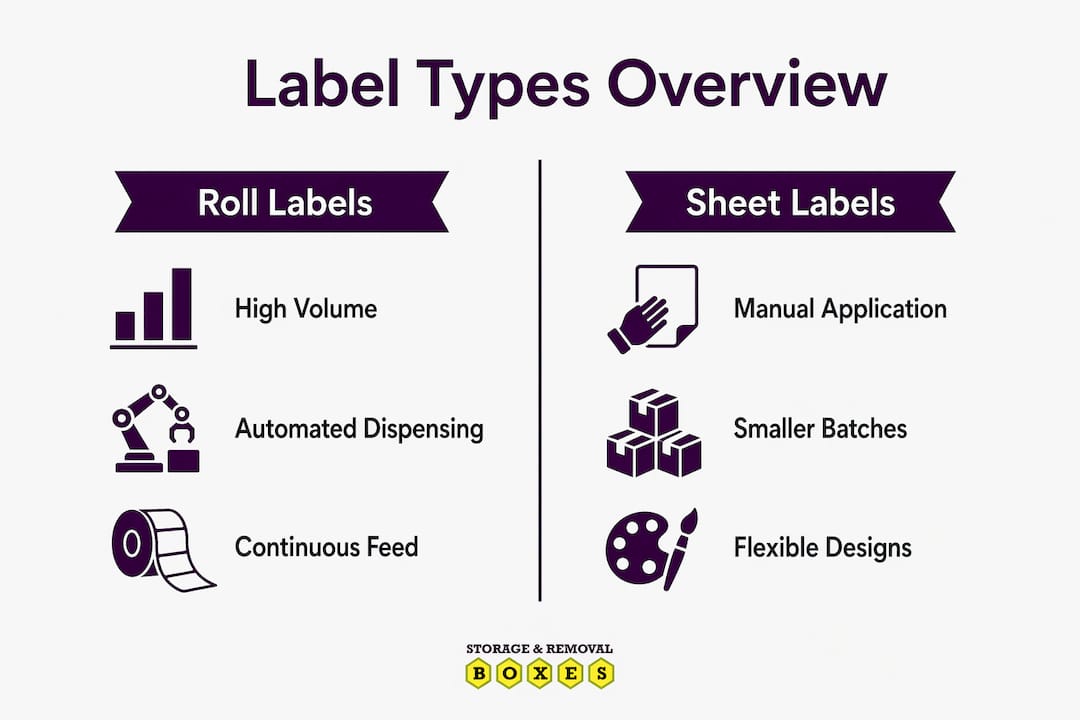
Labels also come in different physical formats. Roll labels suit high-volume automated dispensing. Sheet labels work well for low-volume desktop printing. Custom die-cut labels follow any outline shape, which is useful for fragile goods labelling and branded product packaging.
How are custom labels printed and designed today?
The printing method you choose affects cost, durability, and turnaround time. Three technologies dominate the market for custom label printing.

| Printing method | Best for | Key advantage | Key limitation |
|---|---|---|---|
| Digital inkjet | Short runs, full colour | Low setup cost, fast turnaround | Can smear if wet |
| Laser (digital) | Office and desktop printing | Sharp text, dry output | Limited media compatibility |
| Thermal transfer | Shipping, barcodes, asset tags | Smudge-proof, waterproof output | Requires ribbon consumables |
| Flexographic | High-volume production runs | Very low per-unit cost at scale | High setup and plate costs |
Thermal printers use heat to create smudge-proof, waterproof labels that are ideal for shipping. Inkjet-printed labels can smear in rain, which makes them a poor choice for parcels travelling through the UK’s unpredictable weather. For any business dispatching more than a handful of parcels per day, a direct thermal printer pays for itself quickly through reduced reprints and fewer delivery failures.
Design decisions affect whether a label functions correctly in the real world. Key considerations include:
- Resolution: Print at a minimum of 300 DPI for text and graphics. Barcodes require at least 203 DPI, though 300 DPI is the safer standard for reliable scanning.
- Font size: Use a minimum of 8pt for any text that must be read by humans. Regulatory text such as allergen warnings often has a legally mandated minimum size.
- Colour and contrast: Dark text on a light background scans and reads most reliably. Avoid placing barcodes on coloured or patterned backgrounds.
- Barcode placement: Position barcodes away from label edges and folds. Leave a quiet zone (blank space) of at least 2.5mm on each side of the barcode.
Pro Tip: Submit artwork files as vector PDFs or high-resolution TIFFs rather than JPEGs. JPEG compression degrades barcode edges and can cause scan failures even when the image looks fine on screen.
For businesses integrating shipping APIs with thermal printers, label creation becomes automated and error rates drop significantly. This is particularly valuable for e-commerce operations processing dozens of orders per day.
What legal rules apply to printed labels in the UK?
UK label compliance is not optional. Incorrect or missing information on product labels can result in enforcement action, product recalls, and reputational damage.
UKCA and CE marking applies to a wide range of manufactured goods sold in Great Britain. UKCA marking can appear on the product label itself or on accompanying documents until 31 december 2027. After that deadline, physical product marking becomes mandatory for most categories. Businesses currently using document-based marking should plan their transition now rather than waiting for the deadline.
Both UKCA and CE markings remain valid for the Great Britain market, provided the product meets the corresponding GB regulations. This gives businesses some flexibility, but the choice of marking must be consistent and correctly applied.
Food labelling carries its own set of requirements. EU Regulation 1169/2011 food rules remain in force in the UK post-Brexit, covering allergen declarations, ingredient lists, use-by and best-before dates, and accurate net weight statements. Allergen information must appear in a font size no smaller than 1.2mm and must be emphasised (for example, in bold) relative to the surrounding text.
| Label type | Key mandatory information | Regulatory basis |
|---|---|---|
| Food product | Allergens, ingredients, use-by date, net weight | EU Regulation 1169/2011 (retained UK law) |
| Manufactured goods | UKCA or CE marking, manufacturer details, warnings | UK Product Safety Regulations |
| Shipping label | Recipient address, sender address, barcode, carrier code | Carrier-specific requirements |
| Hazardous goods | GHS pictograms, hazard statements, supplier details | UK REACH and CLP Regulations |
| Warning/fragile labels | Clear pictogram or text warning | Industry best practice and carrier rules |
Misleading labels carry serious consequences. Trading Standards can issue improvement notices, and repeat offences can result in prosecution. For businesses using stickers and labels for storage and removals, the risk is lower, but accuracy still matters for inventory control and insurance purposes.
Best practices for applying shipping labels correctly
Correct label application is where many businesses lose money without realising it. A perfectly designed and printed label fails if it is placed incorrectly or damaged during transit.
Place shipping labels on the largest flat surface of the parcel, away from seams, edges, and corners. Barcode flatness is critical. A label that bridges a fold or wraps around an edge will distort the barcode and cause scanner errors at automated sorting facilities.
Dos and don’ts for label application:
- Do clean and dry the surface before applying. Dust, moisture, and grease all reduce adhesion.
- Do press the label firmly from the centre outward to remove air bubbles.
- Do orient barcodes parallel to the cylinder’s length on round or tubular parcels. This reduces distortion and improves automated sorting accuracy.
- Do test print labels after any software update or equipment change to catch misalignment before it affects live shipments.
- Don’t cover any part of the barcode with packing tape. Reflective tape over barcodes blinds optical sorting machines and causes costly manual handling delays.
- Don’t apply labels over existing labels, printed text, or graphics on the box surface.
- Don’t fold, crease, or cut labels before application.
Shipping labels function as more than identification. They are tracking documents that enable real-time customer updates throughout the delivery chain. A damaged or unreadable label does not just delay one parcel. It can trigger a chain of manual interventions that adds cost at every stage.
Pro Tip: Keep a small stock of blank label sheets alongside your thermal printer for urgent reprints. Label misprints due to incorrect parcel weight or dimension data are common, and having blank stock on hand means you can reprint and dispatch without delay. Always test print after changes to software or printer settings.
For parcels going into self-storage or removal, pair your printed labels with a consistent numbering system. Write the same number on the box with a permanent marker pen and keep a corresponding inventory list. This approach takes minutes to set up and saves hours when unpacking.
For further guidance on optimal label placement and scanning reliability, Storageremovalboxes has published a practical guide covering the full logistics workflow.
Also worth reading: this parcel packaging best practices guide covers label placement alongside box selection and sealing methods for reliable delivery.
Key takeaways
The most effective approach to printed labels combines the right material and adhesive for the environment, a printing method suited to volume and durability needs, and strict compliance with UK regulatory requirements.
| Point | Details |
|---|---|
| Match material to environment | Choose polypropylene or freezer-safe adhesive for moisture, heat, or cold storage applications. |
| Use thermal printing for shipping | Thermal labels are waterproof and smudge-proof, making them far more reliable than inkjet for parcels. |
| Know your legal obligations | UKCA marking on documents is permitted until 31 december 2027; food labels must comply with EU Regulation 1169/2011. |
| Apply labels correctly | Place on the largest flat surface, never cover barcodes with tape, and orient barcodes correctly on cylindrical items. |
| Test before you dispatch | Print a test label after any software or equipment change to prevent costly misprint errors at scale. |
Why the label you choose matters more than most people think
People underestimate labels until something goes wrong. I have seen removal jobs where every box was packed perfectly but arrived at the destination in complete chaos because the labels were handwritten, smudged, or fell off in the van. The contents were fine. The organisation was not.
The same pattern plays out in business. A company invests in good packaging and then prints shipping labels on a standard inkjet printer. The labels look fine in the office. Three days later, a parcel arrives with an unreadable barcode because it rained during the last-mile delivery. The carrier charges a manual handling fee. The customer complains. The business absorbs the cost and wonders why.
What I find most interesting about the label market in 2026 is how much the regulatory environment has tightened while the technology has simultaneously become more accessible. A direct thermal printer that would have cost several hundred pounds a decade ago is now available for under £100. There is no longer a cost argument for using the wrong printing method.
The compliance side is where I see the most avoidable mistakes. Businesses assume that food labelling rules changed after Brexit. They did not. EU Regulation 1169/2011 remains the standard. The UKCA transition deadline of 31 december 2027 is also frequently misunderstood. Document-based marking is still valid now, but the clock is running. Businesses that wait until late 2027 to update their physical product labels will face a bottleneck.
My practical recommendation is simple. Audit your current label types, match each one to the correct material and printing method, and check your compliance obligations against the current UK regulations. Do it once, document it, and you will not need to revisit it for years.
— Adrian
Packaging and labels from Storageremovalboxes
Printed labels work best when the boxes underneath them are equally reliable. Storageremovalboxes supplies double-walled moving boxes, packing kits, and protective materials designed for removals and self-storage across the UK. Whether you are labelling a single room or an entire office move, pairing your labels with the right boxes makes the whole system work. Browse the full range of removal box kits for pre-selected combinations that suit different household sizes, or go straight to the large double-wall boxes built to handle heavy loads without buckling. Nationwide delivery is available, and bulk discounts apply for larger orders.
FAQ
What is the best material for printed labels on parcels?
Polypropylene or direct thermal label stock is the best choice for shipping parcels. Both resist moisture and handling damage far better than standard paper labels.
Do food labels in the UK still follow EU rules?
Yes. EU Regulation 1169/2011 remains in force in the UK as retained law. Food labels must include allergens, ingredients, use-by dates, and accurate net weights.
Can I use CE marking instead of UKCA in Great Britain?
Both CE and UKCA markings are currently valid for the Great Britain market, provided the product meets the relevant GB regulations. Document-based UKCA marking is permitted until 31 december 2027.
Why should I avoid putting tape over a barcode?
Reflective packing tape causes glare that blinds optical barcode scanners at sorting facilities. This triggers manual handling, which adds cost and delays delivery.
What is the difference between permanent and removable label adhesive?
Permanent adhesive bonds firmly and resists removal, making it suitable for shipping and safety labels. Removable adhesive allows clean repositioning without leaving residue, which suits temporary organisation and retail pricing.