Moving House Checklist UK: Complete Packing Guide

Moving home in the United Kingdom often feels like juggling dozens of deadlines and essential notifications all at once. Missing a vital contact or leaving packing supplies to the last minute quickly leads to stress and extra costs. This guide walks you step by step through setting up your timeline, choosing high-quality supplies, and prioritising eco-friendly practices so every important detail gets covered in your next move.
Table of Contents
- Step 1: Set Up Your Moving Timeline And Notify Key Contacts
- Step 2: Assess And Order Essential Packing Materials
- Step 3: Organise, Declutter, And Prepare Household Items
- Step 4: Pack Securely Using Eco-Friendly Solutions
- Step 5: Verify Removals, Labels, And Final Property Checks
Quick Overview
| Key Takeaway | Explanation |
|---|---|
| 1. Create a detailed moving timeline | Outline your moving schedule from acceptance to completion to ensure all tasks are completed timely. |
| 2. Notify essential contacts promptly | Inform your solicitor, mortgage lender, utility providers, and educational institutions well in advance to prevent delays. |
| 3. Declutter your belongings before packing | Sort items into keep, sell, and donate categories to reduce moving costs and simplify packing. |
| 4. Order packing materials early with eco-friendly options | Obtain necessary materials at least two weeks in advance, prioritising recyclable and sustainable choices. |
| 5. Verify arrangements and conduct property checks | Confirm details with your removal company and thoroughly inspect both properties for damages and items left behind. |
Step 1: Set up your moving timeline and notify key contacts
Your move involves countless moving parts, so creating a clear timeline is your foundation for staying organised. The moment your offer is accepted, you’ll need to work backwards from your completion date to ensure every task gets done in the right order.
Start by identifying all the key people who need to know about your move. These contacts form your essential notification list:
- Conveyancing solicitor and surveyor
- Mortgage lender or landlord
- Home insurance provider
- Your employer (if relevant to relocation)
- Schools (if you have children)
- Utility suppliers and energy companies
- GP surgery and dentist
- Banks and financial institutions
Notifying your energy suppliers requires giving at least 48 hours’ notice. You’ll want to arrange final meter readings and provide a forwarding address for your final bill. Contact your new home’s energy suppliers promptly after arrival to avoid being charged for the previous occupant’s usage.
For property-related contacts, the HomeOwners Alliance recommends notifying your conveyancing solicitor and mortgage lender as early as possible. Prompt communication with these parties prevents delays in your completion process.
Creating a written timeline from offer acceptance to completion day keeps everyone—yourself included—accountable and on schedule.
Use a spreadsheet or dedicated moving checklist to map out your timeline. Include key dates for surveys, inspections, insurance arrangements, and utility transfers. This visual reference prevents you from missing critical deadlines.
Notify workplace contacts and schools at least two weeks before your move. Some employers need time to adjust work arrangements, and schools need to process your child’s transfer.
Contact your GP surgery and dentist early enough for them to transfer your medical records to your new practice. This typically takes a few weeks to process.
Pro tip: _Create a master spreadsheet with contact details, notification dates, and confirmation of each notification. Reference it throughout your move to ensure nothing slips through the cracks.
Here is a quick reference for optimal notification timing of key contacts during your move:
| Who to Notify | Recommended Notice Period | Reason for Timing |
|---|---|---|
| Energy suppliers | At least 48 hours before moving | Arrange meter readings, final bill |
| Schools | Two weeks minimum before move | Ensure a smooth enrolment |
| Employer | At least two weeks prior | Adjust work arrangements |
| GP and dentist | Several weeks before completion | Time required to transfer records |
| Insurance provider | Immediately after offer accepted | Update policy and address |
| Mortgage lender/landlord | Upon offer acceptance | Prevent legal or financial delays |
| Utility providers | Two weeks before completion | Avoid service interruptions |
Step 2: Assess and order essential packing materials
Before you start packing, you need to understand what materials will actually protect your belongings. Taking time to assess your items upfront saves money and prevents damage during transit.
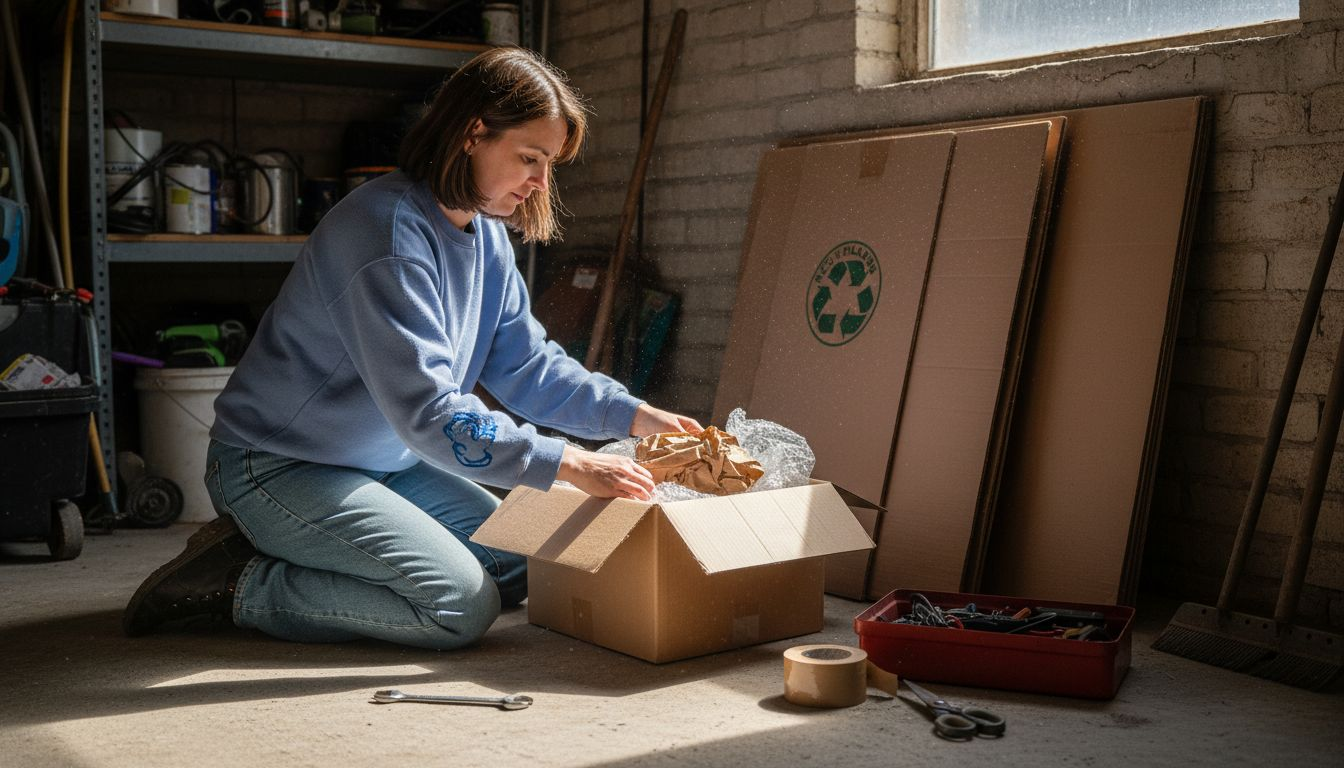
Begin by walking through each room and categorising your possessions by fragility and size. Fragile items like glassware, ceramics, and electronics need specialist protection. Larger furniture and textiles require different materials than delicate ornaments.
National Museums Scotland recommends selecting chemically stable packing materials based on the nature, size, weight, and fragility of each item. This means choosing materials that won’t react with your belongings over time and will provide adequate cushioning during movement.
Create a simple inventory as you assess. List heavy items, fragile items, and bulky items separately. This helps you determine exactly what materials you’ll need and in what quantities.
Once you know what you’re packing, order your materials with a buffer. Here’s what most households need:
- Strong cardboard boxes in multiple sizes
- Bubble wrap for fragile items
- Packing paper or tissue paper for wrapping
- Foam corner protectors for furniture
- Packing tape and a dispenser
- Markers for labelling boxes
- Moving blankets for large furniture
Order 20 percent more materials than you think you’ll need—you’ll almost certainly use every bit of it.
Consider ordering pre-packed removal kits if you want a stress-free approach. These bundles combine the most commonly used materials in appropriate quantities for different household sizes.
Check that your packing materials comply with environmental standards. UK government guidance emphasises using materials that facilitate recycling and waste reduction, so choose suppliers committed to sustainable packaging practices.
Order at least two weeks before your moving day. This gives you time to receive everything and start packing without rushing. Last-minute orders may arrive incomplete or delay your packing schedule.
Pro tip: Order your packing materials from a supplier offering bulk discounts, then store any extras in your garage or shed—you’ll always have materials on hand for future moves or storage needs.
Step 3: Organise, declutter, and prepare household items
Before you pack a single box, you need to decide what’s actually worth moving. Decluttering reduces costs, saves packing time, and means you’re only transporting items you genuinely want in your new home.
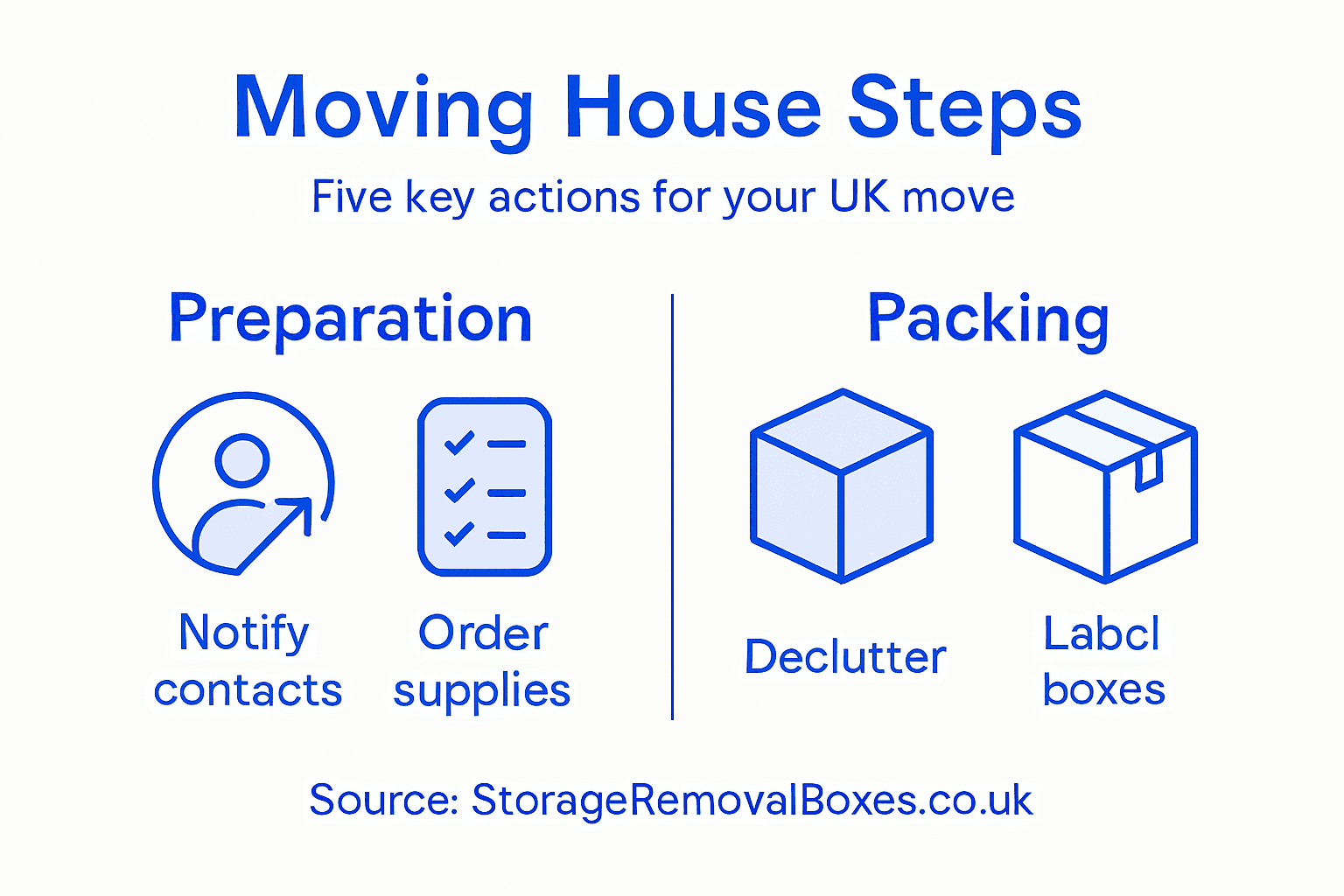
Start by going room by room and sorting everything into three categories: keep, sell, and donate. Be honest about what you use regularly versus what’s gathering dust in cupboards and under beds.
Scope UK recommends planning ahead to declutter and disposing of unneeded items through sale, donation, or recycling. This approach reduces moving costs and helps others benefit from your unwanted possessions.
Create separate piles for each category as you work. Items to sell can go on online marketplaces or to local car boot sales. Donations work well for charities, community groups, or friends who might appreciate them.
Here’s a practical decluttering approach:
- Pull items out of storage completely
- Ask yourself if you’ve used it in the past year
- Consider whether it fits your new space
- Check condition and whether repairs are worthwhile
- Be ruthless about sentimental items that take up valuable space
The fewer items you move, the less you’ll spend on packing materials, boxes, and transport costs.
For bulky items like old furniture, contact your local council about bulky waste collection. Many councils offer free or low-cost removal services. Sort this out early so items are gone before your packing begins.
Organise your paperwork at the same time. Keep important documents like deeds, mortgage papers, and insurance certificates together in a clearly labelled folder. These travel separately from household boxes for safety.
Electronics need special preparation. Back up computer data, note down Wi-Fi passwords and device settings, and take photos of cable connections so you can reconnect everything easily at your new home.
Label boxes as you pack, noting which room they belong in and what they contain. This makes unpacking infinitely easier and helps removal staff place items in the correct rooms.
Pro tip: Take photos of your decluttered items before listing them for sale—this saves time photographing everything individually and helps buyers see the condition clearly.
Step 4: Pack securely using eco-friendly solutions
Protecting your belongings during a move doesn’t mean harming the environment. Eco-friendly packing materials work just as effectively as conventional options whilst reducing your carbon footprint and supporting sustainable practices.
Start by choosing recyclable cardboard boxes as your foundation. These are made from recycled materials and can be recycled again after your move, completing the circular economy loop.
Government guidance on packaging emphasises using recyclable materials that minimise environmental harm and support local authority recycling schemes. This approach reduces packaging waste whilst maintaining strong protection for your items during transit.
For cushioning fragile items, consider these sustainable alternatives:
- Newspaper offcuts or plain paper instead of plastic bubble wrap
- Shredded paper from your own documents or old newspapers
- Cardboard corner protectors rather than foam
- Blankets and soft furnishings to wrap larger items
- Biodegradable packing peanuts made from natural materials
Wrap glassware, ceramics, and electronics individually in newspaper or kraft paper. These materials provide excellent cushioning whilst remaining completely recyclable. Avoid glossy magazines or coloured paper that contain harmful inks.
Eco-friendly packing requires no compromise on safety—your items arrive just as protected whilst you reduce landfill waste.
For bulky items like furniture, use moving blankets made from recycled or natural fibres. These protect surfaces from scratches and can be reused indefinitely, making them more economical long term.
When packing boxes, fill them completely to prevent collapse during transport. Use crumpled paper to fill gaps rather than plastic air pillows. This keeps items stable whilst using only recyclable materials.
Label everything clearly with a marker on cardboard labels rather than plastic stickers. This ensures labels don’t contaminate the recycling process later.
After your move, break down cardboard boxes completely and recycle them through your local authority’s scheme. Return rental blankets or donate them if you’ve purchased them, extending their useful life.
The following table summarises the main differences between conventional and eco-friendly packing materials for your move:
| Criteria | Conventional Materials | Eco-Friendly Alternatives |
|---|---|---|
| Environmental impact | Creates landfill waste | Supports recycling efforts |
| Cost | May be slightly lower upfront | Often similar or slightly higher |
| Reusability | Limited re-use options | Designed for multiple uses |
| Protection level | High when used correctly | Equally high when chosen wisely |
| Disposal process | Landfill or incineration | Local recycling schemes |
Pro tip: Collect newspaper and cardboard boxes from supermarkets and shops weeks before packing begins—they’re usually free and you’ll have plenty of materials without purchasing new items.
Step 5: Verify removals, labels, and final property checks
As moving day approaches, you need to confirm every arrangement is in place and prepare for final property handover. This step ensures nothing gets forgotten and protects you against disputes or missing items.
Contact your removal company at least one week before the scheduled date. Confirm the arrival time, number of staff, vehicle size, and any special access requirements. Clarify whether they’re providing equipment or if you need to arrange anything separately.
The HomeOwners Alliance recommends verifying all arrangements with removal firms and monitoring the removals process closely. This includes keeping valuable items with you and recording the condition of belongings on arrival to address any damage promptly.
Check your box labels thoroughly before packing day. Ensure every box is clearly marked with its destination room and contents. This streamlines unloading and prevents boxes ending up in wrong rooms at your new home.
Here’s your final verification checklist:
- Confirm removal company details and arrival time
- Verify all utility transfers are scheduled
- Check that forwarding addresses are registered with banks and services
- Take photos of your old property’s condition
- Plan your moving day timeline and identify parking for the removal lorry
- Arrange someone to be present at both properties during the move
- Prepare a “moving day” box with essentials you’ll need first
Document everything on moving day—photographs of empty rooms and incoming items protect you against damage disputes.
Walk through your old property room by room before handing over keys. Check all cupboards, drawers, lofts, and sheds. Take photographs of each empty room to confirm you’ve left nothing behind.
Verify that all utilities are disconnected properly. Take final meter readings for gas and electricity, and confirm these match what you’ve reported to suppliers. This prevents disputes over final billing.
At your new property, check that existing damage is recorded in writing. Document the condition before your items arrive so you can’t be charged for pre-existing issues.
Pro tip: Create a moving day contact sheet with your removal firm’s phone number, your mobile number, and your new address’s contact details—keep it easily accessible in case anyone needs to reach you with questions or delays.
Simplify Your Move with the Right Packing Solutions from StorageRemovalBoxes.co.uk
Moving house involves detailed planning and precise packing to protect your valuable belongings while keeping everything organised. The article highlights crucial steps such as creating a clear moving timeline, assessing packing materials, decluttering, and using eco-friendly packaging to ensure a smooth transition. Your biggest challenge might be finding strong, reliable, and sustainable packing materials that fit your specific needs and keep fragile or bulky items safe during transit.
StorageRemovalBoxes.co.uk specialises in providing exactly what you need to overcome these challenges. From robust double-walled moving boxes and bubble wrap rolls to environmentally friendly packing kits and moving blankets, our products streamline every stage of your packing process. With nationwide delivery, expert customer support, and bulk discount options, you can get all your packing essentials in one place and start your move confidently.

Ready to take the stress out of your house move? Discover our range of high-quality, eco-friendly packing materials and removal kits at StorageRemovalBoxes.co.uk. Get your move organised today by choosing trusted supplies tailored for UK house removals, storage, and transportation. Don’t wait until the last minute – visit StorageRemovalBoxes.co.uk now to order everything you need to pack securely and efficiently.
Frequently Asked Questions
How do I create a moving timeline for my house move?
To create a moving timeline, start from your completion date and work backwards to schedule all essential tasks. Identify key contacts and deadlines for notifications, such as your conveyancer and utility suppliers, and use a spreadsheet to track progress.
What packing materials do I need for moving house?
Essential packing materials include strong cardboard boxes, bubble wrap, packing paper, and packing tape. Assess your belongings first to determine the quantity and types of materials needed, noting that ordering about 20% more than estimated will help prevent shortages.
How can I effectively declutter my home before moving?
Decluttering effectively involves sorting your belongings into three categories: keep, sell, and donate. Go room by room, and be honest about what you use regularly—this can significantly reduce packing time and costs by only moving items you genuinely want.
What are eco-friendly packing solutions I can use?
Eco-friendly packing solutions include recyclable cardboard boxes, newspaper for cushioning, and biodegradable packing peanuts. Aim to minimise environmental impact while ensuring your belongings remain protected during transit by fully utilising recyclable materials.
How should I label my boxes for moving?
Label each box clearly with its destination room and contents to streamline the unpacking process. Use markers on cardboard labels instead of plastic stickers, as this helps ensure labels are recyclable after the move.
What checks should I perform on the final moving day?
On moving day, confirm all arrangements with your removal company and double-check box labels. Document the condition of your old property, take final meter readings, and ensure someone is present at both locations to manage the move smoothly.