Packaging terminology explained for movers and businesses

- Packaging terminology consists of standardized terms describing packaging types, functions, and hierarchies used in logistics and storage. Understanding these terms ensures effective coordination across industries, minimizes damage, and complies with regulations throughout the supply chain. Proper application of primary, secondary, and tertiary packaging layers, along with accurate shipment documentation like ASN and TI/HI patterns, optimizes movement and storage processes.
Packaging terminology is the set of standardised terms that describe the types, functions, and hierarchies of packaging used in logistics, storage, and transportation. Whether you are moving house, running a removal company, or coordinating shipments with a warehouse, understanding these definitions prevents costly errors and miscommunication. The industry organises packaging into three core layers, primary, secondary, and tertiary, and extends into logistics concepts like the Advance Ship Notice (ASN), GS1-128 barcodes, and TI/HI pallet patterns. Knowing this language puts you in control of every stage of the packing and shipping process.
What is packaging terminology and why does it matter?
Packaging terminology is the recognised vocabulary used across the packaging industry to describe materials, structures, functions, and logistics processes. The term covers everything from the bottle touching a product directly to the pallet carrying 500 units across the country. Without shared definitions, suppliers, carriers, and warehouses cannot coordinate effectively, and goods arrive damaged, delayed, or incorrectly labelled.
The ASTM packaging-distribution terminology links workflow, product requirements, and distribution environment directly to packaging specifications and operational performance. This means a mismatch in terminology between two business partners is not just a communication issue. It is a compliance and quality control risk. For individuals moving home, the same principle applies at a smaller scale: using the wrong box type or protection method because you misunderstood the specification leads to breakages.
Packaging terminology also underpins regulatory labelling, carrier requirements, and storage facility rules. Removal companies, self-storage operators, and logistics managers all rely on a common glossary to quote accurately, pack correctly, and deliver safely.
What are primary, secondary, and tertiary packaging?
Packaging is broken into three layers: primary, secondary, and tertiary, each with a distinct function in the supply chain.

Primary packaging is the layer in direct contact with the product. A glass bottle, a tin canister, a blister pack, or a polythene bag around a single item are all primary packaging. Its job is product containment and preservation, and it is the layer the end consumer typically handles.
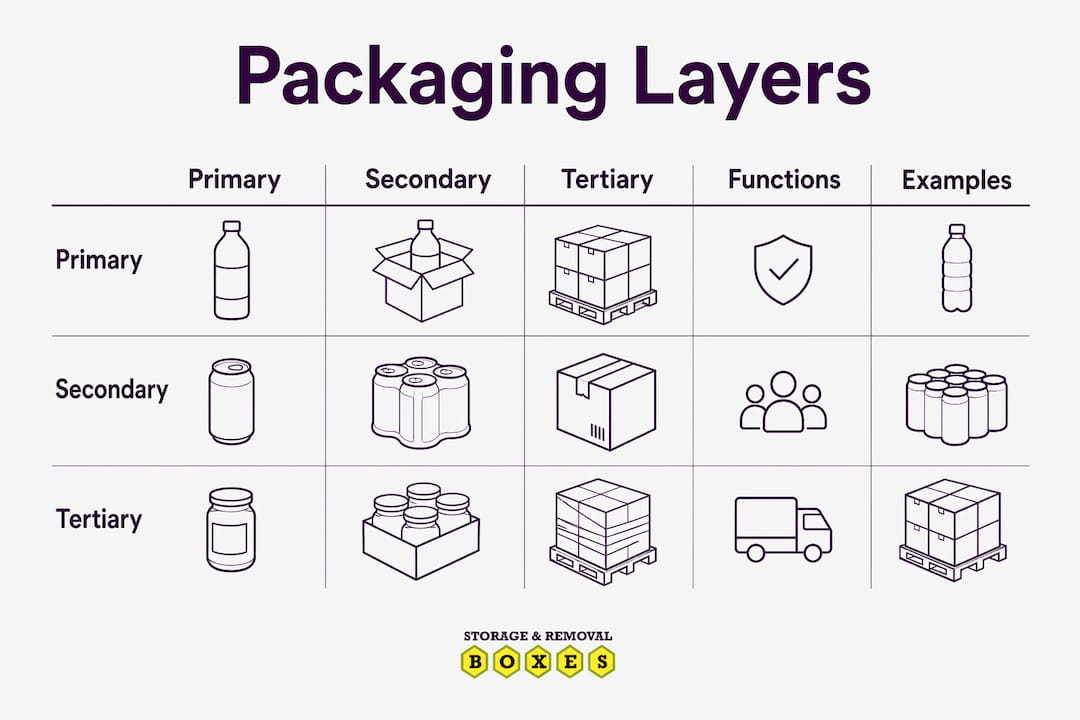
Secondary packaging groups primary packs into logistical units. A cardboard box holding six bottles, a shrink-wrapped tray of cans, or a retail shelf-ready display unit are all secondary packaging. This layer makes picking, packing, and retail display practical. For house removals, the double-walled cardboard box you fill with kitchen items functions as secondary packaging around the individual items inside.
Tertiary packaging handles storage and transport at scale. Pallets, stretch-wrapped pallet loads, and bulk bags (sometimes called big bags or FIBCs) are tertiary packaging. This layer protects secondary units during transit and allows mechanical handling by forklifts and pallet trucks.
| Packaging level | Primary function | Common examples |
|---|---|---|
| Primary | Direct product contact and containment | Bottle, canister, blister pack, polythene bag |
| Secondary | Grouping primary units for logistics | Cardboard box, shrink wrap, tray |
| Tertiary | Transport and storage at scale | Pallet, stretch wrap, bulk bag |
Pro Tip: When planning a house move or storage job, think in layers. Wrap fragile items individually (primary), pack them into a sturdy double-walled box (secondary), and stack boxes onto a trolley or pallet (tertiary). Each layer adds protection and makes handling safer.
Which common packaging terms are used in logistics and shipment preparation?
Logistics packaging terminology extends well beyond box sizes. The Advance Ship Notice (ASN), also known as EDI 856, is a document sent by a supplier to a receiving partner before a shipment arrives. It communicates what is shipping, how it is packed, and when it will arrive, allowing the warehouse to prepare receiving records in advance.
The ASN uses HL codes to structure packing hierarchy: S for shipment, O for order, P for pack, and I for item. This hierarchy maps directly onto physical packaging levels, connecting the paperwork to the boxes and pallets on the lorry. For businesses receiving large volumes of stock, this structure is what allows scan-based receiving to work accurately and quickly.
Key identifiers you will encounter in logistics packaging documents include:
- SSCC-18 (Serial Shipping Container Code): an 18-digit code embedded in a GS1-128 barcode on cartons and pallets, used for traceability throughout the supply chain.
- UPC (Universal Product Code): the standard barcode identifying individual product units at item level.
- Carton: a single corrugated or cardboard shipping box, typically the secondary packaging unit.
- Pallet: a flat wooden or plastic platform carrying stacked cartons, the standard tertiary unit for freight.
- Pack: a grouped set of items within a carton, sometimes used as an intermediate level in ASN documents.
- Pick and pack: the warehouse process of selecting individual items and packing them into outbound cartons.
Pro Tip: Accurate ASN data, including correct packaging hierarchy and SSCC codes, allows warehouses to scan pallets on arrival and match them instantly to pre-created receiving records. This cuts unloading time significantly and reduces disputes over missing stock.
What are TI/HI and other specialised pallet terminology?
TI/HI is one of the most specific and frequently misunderstood terms in packaging logistics. TI refers to the number of cases per layer on a pallet (Tier), and HI refers to the number of layers high (High). Together, TI/HI defines the exact pallet build pattern a supplier must follow when preparing a shipment.
A pallet with a TI of 6 and a HI of 8 holds 48 cases in total. Change either number and you alter the load height, weight distribution, and stability of the pallet. Retailers and distribution centres specify TI/HI precisely because it affects how pallets fit into lorries, racking systems, and automated warehouses.
| TI (cases per layer) | HI (layers high) | Total cases per pallet |
|---|---|---|
| 4 | 6 | 24 |
| 6 | 8 | 48 |
| 8 | 10 | 80 |
Related terms that affect pallet stability include tare weight (the weight of the packaging itself, excluding product), gross weight (total weight including product and packaging), and pack size (the number of units within a single carton). All three feed into load planning calculations for pallet delivery and carrier booking.
Pro Tip: Always confirm TI/HI with your carrier or receiving warehouse before building pallets. A pallet built to the wrong pattern may be refused at the dock or collapse in transit, resulting in damaged goods and a costly re-delivery.
How does packaging terminology vary across industries?
Packaging definitions are not universal. The same word can carry different meanings depending on whether you are working in food manufacturing, pharmaceutical distribution, e-commerce fulfilment, or domestic removals. A “case” in grocery logistics is a secondary carton of retail units. In pharmaceutical supply, a “case” may refer to a temperature-controlled outer container with specific regulatory requirements.
ASTM and ISTA standards provide frameworks for aligning packaging terminology with distribution environments and testing protocols. ASTM D4169, for example, defines performance testing for shipping containers and systems, and the terminology within it is specific to that test environment. Using ASTM definitions outside their intended context without clarification creates specification errors.
The EDI 856 ASN standard illustrates this variation clearly. Different receivers may include or omit packing levels such as carton or pallet within their ASN requirements, meaning the same term “pack” can represent different physical units depending on the trading partner. For businesses working across multiple clients or sectors, this inconsistency is a genuine operational risk.
For individuals and small businesses, the practical consequence is simpler but equally real. Ordering the wrong box specification because you confused “single wall” with “double wall,” or misreading a storage unit’s cubic metre capacity because you confused internal and external dimensions, leads to wasted money and damaged goods. Checking industry packing standards before you commit to a packaging specification is always worth the time.
How to apply packaging terminology for efficient moving and storage
Understanding packaging terms is only useful when you act on them. Here is a practical sequence for applying this knowledge to a move or storage project:
- Identify your packaging layers. Decide what needs primary protection (fragile items wrapped in bubble wrap or foam), what goes into secondary containers (double-walled removal boxes), and how tertiary handling will work (trolleys, pallets, or a removal van).
- Match box specifications to contents. Use the correct box size and wall strength for the weight and fragility of your items. Shipping cartons are rated by burst strength and edge crush test (ECT) values, which tell you how much weight they can bear.
- Label clearly and consistently. Use standard labels: “Fragile,” “This Way Up,” and room destination labels. In logistics, this mirrors the function of ASN item-level data, telling handlers exactly what is inside and how to treat it.
- Document your packing hierarchy. For business shipments, record which items are in which carton, and which cartons are on which pallet. For house moves, a simple room-by-room inventory achieves the same result and speeds up unpacking.
- Communicate specifications to carriers. Tell your removal company or courier the total weight, number of boxes, and any special handling requirements before collection. This is the domestic equivalent of sending an accurate ASN and it prevents delays and damage claims.
For self-storage, applying packaging terminology means understanding cubic capacity, weight limits per shelf, and the difference between self-storage packaging requirements and standard removal packing. Storage units are static environments, but moisture, pressure, and stacking loads still apply.
Key takeaways
Mastering packaging terminology reduces errors, protects goods, and speeds up every stage of moving, storage, and logistics.
| Point | Details |
|---|---|
| Three packaging layers | Primary, secondary, and tertiary packaging each serve a distinct function from product contact to transport. |
| ASN and packing hierarchy | EDI 856 communicates shipment structure using HL codes, enabling faster and more accurate warehouse receiving. |
| TI/HI pallet patterns | TI and HI values define pallet build precisely, affecting load stability, transport safety, and carrier compliance. |
| Industry variation | The same packaging term can mean different things across sectors, making alignment with partners critical. |
| Practical application | Applying terminology to labelling, documentation, and carrier communication prevents damage and delays. |
Why terminology is the foundation, not the finishing touch
I have seen packaging terminology treated as an afterthought more times than I can count. Businesses spend weeks selecting the right product, negotiating carrier rates, and setting up warehouse systems, then lose time and money because a supplier built pallets to the wrong TI/HI, or a removal team arrived with single-wall boxes for a job that needed double-wall.
The uncomfortable truth is that terminology errors compound. One misunderstood term in a specification document can cascade into a refused delivery, a damaged goods claim, and a broken client relationship. I have watched a single incorrect ASN packing level cause a distribution centre to reject an entire lorry load because the scan-based receiving system could not reconcile the physical pallet against the electronic record.
My advice to anyone new to this area: start with the three packaging layers and get those definitions fixed in your mind. Then learn what an ASN does and why pallet patterns matter. You do not need to memorise every term in a packaging terminology glossary on day one. You need to understand the logic behind the hierarchy, because once you see how primary feeds into secondary feeds into tertiary, the rest of the vocabulary falls into place naturally.
The packaging industry is also moving towards greater standardisation, with GS1 standards and EDI protocols becoming more widely adopted even among smaller businesses. Getting comfortable with this language now means you are prepared for the direction the industry is heading, not just where it stands today.
Pack smarter with the right materials from Storageremovalboxes
Understanding packaging terminology is only half the job. The other half is having the right materials to put that knowledge into practice. Storageremovalboxes stocks everything you need for a well-organised move or storage project, from large double-wall removal boxes built to handle heavy loads, to bubble wrap rolls for primary-level protection of fragile items, and foam edge and corner guards for furniture. Every product is selected with strength, reliability, and recyclability in mind. If you are unsure which specification suits your needs, the Storageremovalboxes customer support team can help you choose the right combination for your household size, storage duration, or shipment volume.
FAQ
What is packaging terminology?
Packaging terminology is the standardised vocabulary used to describe the types, functions, and hierarchies of packaging materials and processes in logistics, storage, and transportation. It covers terms from primary packaging through to pallet patterns and shipment documentation.
What are the three main types of packaging?
The three main types are primary packaging (direct product contact), secondary packaging (grouping units into logistical containers), and tertiary packaging (pallets and bulk units for transport and storage).
What does TI/HI mean in packaging?
TI refers to the number of cases per layer on a pallet and HI refers to the number of layers high. Together, TI/HI defines the exact pallet build pattern and directly affects load stability and carrier compliance.
What is an ASN in packaging logistics?
An ASN (Advance Ship Notice), also known as EDI 856, is a document sent before a shipment arrives that communicates what is being shipped, how it is packed, and when it will be delivered. It uses HL codes to represent shipment, order, pack, and item levels.
Why does packaging terminology vary between industries?
Different industries apply the same terms to different physical realities depending on their distribution environment and regulatory requirements. Standards such as ASTM D4169 and ISTA protocols define terminology within specific testing and operational contexts, meaning alignment with your trading partners is always necessary.