Stickers and labels: a practical guide for 2026

- Stickers are mainly for decoration and branding, while labels serve functional identification in shipping and packaging. Choosing the correct materials, cutting formats, and print specifications based on environment and purpose prevents costly mistakes and ensures durability. Proper design, order planning, and testing help achieve high-quality results suited for both personal projects and industrial applications.
Stickers and labels are adhesive products designed for two distinct purposes: decoration and promotion on one hand, and functional identification on the other. Both appear across personal projects, product packaging, logistics, and brand marketing, yet choosing the wrong type for a given task costs time and money. This guide covers materials, print specifications, real-world applications, and ordering strategies so you can make the right call from the start.
What types of stickers and labels are available?
Labels are functional identifiers used for shipping, packaging, and product information, while stickers focus on decoration and branding. Labels tend to be thinner and less durable outdoors. Stickers are typically thicker, vinyl-based, and often laminated for protection. Understanding this distinction before you order prevents costly reprints.
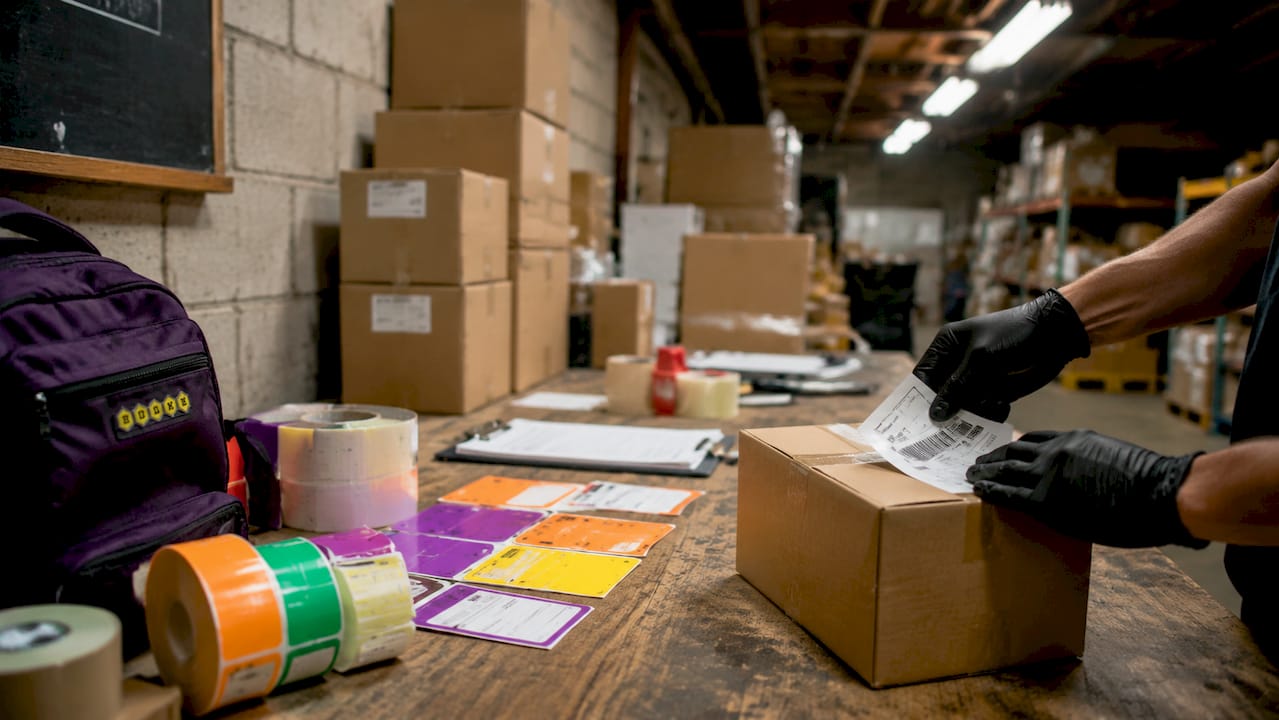
Paper, vinyl, and BOPP: which material suits your project?
Material choice determines how long your printed product survives in the real world. Here is a breakdown of the most common substrates:
- Paper: Best for indoor use only. Suitable for office organisation, jar labels, and product tags in dry environments. Paper degrades quickly when exposed to moisture or oils.
- Vinyl: The standard choice for outdoor applications. Premium vinyl stickers with weather-resistant coating last 3–5 years outdoors, resisting fading, scratching, and water exposure. Ideal for vehicle graphics, outdoor signage, and product branding.
- BOPP (Biaxially Oriented Polypropylene): The preferred substrate for food and beverage labels. BOPP or vinyl materials are required for exposure to moisture, oils, or refrigerated temperatures. A paper label on a chilled drinks bottle will peel within hours.
- Polyester: Durable and chemical-resistant. Used in industrial settings, laboratory environments, and on equipment that requires frequent cleaning.
Die-cut, kiss-cut, and transfer: choosing the right format
Cutting method affects both the look and the ease of application. Die-cut stickers are cut through the material and backing to the exact design shape, giving a clean, professional finish with no visible border. Kiss-cut labels retain a backing border around the design, which protects intricate shapes and makes peeling far easier, particularly for small or detailed artwork. Transfer stickers, sometimes called vinyl decals, require transfer tape for accurate placement and leave no background residue. Decals are durable and intended for long-term outdoor use on vehicles or windows.
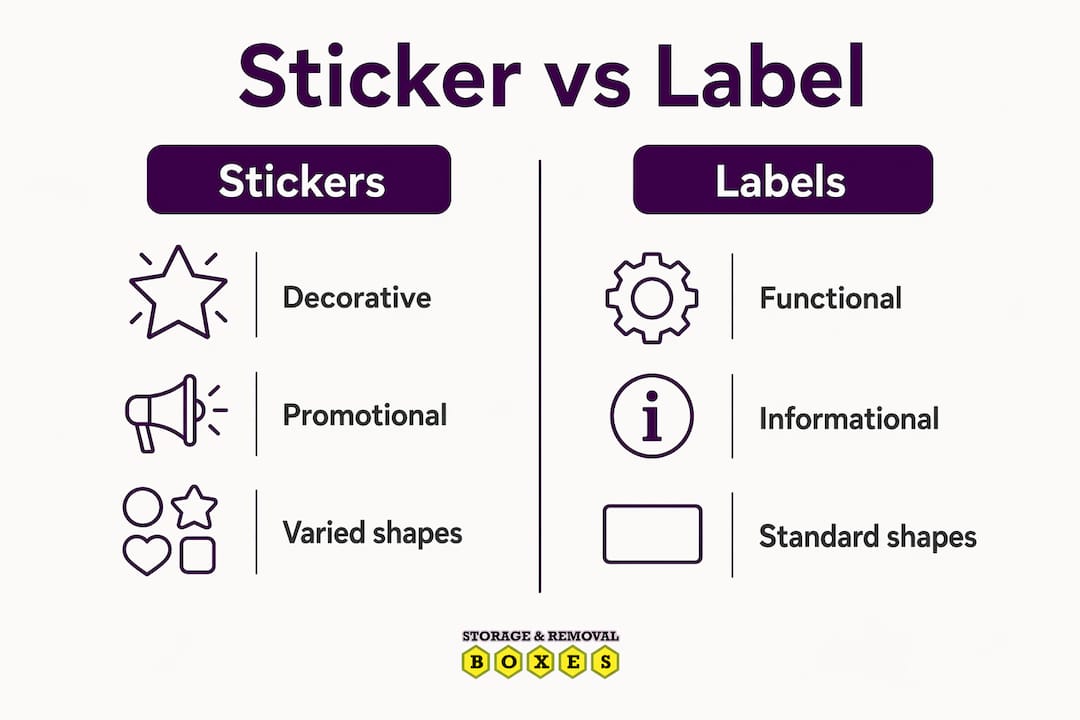
Sheet labels typically contain 4–30 stickers per A4 or 8.5" x 11" page and serve small to medium organisational needs effectively. Roll labels are preferred for large-volume or automated applications, such as warehouse despatch lines.
Pro Tip: Never apply a paper label to a surface that will be refrigerated, washed, or stored outdoors. Switch to BOPP or vinyl the moment moisture becomes a factor, even for short-term use.
How do design and print specifications differ for labels vs stickers?
Getting the design right before sending files to print is the single biggest factor in quality. Most people underestimate how different screen design is from print production.
- Use CMYK, not RGB. Screens display colour in RGB. Printers use CMYK. Designing for print requires CMYK colour profiles, precise cut lines, bleed areas, and sometimes white ink layers. Submitting an RGB file produces dull, inaccurate colours in the final print.
- Add bleed and cut lines. Bleed extends your design 2–3mm beyond the cut line so that no white edges appear after trimming. Without bleed, even a 1mm misalignment leaves an unprinted border.
- Include white ink layers where needed. Printing on transparent or metallic substrates requires a white ink base layer beneath your design. Tools like Canva do not support this. Professional services such as Sticker Nation use Fogra 39 ICC profiles and handle print-ready features that generic tools lack.
- Export in the correct file format. Vector files (PDF, AI, EPS) scale without quality loss. Raster files (JPEG, PNG) must be at least 300 DPI at final print size. Submitting a 72 DPI web image produces a blurry sticker.
- Request a digital proof. Most professional label printing services provide a free digital proof before production begins. Always approve it before confirming the order.
Pro Tip: If you are using Canva or a similar browser-based tool for your initial design, export as a high-resolution PDF and ask your printer to check the file before production. Many printers will flag issues at no charge.
What are the best applications for stickers and labels?
The choice between a sticker and a label hinges on intent. Decoration and promotion favour stickers. Functional identification calls for labels. The table below maps common use cases to the most suitable product type.
| Application | Best Product | Key Reason |
|---|---|---|
| Product packaging and branding | Printed label (BOPP or vinyl) | Durable, professional finish; survives handling |
| Shipping and logistics | Roll label (paper or polyester) | Compatible with thermal printers; high volume |
| Promotional giveaways | Custom sticker (die-cut vinyl) | Eye-catching shape; long-lasting outdoors |
| Office and home organisation | Sheet label (paper) | Easy to print at home; cost-effective |
| Vehicle or window graphics | Vinyl decal with transfer tape | No background residue; precise placement |
| Warehouse box identification | Warning label or roll label | Clear, standardised; withstands transit |
Labels dominate logistics and warehouse management because they integrate with thermal printers and barcode scanners. Businesses using customised packaging report stronger brand recognition at the point of delivery, which makes the case for combining functional labels with branded sticker elements on the same parcel. A shipping box can carry a roll-printed address label on one face and a branded vinyl sticker on another, serving both purposes without compromise.
For personal projects, personalised stickers on sticker sheets work well for planners, gift wrapping, and craft projects. For home moves and storage, warning labels in wholesale packs provide a cost-effective way to mark fragile items, room destinations, and handling instructions across dozens of boxes.
How do you order cost-effectively without sacrificing quality?
Ordering strategy matters as much as design. Getting the balance right between quantity, quality, and turnaround time saves money on every project.
- Order in bulk where possible. Bulk ordering significantly reduces unit cost. Small quantities cost around $0.77 per unit, dropping to as low as $0.08 at high volumes. Even modest increases in order size produce meaningful savings per unit.
- Know your minimum order quantities. Some providers start at a single unit; others require batches of 50 sheets or more. For small businesses testing a new design, look for printers offering low minimums with free digital proofing. Professional printers often start at 10–50 units with flexible customisation options.
- Plan for production time. Standard production runs approximately 5 business days. Rush options are available in as few as 2 business days, but carry a price premium. Build lead time into your project schedule rather than relying on rush orders as a default.
- Choose the right format for your volume. Sheet labels suit small runs and home printing. Roll labels are more efficient for high-volume despatch environments and integrate directly with e-commerce fulfilment workflows and label applicators.
- Request samples before committing to a large run. Most professional label printing services will supply a sample pack. Testing adhesion, finish, and colour accuracy on your actual product surface before a full run prevents expensive mistakes.
Not all vinyl stickers are dishwasher safe. Premium vinyl with a protective laminate endures wash cycles, but transfer stickers and window clings do not. Confirm finish specifications with your printer if durability in wet or high-temperature conditions is a requirement.
Key takeaways
The most effective approach to stickers and labels is matching material, cut format, and print specification to the specific environment and purpose before placing any order.
| Point | Details |
|---|---|
| Match material to environment | Use paper indoors, vinyl or BOPP outdoors, and polyester for industrial or wet conditions. |
| Cutting format affects usability | Kiss-cut labels protect intricate shapes; die-cut stickers give a cleaner finished look. |
| Design for print, not screen | Submit CMYK files with bleed and cut lines; avoid RGB exports from browser-based tools. |
| Bulk ordering reduces unit cost | Unit prices drop sharply with volume; plan quantities in advance to avoid premium rush costs. |
| Combine label types for dual use | Use roll labels for logistics and branded stickers for presentation on the same packaging. |
What i have learned after years of watching people get this wrong
The most common mistake I see is treating stickers and labels as interchangeable. They are not. A business owner who orders beautiful custom stickers for their product jars, only to find them peeling after a week in a chilled cabinet, has made a substrate error that no amount of good design can fix. The fix is simple: ask your printer what the label will be exposed to, and let the answer drive the material choice.
The second mistake is designing in RGB and wondering why the printed colours look flat. CMYK and RGB render colour differently, and the gap is most visible in saturated blues and greens. If your brand colour is a vivid teal, test a printed proof before committing to a full run.
I have also noticed a growing trend towards hybrid use, where businesses combine a functional roll label for shipping data with a separate branded sticker applied by hand before despatch. This approach costs slightly more per unit but produces a noticeably more polished unboxing experience. For small businesses competing with larger brands, that detail matters.
First-time buyers often over-order on their first run, locking in a design before they have tested it on the actual surface. Order a small batch first. Confirm the adhesion, the colour, and the finish. Then scale up with confidence.
Label your move the right way with Storageremovalboxes
Labels are not just for products and branding. During a house move or a storage project, clear labelling is the difference between an organised unpacking and hours of confusion. Storageremovalboxes stocks warning labels in wholesale packs designed to withstand the rigours of transit, alongside a full range of packaging for moving that pairs directly with your labelling system.
Whether you are moving a single room or an entire office, pairing your labels with the right boxes makes the whole process faster. Browse the tall double-wall removal boxes at Storageremovalboxes, built to carry heavy loads and accept adhesive labels cleanly on every face.
FAQ
What is the difference between a sticker and a label?
Stickers focus on decoration and branding, while labels serve functional identification purposes such as shipping, packaging, and product information. Labels are typically thinner; stickers are thicker, often vinyl-based, and laminated for durability.
Which material should i use for outdoor stickers?
Vinyl is the standard choice for outdoor use, lasting 3–5 years with a weather-resistant coating. BOPP is preferred for labels exposed to moisture, oils, or refrigerated temperatures.
What is the difference between die-cut and kiss-cut?
Die-cut stickers are cut through both the material and backing to the exact design shape. Kiss-cut labels retain a backing border, which protects intricate shapes and makes peeling easier, particularly for detailed or small designs.
How do i avoid colour problems when printing stickers?
Design in CMYK rather than RGB, and include bleed areas and precise cut lines in your file. Browser-based tools like Canva do not fully support print-ready features, so request a digital proof from your printer before approving production.
Can I order a small quantity of custom labels?
Many professional printers offer runs starting at 10–50 units with free digital proofs and flexible customisation. Small quantities cost more per unit, but allow you to test adhesion and colour accuracy before committing to a larger order.