Understanding box sizes: Your smart guide to packing

TL;DR:
- Using properly sized boxes is crucial for a smooth move, as it prevents damage and optimizes packing efficiency.
- Different suppliers offer varying dimensions, so checking actual measurements and weight limits is essential for effective packing.
- A balanced mix of small, medium, and large boxes, with careful packing strategies, ensures a safer, faster, and less stressful moving process.
Most people assume that a “large” moving box is the same regardless of where they buy it. That single assumption causes more moving day disasters than almost anything else. Overpacked boxes split at the bottom, undersized boxes mean twice as many trips, and an entire lorry-load of mismatched sizes turns unloading into a puzzle nobody wants to solve. Sizes vary by supplier and there is no universal UK standard, yet once you understand how box categories actually work, you can pack faster, protect your belongings better, and even save money in the process.
Key Takeaways
| Point | Details |
|---|---|
| No universal size | Box dimensions and weight limits vary by seller, so always check actual measurements. |
| Match size to weight | Heavy items go in small boxes, light and bulky items in large boxes for easy and safe moving. |
| Mix for efficiency | Using a range of box sizes and shapes allows for the most efficient packing and stacking. |
| Double-wall for strength | Choose double-wall or plastic crates for fragile or heavy loads to prevent accidents. |
| Strategic stacking | Always stack heavier boxes at the bottom, lighter ones above, to avoid crushing and collapse. |
Why box size matters for moving and storage
Box size is not a minor logistical detail. It is one of the biggest factors that determines whether your move is smooth or a stressful ordeal. Think of it this way: the box is the first line of defence for everything you own during transit. Choose the wrong size and that defence fails.
Incorrect sizing leads to two opposite problems. Boxes that are too large get overloaded with heavy items, which causes the base to buckle and the sides to bow outwards. Boxes that are too small force you to use far more of them than necessary, which increases packing time, loading time, and the total number of trips. Neither outcome is acceptable when you are trying to move an entire household efficiently.
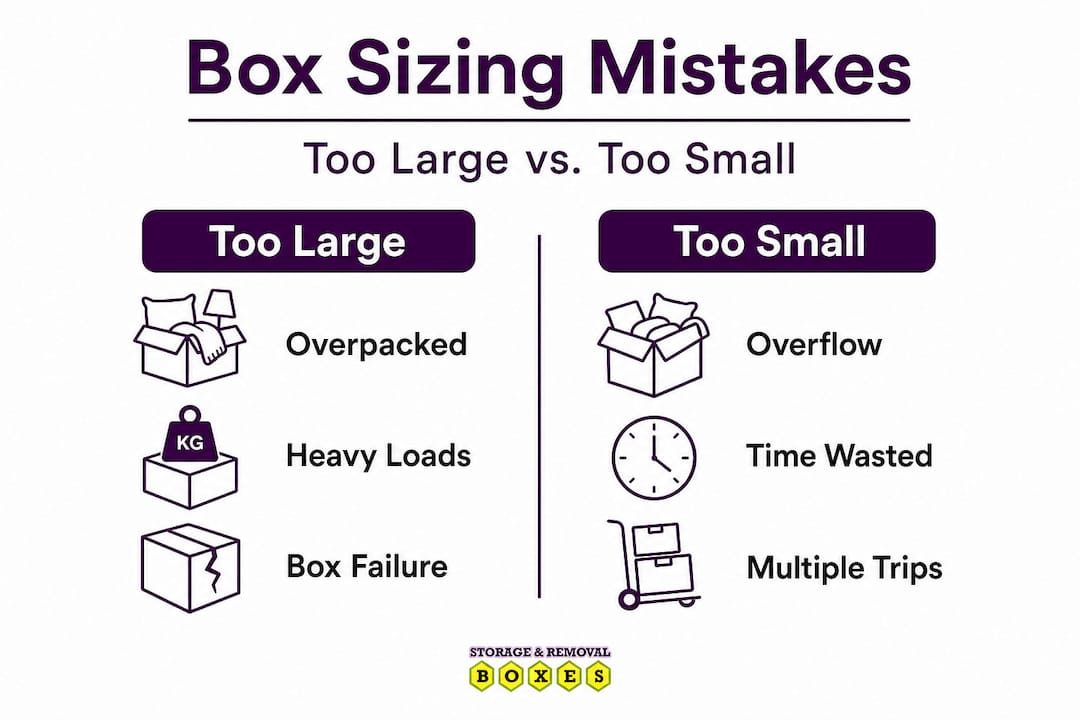
There is also a cost dimension. Many people over-purchase large boxes thinking bigger is always better. In reality, using the right sizes means you buy fewer boxes overall because each one is actually filled to its optimal capacity. You waste less cardboard, spend less money, and reduce the amount of packaging that ends up in the recycling bin.
Different sizes serve genuinely different purposes, and understanding those purposes is the heart of good packing:
- Small boxes are built for heavy, dense items such as books, tools, tins, and glassware. Their compact size forces you to keep weight manageable.
- Medium boxes are the workhorse of any move, ideal for kitchenware, clothing, toys, and electrical items.
- Large and extra-large boxes are designed exclusively for light but bulky items such as bedding, cushions, lampshades, and pillows.
“Small boxes are best for heavy items like books and tools, carrying up to 20 to 23 kg; medium boxes suit kitchenware, clothes, and toys up to around 20 kg; large and extra-large boxes should carry light bulky items such as bedding and pillows, typically rated to 15 to 20 kg.”
Keeping this principle front of mind from the start will save you time, physical strain, and damaged possessions.
Understanding box size categories and what fits inside
Understanding why box sizing is critical, it is time to look at what “small”, “medium”, “large”, and “extra large” actually mean in practice, and how these guide your packing decisions room by room.
In the UK, box sizes generally fall into these approximate dimensions:
| Size label | Typical dimensions (mm) | Approx. volume | Max recommended weight | Best used for |
|---|---|---|---|---|
| Small | 305 x 305 x 305 | 28 litres | 20 to 23 kg | Books, tools, tins, ceramics |
| Medium | 457 x 305 x 305 | 42 litres | Up to 20 kg | Kitchenware, clothes, toys |
| Large | 457 x 457 x 457 | 95 litres | Up to 20 kg | Pots, bedding, towels |
| Extra large | 457 x 457 x 610 | 127 litres | 15 to 18 kg | Duvets, pillows, lampshades |
These figures are a useful guide, but remember that actual dimensions vary by supplier. Always check the product listing before ordering.
Here is a simple numbered guide to help you decide which box suits each area of your home:
- Kitchen: Use small boxes for tins, jars, and heavy ceramic dishes. Use medium boxes for pots, pans, and lighter appliances.
- Living room: Use small boxes for books and ornaments. Use large boxes for cushions and throws.
- Bedroom: Use medium boxes for folded clothing. Use extra-large boxes for duvets, pillows, and bulky fabrics.
- Home office: Use small boxes for files, manuals, and stationery. Use medium boxes for monitors and loose equipment.
- Garage or shed: Use small and medium boxes for tools, paint tins, and fixings. Keep heavy items in small boxes regardless of their shape.
For medium box packs suited to kitchen and bedroom use, or for mixed box bundle options covering your whole move, having the right variety in advance saves enormous time on packing day.
Pro Tip: Before you seal any box, lift it carefully from the base using both hands. If it feels uncomfortably heavy or the base flexes, remove some items and redistribute them into a smaller box. Your back and your removal team will thank you.

The facts: No universal standards and what that means
Armed with knowledge about typical box categories, it is important not to fall into the trap of assuming “large” means the same everywhere.
The uncomfortable reality is that no universal standard exists for moving box sizes in the UK. One supplier’s “large” might be 40% bigger than another supplier’s “large.” This creates genuine confusion for people ordering online, especially when buying from multiple sources to stock up.
Some suppliers even use cubic feet to describe box volume, a legacy of American influence on packaging catalogues. Others use millimetres or litres. Weight limits vary considerably across the industry too, ranging from 15 kg to 30 kg depending on the box construction. Houses typically need a far greater variety and volume of boxes than flats, and buying all large boxes regardless is a mistake that costs both money and effort.
Here is what typically differs between suppliers when labelling the same size category:
| Supplier label | Actual dimensions example A | Actual dimensions example B | Difference |
|---|---|---|---|
| Small | 300 x 300 x 300 mm | 330 x 330 x 280 mm | Noticeable volume change |
| Medium | 430 x 300 x 300 mm | 460 x 310 x 310 mm | Moderate size change |
| Large | 450 x 450 x 450 mm | 500 x 400 x 400 mm | Significant volume gap |
Box shape also matters more than most people realise. A tall, narrow box behaves completely differently from a cubed box of similar volume. Tall boxes can tip more easily in a lorry, while cubed box sizes stack more predictably and use vertical space efficiently in both vehicles and storage units. For anyone managing box handling logistics across multiple locations, consistent dimensions are especially valuable.
When choosing between suppliers with varying size listings, keep these points in mind:
- Always read the listed dimensions in millimetres, not just the size label
- Check the stated weight limit for each individual box
- Confirm whether the box is single-wall or double-wall construction
- Buy a small sample order before committing to bulk quantities
- Ask the supplier if their dimensions are internal or external measurements
These steps take just a few minutes but prevent costly ordering mistakes.
Packing strategies: Mixing sizes for efficient packing and storage
Now that you know size names are relative, let us look at real strategies for using box variety to their fullest. You can pack, move, or store much more efficiently with the right approach.
The single most effective packing strategy is to use a mix of sizes rather than ordering exclusively from one category. A van loaded with uniform large boxes may look neat, but those boxes will be either overloaded with heavy contents or stuffed with light items that leave half the box empty. Neither is efficient.
For self-storage, the logic is identical. Mixing small, medium, and large boxes means you can fill a storage unit from floor to ceiling far more effectively. Uniform-height boxes do stack better against walls, but having smaller boxes to fill gaps between larger ones maximises every square metre of space you are paying for.
The removal box options available cover a wide range of sizes precisely because experienced movers know that variety is the key to efficiency, not uniformity.
Here is how to put a smart mixed-size strategy into practice:
- Pack all heavy, dense items into small boxes first, keeping weight under 20 kg per box
- Reserve large and extra-large boxes strictly for light, bulky items such as bedding and soft furnishings
- Fill any void spaces inside boxes with crumpled paper, bubble wrap, or clothing to prevent items shifting
- Label every box clearly on the top and at least two sides with the room destination and a brief contents list
- Number boxes per room so you can track everything during unloading
- Group boxes of similar heights together when loading to create stable, even stacks in the van or storage unit
Pro Tip: Always load the heaviest, most robust boxes onto the lorry or into storage first, placing them at the bottom. Lighter boxes go on top. A large duvet box balanced on a stack of book-filled small boxes is an accident waiting to happen. Reverse that order and everything stays stable.
Pitfalls to avoid: Overloading, weak boxes, and storage mistakes
Great strategy can still be undermined by a few classic errors. Here is what to watch for and how to avoid it.
The most common mistake is placing heavy items into large boxes simply because there is more room. Overpacking large boxes with heavy items causes rips, base failure, and potential injury when lifting. A box full of heavy books in an extra-large box can easily exceed 40 kg, which is dangerous for anyone carrying it and almost certainly over the box’s structural limit.
Cardboard quality is another area where people cut corners. Single-wall cardboard is fine for light clothing or soft toys. For anything heavy, fragile, or valuable, double-wall cardboard boxes are essential. Double-wall construction provides a second layer of corrugation that resists crushing, puncturing, and moisture far better than single-wall alternatives.
For multiple moves or long-term storage, plastic crates are better than cardboard because they are reusable, waterproof, and structurally consistent. For a single house move, high-quality double-wall cardboard boxes offer excellent protection at a lower cost and can be recycled afterwards.
Common mistakes and their straightforward fixes:
- Mistake: Filling large boxes with heavy kitchen items. Fix: Use small or medium boxes for anything weighing more than 5 kg per item.
- Mistake: Leaving boxes less than two-thirds full. Fix: Fill voids with packing paper or bubble wrap to prevent internal movement.
- Mistake: Stacking single-wall boxes for storage. Fix: Switch to double-wall or plastic crates for anything stored longer than a week.
- Mistake: Forgetting to check box weight before sealing. Fix: Always do a final lift test from the base before applying tape.
- Mistake: Buying all one size to simplify ordering. Fix: Order a planned mix of small, medium, and large using the room-by-room guide above.
Browse the removal box packs available for pre-assembled bundles that take the guesswork out of ordering the right mix for your property size.
The uncomfortable truth about box sizes: One size never fits all
Here is something most standard moving guides will never say plainly: the advice to “just buy a load of large boxes” is one of the most expensive pieces of bad advice in the entire removal industry. It sounds logical. Large boxes mean fewer boxes, fewer trips, and less hassle. In practice, it leads to collapsed bases, strained backs, broken belongings, and a moving team that quietly resents you by lunchtime.
We see this pattern repeatedly. Customers who order all large boxes, load them with everything in sight, and then wonder why three boxes split before they even reached the van. The boxes did not fail because they were poor quality. They failed because they were used for the wrong items at twice their safe weight limit.
The real lesson here is that flexibility in packing is a genuine skill, not just a nice idea. A well-planned move uses perhaps 40% small boxes, 40% medium boxes, and just 20% large or extra-large boxes. That ratio shifts depending on what you own, but the principle holds: heavy items always go in small boxes, always. No exceptions, no matter how tempting it is to just drop that last set of encyclopaedias into the nearest large box.
Variety also makes loading and unloading more ergonomic. Smaller, heavier boxes can be carried at waist height with proper posture. Large, light boxes can be carried in front of the body with a clear line of sight. Mix that into your loading strategy and you move faster, more safely, and with far less physical exhaustion.
The uncomfortable truth is this: there are no shortcuts in packing. The movers who finish fastest and arrive with everything intact are invariably the ones who spent the most time thinking about which box to use before they ever started filling anything.
Ready to pack smarter? Find the perfect boxes and materials
With your new understanding of box sizes, choosing the right packing materials becomes straightforward rather than overwhelming.
At Storage Removal Boxes Ltd, you will find a carefully selected full box selection covering every size from small archive boxes to extra-large double-wall removal boxes. Whether you are moving a single room or an entire five-bedroom house, the range includes pre-packed removal kits sized for different households, so you are never left guessing how many boxes to order. For heavier loads or awkward items, the large double wall boxes offer exceptional structural strength while remaining fully recyclable. Everything is available with nationwide delivery, so your packing supplies arrive before your moving day stress does.
Frequently asked questions
What is the strongest type of moving box?
Double-wall cardboard boxes and heavy-duty plastic crates offer the most strength for fragile or heavy items, with plastic crates being the better choice for repeated use or long-term storage.
How many boxes will I need for a one-bedroom flat?
A one-bedroom flat typically fills roughly 25 to 75 sq ft of storage space, which generally equates to around 10 to 20 small and medium boxes depending on how much you own.
Can I use all large boxes for moving?
It is best to avoid using only large boxes, as overpacking them with heavy items causes structural failure, makes them unsafe to carry, and wastes the box’s actual volume capacity.
Why do box sizes vary between sellers?
There is no universal UK standard for moving box sizes, so dimensions differ by supplier. Always check the actual measurements listed in millimetres rather than relying on the size label alone.
Are plastic crates better than cardboard boxes for storage?
Plastic crates are preferable for reusable and long-term storage scenarios, while quality double-wall cardboard boxes are practical and cost-effective for a single house move.