Warning signs every family should know before moving

TL;DR:
- Warning signs in packing, storage, and transportation can indicate risks of damage or scams during a house move. Recognizing these signs early helps protect belongings and budgets from rogue operators. Always verify removal company credentials, demand written quotes, and check security features at storage facilities to ensure safety and legitimacy.
Warning signs in packing, storage, and transportation are specific indicators that predict damage, financial loss, or outright scams during a house move. Recognising these danger signs early is the single most effective way to protect your belongings and your budget. The British Association of Removers (BAR) and Companies House registration both serve as verifiable benchmarks for legitimacy. Yet thousands of families each year miss the alert signs that separate trustworthy services from rogue operators. This guide covers every major category of risk, from choosing a removal firm to selecting a self-storage facility and packing your boxes correctly.
What are the warning signs of an unreliable removal company?
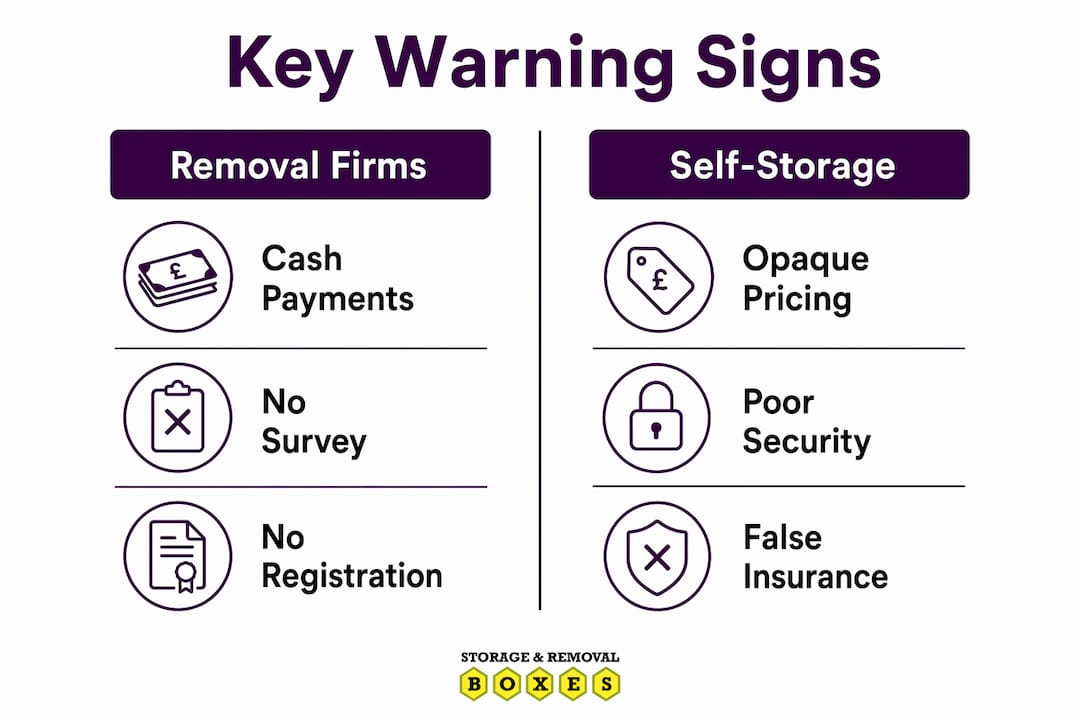
Paying cash for removal services over £500 is a major red flag of rogue activity. Professional removal firms request a deposit of around 25% and accept card or bank transfer payments. A demand for large cash sums before the move begins signals that the company operates outside normal business practice.
A binding quote for any home larger than a studio flat should always follow a physical or video pre-move survey. A quote given over the phone without a survey is a clear indicator of underquoting or inexperience. Underquotes are a classic setup for unexpected charges on moving day.
One of the most serious scams in the industry is the hostage load tactic. Rogue movers load your belongings and then demand a much higher payment before they will unload. BAR membership gives you access to a formal dispute resolution process, which is your best legal protection if this happens.
Key indicators of risk to check before you book:
- No verifiable address or only a mobile number listed online
- No Companies House registration number on their website or invoice
- Refusal to provide a written contract detailing scope and cost
- Pressure to pay the full balance before the move date
- No BAR membership or equivalent trade body affiliation
- Vague or evasive answers about subcontracting arrangements
Pro Tip: Search the company name on Companies House before signing anything. A legitimate removal firm will have a registered address, a director’s name, and a trading history you can verify in under two minutes.
Adherence to a binding Code of Practice and formal dispute resolution is the best indicator of a removal company’s legitimacy, beyond professional appearance alone. A polished website and a friendly phone manner prove nothing without verifiable credentials behind them.
How do you spot warning signals at a self-storage facility?
Lack of transparent, upfront pricing is the first sign of trouble at a self-storage site. Reputable facilities publish their rates clearly and do not add hidden administration fees after you sign. Vague pricing at the enquiry stage almost always means unexpected charges later.
Poor security is a more serious concern. A storage provider’s security should include individual unit locks, alarmed units, perimeter fencing, and monitored access, not just CCTV cameras. Vague answers about how security is managed indicate poor oversight and are a clear reason to look elsewhere.
Approximately 15% of UK self-storage sites operate without permanent on-site staff. That absence affects both security response times and the quality of customer support when something goes wrong. If a facility cannot tell you clearly who is on site and when, treat that as a warning signal.
Insurance is another area where facilities frequently mislead customers. Most storage facilities do not provide insurance as part of the rental fee. You must verify coverage independently or obtain a separate policy before storing anything of value.
| Security feature | What to look for | Red flag |
|---|---|---|
| Access control | PIN or fob entry with logged access | Shared padlock or no access record |
| Unit alarms | Individual unit alarm per door | Alarm only at main entrance |
| Perimeter | Fenced boundary with gated entry | Open car park with no barrier |
| CCTV | 24-hour monitored cameras | Cameras present but not monitored |
| Staff presence | Permanent on-site staff during hours | Remote-only support with no on-site cover |
Climate-controlled storage is frequently oversold in the UK. Climate-stable facilities, which are well-insulated and ventilated, are sufficient for most household goods in the British climate. Paying a premium for full climate control is rarely necessary unless you are storing wine, artwork, or sensitive electronics.
How to recognise warning signs in packing materials and methods
Frequent damage during transit is the clearest symptom of inadequate packaging. The cause is almost always the same: boxes that are too weak for their contents, or contents that are packed without enough internal support. Damage does not happen randomly; it follows directly from packing decisions made before the van leaves.

Single-wall boxes are the primary cause of packaging failure for heavier or fragile items. Professionals recommend double-wall corrugated board for heavier loads to prevent crush damage during stacking. A single-wall carton that looks fine on the floor will buckle under the weight of two or three boxes stacked on top of it.
Moisture damage is a subtler but equally serious problem. Soft or damp cardboard loses structural integrity quickly, even before it visibly deteriorates. If a box feels soft at the corners or smells musty, it will not protect its contents reliably in transit.
| Packing approach | Risk level | Recommended alternative |
|---|---|---|
| Single-wall box for books or crockery | High | Double-wall corrugated box |
| Oversized box with excessive void fill | Medium | Correctly sized box with foam padding |
| Damp or recycled soft cardboard | High | New, dry double-wall carton |
| No internal wrapping for fragile items | High | Bubble wrap or foam protectors per item |
| Mixed heavy and light items in one box | Medium | Separate by weight category |
Pro Tip: Pack boxes so that they do not flex when you press the sides. A box that gives under hand pressure will collapse under load. Use double-wall removal boxes for anything heavier than 10kg and fill all void space to stop contents shifting.
Micro-impacts during loading and unloading cause more hidden damage than most families realise. Repetitive short drops during loading and unloading compromise box integrity without leaving visible marks. Insurance claims are frequently denied when packaging is judged inadequate for the transit conditions it faced.
What transportation red flags predict loss or damage?
Unclear or absent insurance coverage for transit is the most consequential indicator of risk. A removal firm that cannot produce written evidence of goods-in-transit insurance should not be trusted with your belongings. Ask for the policy number and the insurer’s name before the van is loaded.
Pressure sales tactics and refusal to provide a detailed written agreement are classic warning signals. Rogue movers use lowball pricing to secure bookings, then increase charges unexpectedly on moving day. A legitimate firm will always confirm the full scope and cost in writing before you commit.
Watch for these transportation-related alert signs:
- No written contract confirming the agreed price and scope of work
- Vague or evasive answers about which vehicle will be used
- Confirmation that the job will be subcontracted to an unknown third party
- No clear point of contact on moving day
- Last-minute requests to change the payment method or amount
- Refusal to confirm transit insurance details in writing
Focusing only on price misleads many families into booking rogue operators. Low quotes that resist detailed contracts are a reliable signal of rogue activity, not a bargain. The cheapest quote on the day often becomes the most expensive move overall once hidden charges and damage are factored in.
For guidance on protecting specific valuables during transit, the safe transport of valuables requires purpose-specific packaging and a clear chain of custody from collection to delivery.
Key takeaways
Identifying warning signs before and during a move is the most reliable way to prevent financial loss, damaged belongings, and the stress of dealing with rogue operators.
| Point | Details |
|---|---|
| Verify removal firm credentials | Check Companies House registration and BAR membership before booking any removal service. |
| Demand a pre-move survey | Any home larger than a studio flat requires a physical or video survey before a binding quote is issued. |
| Use double-wall boxes | Single-wall cartons fail under stacking pressure; double-wall corrugated board protects heavy and fragile items reliably. |
| Confirm storage security in writing | A legitimate facility will detail its alarm systems, access control, and on-site staff arrangements clearly. |
| Get transit insurance confirmed | Always obtain written confirmation of goods-in-transit insurance before the removal van is loaded. |
What I have learned from watching moves go wrong
Moving is one of the few situations where the warning signals are obvious in hindsight but easy to miss in the moment. Families are stressed, timelines are tight, and the temptation to trust a friendly voice on the phone is real. I have seen the same patterns repeat: a quote that seemed too good, a company that resisted putting anything in writing, boxes that were clearly too soft for the job.
The single most underestimated risk is packing quality. Families spend weeks researching removal firms and then pack their most fragile items in supermarket boxes. A professional packing approach costs far less than replacing a broken television or a set of damaged crockery. The materials matter as much as the method.
My honest view is that the best protection is not a checklist. It is a willingness to walk away. If a removal firm resists a survey, cannot name its insurer, or pushes for cash, the right answer is always to find someone else. The same applies to storage facilities that give vague answers about security. Transparency is not a bonus feature in this industry. It is the baseline expectation.
— Adrian
Packing supplies that give your belongings real protection
Every warning sign in this article points to the same underlying solution: use materials and services that are built to the right standard.

Storageremovalboxes supplies double-wall removal boxes, bubble wrap rolls, foam corner protectors, and moving blankets, all designed for the specific stresses of UK house moves. The large double-wall removal boxes are built to handle heavy loads without buckling under stack pressure. For families who want everything in one order, the complete moving kits include the right mix of box sizes, protective wrapping, and labelling supplies. Every product ships nationwide with no minimum order.
FAQ
What is the biggest warning sign of a rogue removal company?
Demanding cash payment over £500 is the clearest indicator of rogue activity. Legitimate removal firms accept card or bank transfer and request a deposit of around 25%.
How do I check if a removal company is legitimate?
Search the company name on Companies House and confirm BAR membership. A registered firm will have a verifiable address, director details, and a trading history.
What security should a self-storage facility have?
A reputable facility provides individual unit alarms, PIN or fob access control, perimeter fencing, and 24-hour monitored CCTV. Vague answers about any of these are a reason to look elsewhere.
Why do single-wall boxes fail during a move?
Single-wall corrugated board buckles under the weight of stacked boxes, particularly with heavy or fragile contents. Double-wall boxes distribute load more effectively and resist crush damage during transit.
Does self-storage insurance come with the rental fee?
Most UK storage facilities do not include insurance in the rental price. Customers must verify coverage separately or arrange their own policy before storing valuables.