What is commercial storage: a guide for businesses

TL;DR:
- Commercial storage offers secure, flexible space for businesses and individuals to manage inventory outside their main premises. Starting with self-storage units allows easy scaling to warehouse space, benefiting seasonal and growing operations. Modern facilities emphasize security features and cost savings by avoiding long-term property commitments.
Commercial storage is defined as purpose-built, secure space rented by businesses or individuals to store goods, equipment, or materials outside their primary premises. The UK self-storage sector reached £1.2 billion in turnover, with revenue per square foot rising to £29.13 in 2025. That figure signals how central commercial storage solutions have become to everyday business operations. Whether you run a small online retail shop, a trades business, or a growing SME, understanding what commercial storage offers can directly affect your costs, flexibility, and operational efficiency.
What is commercial storage and how does it differ from business storage?
Commercial storage refers to facilities designed for industrial-scale needs, typically involving longer lease commitments and separate billing for rates and service charges. Business self-storage, by contrast, operates on month-to-month, all-inclusive contracts suited to smaller operations. The distinction matters because choosing the wrong type can lock you into costs and commitments that do not match your actual requirements.

The term “commercial storage” is sometimes used loosely to cover any business-related storage. The recognised industry distinction places commercial storage at the industrial or warehouse end of the spectrum, while business self-storage sits at the flexible, accessible end. Both serve legitimate purposes, but they serve different scales of operation.
A sole trader storing tools and stock between jobs has different needs from a manufacturer holding palletised goods. Knowing which category applies to your situation is the first decision to make before signing any contract.
What are the main types of commercial storage solutions available?
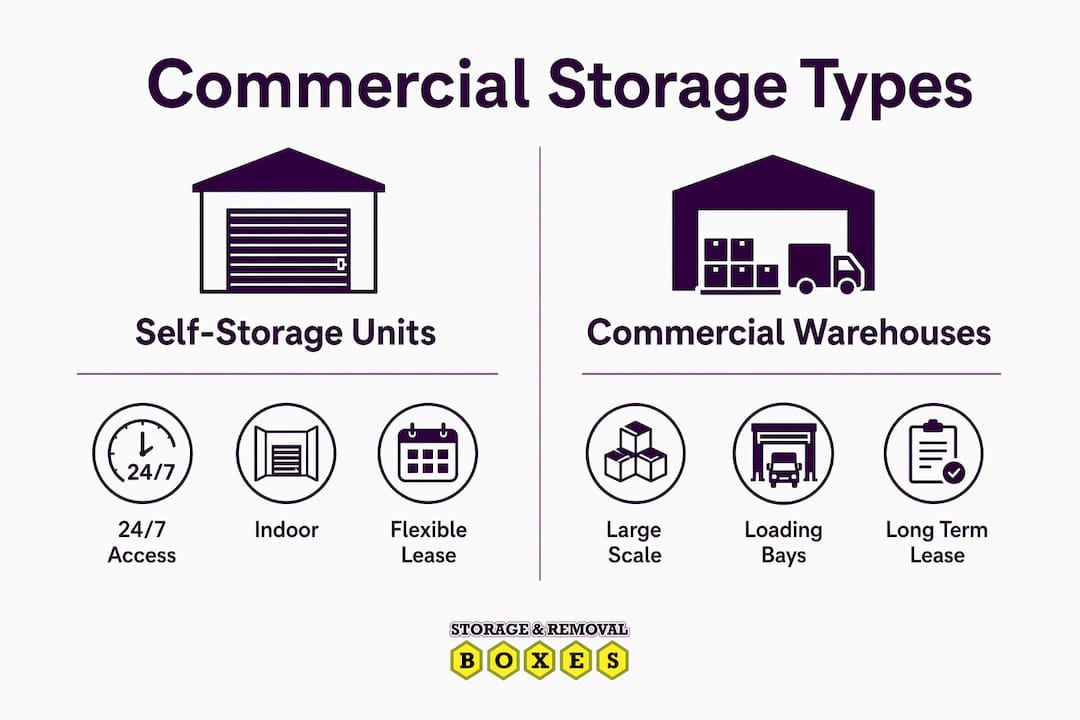
Three main formats dominate the UK market: self-storage business units, commercial warehouses, and container storage. Each suits a different combination of volume, access frequency, and budget.
Self-storage business units
Self-storage units are indoor rooms within managed facilities. They offer climate control, 24-hour access in many cases, and all-inclusive monthly billing. Indoor rooms suit climate-sensitive inventory such as electronics, documents, or fabric goods. Lease terms are typically rolling monthly contracts, making them the lowest-commitment option.
Commercial warehouses
Warehouses provide large-scale space with loading bays, forklift access, and specialist handling. They suit businesses moving high volumes of goods regularly. Warehouses offer specialised handling and dispatch that self-storage cannot match, but they require 3–5 year leases and deposits of 3–6 months’ rent. That commitment is significant for any business without predictable long-term volume.
Container storage
Drive-up containers sit outside or in open yards, giving direct vehicle access. Drive-up units offer rapid access ideal for tradespeople and businesses handling bulky or heavy items regularly. They provide less environmental protection than indoor rooms but cost less per square foot.
| Format | Access | Typical lease | Best suited for |
|---|---|---|---|
| Self-storage unit | 24-hour indoor | Monthly rolling | SMEs, retailers, sensitive stock |
| Commercial warehouse | Loading bay | 3–5 years | High-volume logistics |
| Container storage | Drive-up | Monthly or fixed | Trades, bulky goods |
Pro Tip: If you are unsure which format to start with, choose a monthly self-storage unit. You can scale up to warehouse space once your volume justifies the longer commitment.
How does commercial storage work for businesses and individuals?
Renting commercial storage follows a straightforward process. You assess your volume and access needs, choose a facility, sign a contract, and move your goods in. The operational detail, however, is where most businesses either gain or lose value.
Contracts and access
Month-to-month self-storage contracts give you the freedom to upsize, downsize, or exit without penalty. Commercial warehouse leases bind you for years and include exit clauses that can be costly. Self-storage offers simpler cost profiles with no long-term exit clauses, which is a genuine financial advantage for businesses with variable demand.
Access arrangements vary by facility. Most managed self-storage sites offer keypad or fob entry, with some providing 24-hour access seven days a week. Warehouses typically operate during business hours unless you negotiate otherwise.
Security features to expect
Modern storage facilities have moved well beyond a padlock on a door. Security features now include CCTV, personnel, and gate control, and the best facilities function as specialised command centres for the businesses using them. Proximity to your core operations also matters. A facility 45 minutes from your premises will cost you time on every visit.
Key security and operational features to look for:
- Perimeter CCTV with recorded footage
- Individual unit alarms or padlock points
- Staffed reception during business hours
- Electronic gate access with audit trails
- Fire suppression and pest control
Pro Tip: Visit the facility before signing. Check whether the loading area is wide enough for your vehicle and whether the corridors accommodate your largest items.
What are the key benefits and cost considerations of commercial storage?
The core financial benefit of commercial storage is avoiding capital expenditure on property. Commercial storage improves operational efficiency by removing the need for business rates, building maintenance, and long-term property commitments. For SMEs, that translates directly into better cash flow.
Cost comparison
Self-storage units in the UK typically cost £1–£2 per square foot annually on rolling monthly contracts. Warehouses require deposits of 3–6 months’ rent plus ongoing business rates and service charges. Those hidden costs make warehouse leases significantly more expensive than the headline rent figure suggests.
The numbered list below summarises the key financial advantages of self-storage over traditional warehouse leases:
- No business rates on top of rent
- No service charge for building maintenance
- No long-term exit clause or break penalty
- All-inclusive monthly billing with no surprises
- Ability to scale space up or down within weeks
For inventory management in small businesses, the ability to adjust storage size monthly is a genuine operational tool, not just a convenience.
When commercial storage reduces financial risk
Seasonal businesses benefit most from flexible storage. A retailer stocking up for the Christmas period can take a larger unit in october and release it in january without penalty. A startup testing a new product line avoids committing to warehouse space before knowing whether the line will succeed. Flexible self-storage is a strategic tool for SMEs that improves cash flow by matching costs to actual demand rather than projected demand.
| Factor | Self-storage | Commercial warehouse |
|---|---|---|
| Upfront cost | Low (1 month deposit) | High (3–6 months deposit) |
| Lease flexibility | Monthly rolling | 3–5 year fixed |
| Hidden charges | None (all-inclusive) | Rates, service charges |
| Scalability | High | Low |
| Best for | SMEs, seasonal demand | High-volume logistics |
Who should consider commercial storage solutions and when do they make sense?
Commercial storage suits a wide range of businesses and individuals. The common thread is a need for space that does not justify buying or leasing a full property. 24% of business users operate their enterprises directly from storage units, which shows how central these facilities have become to daily operations.
Businesses and individuals who benefit most include:
- SMEs and startups that need stock space without a long-term property commitment
- Retailers managing seasonal inventory peaks and troughs
- Tradespeople storing tools, materials, and equipment between jobs
- E-commerce sellers holding stock close to dispatch points
- Businesses relocating and needing temporary overflow space
- Individuals downsizing who need secure space for furniture or personal effects
The clearest sign you need commercial storage is when your current premises cannot hold your stock or equipment, but a warehouse lease is financially out of reach. Starting with a self-storage unit and scaling to warehouse space as volume grows is the most financially sound progression. For practical guidance on planning your storage needs, assessing volume and access frequency before committing to any format saves money and time.
A common misconception is that storage units are purely for overflow. In practice, many businesses use them as their primary operational base, running dispatch, stock management, and client collections from a single well-organised unit.
How to choose and optimise your commercial storage space
Choosing the right storage space starts with three questions: how much volume do you need, how often will you access it, and what type of goods are you storing? Answering these honestly prevents you from paying for space or features you do not need.
Practical steps for choosing and organising your space:
- Measure your current stock or equipment volume in cubic metres before viewing units
- Choose a facility within a practical distance of your premises or home
- Confirm access hours match your working pattern before signing
- Check whether the unit has electrical sockets if you need lighting or charging
- Use security labels on boxes to track contents without opening every container
- Stack heavier boxes at floor level and lighter ones above to prevent collapse
- Leave a central aisle so you can reach items at the back without unloading everything
Good packing materials make a measurable difference to how efficiently you use a unit. Double-walled boxes stack more reliably than single-wall alternatives, reducing the risk of collapse and wasted vertical space. Storageremovalboxes supplies self-storage packaging including double-walled boxes, bubble wrap, and foam protectors suited to both short-term and long-term commercial storage.
Pro Tip: Label every box on the side, not the top. When boxes are stacked, side labels remain visible and save you from unpacking an entire column to find one item.
Key takeaways
Commercial storage is the most cost-effective and flexible option for SMEs and individuals who need secure, accessible space without committing to a long-term property lease.
| Point | Details |
|---|---|
| Definition is specific | Commercial storage covers industrial-scale facilities; business self-storage suits smaller, flexible needs. |
| Cost advantage is real | Self-storage avoids business rates, service charges, and long-term exit clauses that inflate warehouse costs. |
| Security has improved significantly | Expect CCTV, gate control, and staffed reception as standard at reputable UK facilities. |
| Start flexible, scale later | Begin with a monthly self-storage unit and move to warehouse space only when volume justifies the commitment. |
| Packing quality affects efficiency | Double-walled boxes and clear labelling maximise vertical space and reduce retrieval time in any storage unit. |
Why commercial storage is more than just renting a room
I have spent years watching businesses make the same mistake: they treat storage as a last resort rather than a planned part of their operation. A retailer I worked with was paying for a unit twice the size he needed because he had never properly measured his stock. He was also losing an hour a day searching for items because nothing was labelled. Two changes fixed both problems: right-sizing the unit and introducing a consistent labelling system.
The shift I have seen in the UK market is that businesses now treat storage as a genuine operational asset. The self-storage in logistics conversation has moved from “where do we put the overflow?” to “how do we build our supply chain around flexible storage?” That is a meaningful change in thinking.
My honest view is that most SMEs underestimate how much a well-chosen, well-organised storage unit can reduce their overheads. The monthly rolling contract is not just a convenience. It is a financial buffer that lets you respond to demand without being locked into costs you cannot exit. The businesses that use storage well treat it like a second premises, not a dumping ground.
— Adrian
Storage boxes and packing supplies from Storageremovalboxes
Getting your commercial storage right starts before you move a single item in. The quality of your packing materials determines how safely your stock travels, how efficiently it stacks, and how quickly you can retrieve it.
Storageremovalboxes supplies large double-walled removal boxes built for the demands of commercial storage, alongside bubble wrap, foam protectors, and packing kits that cover every item type. All products are made from recyclable materials and available with nationwide delivery. Bulk purchasing discounts make Storageremovalboxes a practical choice for businesses stocking up ahead of a move or a seasonal storage period.
FAQ
What is commercial storage used for?
Commercial storage provides businesses and individuals with secure, accessible space to store goods, equipment, or materials outside their main premises. Common uses include inventory management, seasonal stock overflow, and equipment storage for tradespeople.
How does commercial storage differ from a warehouse?
Commercial warehouses require 3–5 year leases and carry additional costs such as business rates and service charges. Self-storage business units operate on monthly rolling contracts with all-inclusive billing, making them lower risk for smaller operations.
How much does commercial storage cost in the UK?
Self-storage units typically cost £1–£2 per square foot annually on monthly contracts. Warehouse leases carry higher upfront deposits of 3–6 months’ rent plus ongoing rates and service charges.
What security should I expect from a commercial storage facility?
Reputable UK facilities provide CCTV coverage, electronic gate access with audit trails, individual unit alarms, and staffed reception during business hours. Security standards have improved significantly across the sector.
Can I run my business from a commercial storage unit?
Yes. Around 24% of business storage users operate their enterprises directly from storage units, using them for dispatch, stock management, and client collections alongside standard storage functions.