What is durable packaging? A clear guide for 2026
TL;DR:
- Durable packaging is made from materials like plastic or high-grade cardboard designed to withstand multiple handling cycles. UK regulations specify minimum requirements for weight, volume, and recyclability, incentivizing reusable formats through future Extended Producer Responsibility fees. Plastic crates last longer and have a lower lifetime carbon footprint, while premium cardboard can offer flexibility and recyclability when properly selected.
Durable packaging is defined as any material or container engineered to protect goods through multiple handling cycles without losing structural integrity. Under the Packaging (Essential Requirements) Regulations 2015, UK producers must use the minimum volume and weight necessary to maintain product safety, and keep compliance records for up to four years. Standards such as BS EN 13428 and the ISO 1860 series set the technical benchmarks for what qualifies. For anyone moving house, running a storage facility, or shipping fragile goods, understanding packaging durability is not an abstract concern. It directly affects whether your items arrive intact and whether your business stays on the right side of UK law.
What is durable packaging made from?
The two dominant material categories are plastic and paper-based solutions, and they perform very differently under real-world conditions.
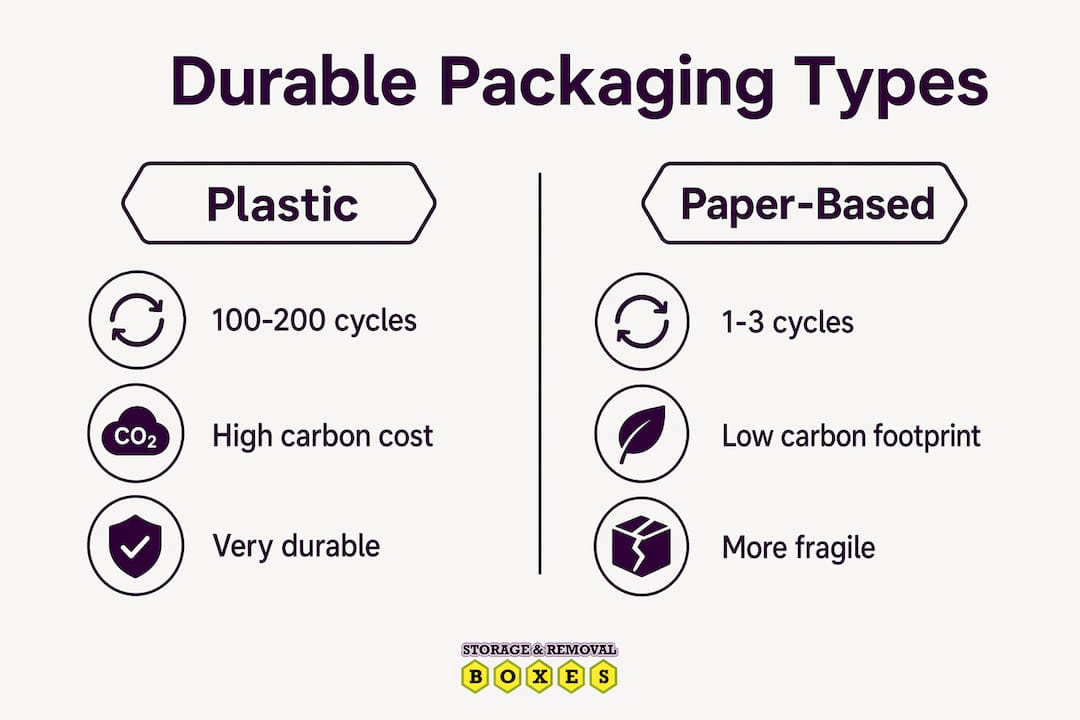
Plastic crates sit at the top of the durability scale. Plastic crates last 100–200 reuse cycles, with roughly one-hundredth of the embodied carbon of single-use cardboard over their full lifetime. They stay waterproof and stackable under pressure, which makes them the preferred choice for long-term storage and professional removals. Cardboard, by contrast, degrades after one or two heavy uses.
Engineered paper-based packaging is the more nuanced option. Structural honeycomb cardboard, for example, reduces carbon emissions by 50–70% compared to traditional foam in protective applications. The UK paper recycling rate sits at approximately 75%, which strengthens the circular economy case for paper-based materials. However, not all cardboard is equal.
Box strength depends on linerboard grade and flute profile, not simply the number of walls. Low-grade recycled cardboard loses integrity quickly under humidity or repeated loading. Premium double-walled grades maintain stability across more moves. Knowing the grade of your cardboard matters as much as knowing the number of walls.
Key design features that determine packaging durability:
- Stackability: uniform dimensions allow vertical stacking without deformation
- Waterproofing: coated or plastic materials resist moisture ingress during transit
- Impact resistance: double-walled or honeycomb structures absorb shock from drops and vibration
- Closure security: reinforced flaps and locking lids prevent accidental opening under load
- Weight-to-strength ratio: lighter materials with high load ratings reduce transport costs
Pro Tip: When buying cardboard boxes, ask for the linerboard grade or Burst Factor rating. A higher Burst Factor means the box resists puncture and compression far better than standard recycled board.
How do UK regulations shape durable packaging design?
UK law sets a clear floor for what packaging must achieve. The Packaging (Essential Requirements) Regulations 2015 require that packaging uses the minimum necessary volume and weight, is designed for reuse or recovery, and contains heavy metals below specified concentration limits. Producers must document compliance and retain records for four years.
The relevant British Standards add technical precision to those legal requirements:
- BS EN 13428 covers the minimisation of packaging weight and volume at source.
- BS EN 13429 sets criteria for packaging reuse, including the number of trips a container must withstand.
- BS EN 13430 addresses material recycling, specifying what proportion of a package must be recoverable.
The ISO 1860 series complements these by providing lifecycle assessment frameworks. These standards help designers evaluate the full environmental footprint of a packaging solution, from raw material extraction through to end-of-life recovery.
The UK government’s Extended Producer Responsibility scheme, rolling out across 2025 and 2026, adds a financial dimension. EPR modulates fees based on packaging type, with lower fees for reusable and high-durability formats. That creates a direct cost incentive for businesses to move away from single-use materials. A packaging decision that once looked purely environmental now carries a measurable financial consequence. For a broader view of how these frameworks apply in practice, the industry standards for packing guide from Storageremovalboxes covers the legal landscape in plain terms.
What are the environmental impacts of durable packaging?
The sustainability picture is more complicated than it first appears. Plastic crates outperform cardboard on a per-trip carbon basis when reused across their full 100–200 cycle lifespan. Over that same period, single-use cardboard generates far more total waste and manufacturing emissions. The maths strongly favours reusable formats for high-frequency operations.
Paper-based packaging carries its own trade-offs. Recycled paper fibres degrade after 5–7 cycles, which forces designers to use heavier paper weights to maintain strength. Heavier materials increase transportation emissions. This challenges the assumption that recycled content is automatically the greener choice.
“Recycled content is not always a sustainability silver bullet. Packaging design must balance material strength, reuse potential, and full lifecycle carbon impact to deliver genuine environmental benefit.”
The UK’s 75% paper recycling rate does support a strong circular economy for paper packaging. But that figure only holds value if the recovered fibre retains enough quality for reuse. High-stress packaging applications, such as heavy removal boxes, often require virgin or near-virgin fibre to maintain safe load ratings. The sustainable packaging design guide from Branded Agency covers how designers navigate these trade-offs in practice.
| Material | Reuse cycles | Carbon advantage | Key limitation |
|---|---|---|---|
| Plastic crate | 100–200 | Very high over lifetime | Upfront cost, rental complexity |
| Double-walled cardboard | 1–3 (premium grade) | Moderate, recyclable | Degrades under moisture |
| Honeycomb paper | Single use | 50–70% less than foam | Fibre degrades after recycling |
EPR policies are shifting industry economics, making high-durability, reusable packaging a competitive advantage rather than simply a compliance cost. Businesses that invest in reusable formats now are building a cost structure that becomes more favourable as EPR fees rise.
How to choose durable packaging for moving, storage, and fragile items
Selecting the right packaging starts with assessing what you are protecting. Fragile items such as glassware, ceramics, and electronics need both external structural strength and internal cushioning. Heavy items such as books or tools need high load-rated bases and reinforced corners.
Practical guidance for choosing and using durable packaging:
- Match the container to the item weight. Double-walled cardboard handles most household goods; plastic crates are better for heavy or moisture-sensitive items.
- Prioritise waterproofing for long-term storage. Plastic crates remain sealed against humidity; cardboard absorbs moisture and weakens over time.
- Use silica gel inside containers. Even durable plastic crates can trap moisture, and silica gel packets prevent mildew on stored goods during extended periods.
- Stack uniformly. Stackable containers maximise storage utility and reduce the floor space you rent, cutting costs directly.
- Combine formats strategically. Use plastic crates for items in storage for months, and premium double-walled cardboard for a single house move where crate rental logistics are impractical.
Pro Tip: If you are renting plastic crates for a move, plan your return date precisely. Extended rental periods can generate fees that erode the cost advantage over buying good-quality cardboard boxes outright.
For self-storage specifically, the self-storage organisation guide from Storageremovalboxes explains how uniform, stackable packaging translates into measurable savings on unit size. The principle is straightforward: better packaging means you rent less space.
Key takeaways
Durable packaging requires the right material, the correct grade, and a clear understanding of UK regulations to protect goods effectively and remain legally compliant.
| Point | Details |
|---|---|
| Legal definition matters | UK Packaging Regulations 2015 set minimum requirements for weight, volume, and compliance records. |
| Material grade determines strength | Linerboard grade and flute profile, not wall count alone, decide how long cardboard holds up. |
| Plastic crates lead on reuse | With 100–200 reuse cycles, plastic crates offer the lowest lifetime carbon per trip. |
| Recycled content has limits | Paper fibres degrade after 5–7 cycles, so high-stress packaging often needs stronger grades. |
| EPR changes the cost equation | UK Extended Producer Responsibility fees favour reusable formats, making durability a financial decision. |
The part most guides get wrong about durable packaging
People assume that “double-walled” is a guarantee of strength. It is not. I have seen double-walled boxes fail under a stack of books because the linerboard was low-grade recycled board with a poor Burst Factor rating. The number of walls tells you about structure; the linerboard grade tells you about actual performance. Those are two different things.
The rental versus purchase question for plastic crates is also misunderstood. Crates are genuinely excellent for long-term storage, where you control the timeline. For a house move with an uncertain completion date, the rental clock can work against you. I have spoken to people who paid more in extended rental fees than they would have spent on a set of premium cardboard boxes. The material advantage of plastic is real, but only when the logistics are managed tightly.
The insight I find most underappreciated is internal climate control. You can have the most structurally sound container on the market, and still ruin its contents with trapped moisture. Silica gel packets cost almost nothing and prevent the kind of mildew damage that no amount of external packaging strength can stop. If you are storing items for more than a few weeks, that small addition matters more than the container brand.
My overall view is this: use plastic crates when you have control over timing and need waterproofing. Use premium double-walled cardboard when you need flexibility and recyclability. Never buy the cheapest cardboard available and assume it will perform like the premium grade. The difference in cost is small. The difference in performance is not.
— Adrian
Durable packaging solutions from Storageremovalboxes
Storageremovalboxes stocks a full range of packaging built for the demands of house moves, self-storage, and fragile item transport across the UK.
The tall double-walled removal boxes from Storageremovalboxes are made from premium-grade board and designed to stack securely under load. For items needing extra cushioning, the range includes bubble wrap rolls, foam padding, and moving blankets to protect furniture and fragile goods in transit. Pre-packed moving kits are available for different household sizes, with nationwide delivery and bulk pricing for removal companies and storage facilities.
FAQ
What is durable packaging in simple terms?
Durable packaging is any container or material designed to protect goods through multiple handling cycles without failing. Under UK law, it must use the minimum necessary volume and weight while meeting reuse and recovery standards.
What makes packaging durable?
Packaging durability depends on linerboard grade, flute profile, material type, and design features such as waterproofing and stackability. Plastic crates and premium double-walled cardboard are the most common durable formats for moving and storage.
Is cardboard classed as durable packaging?
Premium double-walled cardboard qualifies as durable packaging for most moving and storage applications, but low-grade recycled board degrades quickly under moisture or repeated loading. The grade of the board matters more than the number of walls.
How many times can durable packaging be reused?
Plastic crates can be reused 100–200 times. Premium double-walled cardboard typically withstands 1–3 heavy uses before losing structural integrity, depending on the linerboard grade and storage conditions.
Does UK law require durable packaging?
UK law does not mandate durable packaging in all cases, but the Packaging (Essential Requirements) Regulations 2015 require that packaging is designed for reuse or recovery where feasible, and that producers document compliance for up to four years.