What is secure packaging? A practical guide

- Secure packaging combines layered physical protection and tamper-evident controls to safeguard goods from damage and unauthorized access.
- It relies on immobilizing contents, using purpose-designed tamper-evident tapes, seals, and labels to provide visible evidence of interference throughout the supply chain.
Secure packaging is a system of layered physical controls designed to protect products from damage, detect tampering, and maintain the integrity of goods throughout transport and storage. The Whitlam Group defines it as serving four critical functions: keeping consumers safe, preserving product integrity, protecting the brand, and providing supply chain visibility. Whether you are moving house, shipping fragile goods, or running a commercial storage operation, understanding what makes packaging secure is the difference between goods arriving intact and costly damage claims.
What is secure packaging and what does it actually do?
Secure packaging is the industry term for any packaging system that combines physical protection with tamper-detection features to safeguard contents from the point of packing through to final delivery. It is not a single product. It is a coordinated set of materials and techniques applied in layers.
The core objective is twofold. First, the packaging must prevent physical damage by immobilising contents and absorbing shock during handling. Second, it must make any unauthorised access immediately visible. These two goals address entirely different risks, which is why secure packaging always involves more than one component working together.
Consumers trust visible security elements more than brand claims alone, which is why tamper-evident seals, printed tapes, and security labels have become standard features across retail, pharmaceutical, and logistics sectors. For homeowners and removal companies alike, the same principle applies: a box that shows clear signs of interference protects both the sender and the recipient.
What components make packaging secure and how do they work together?
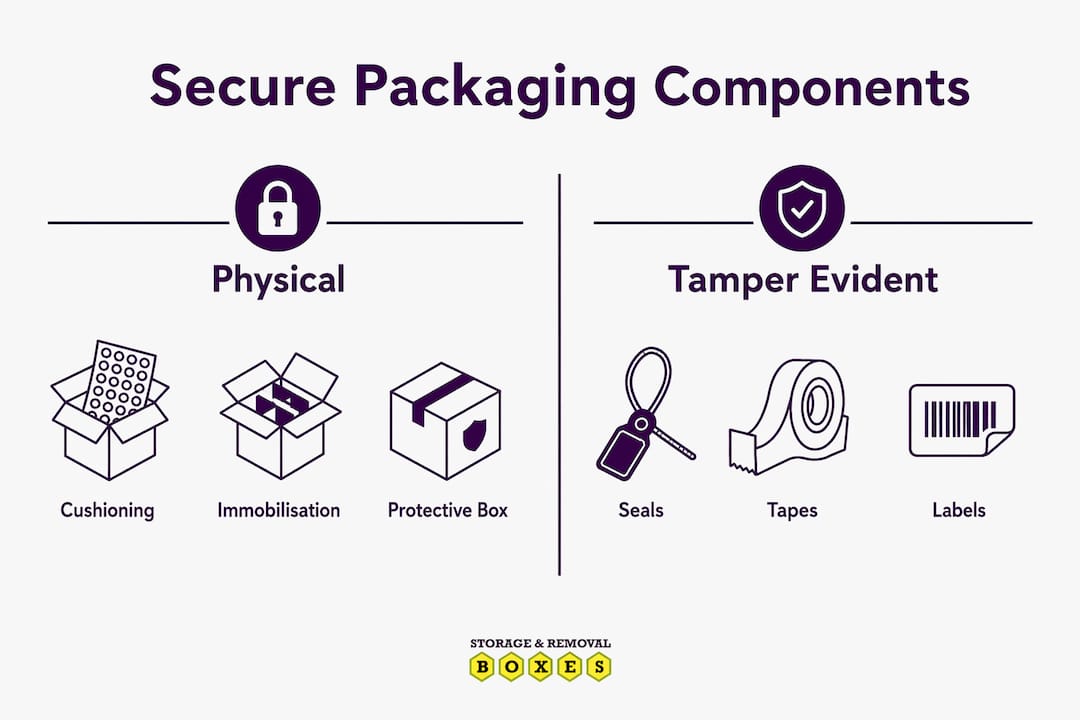
Secure packaging draws on two broad categories of protection: physical cushioning and tamper-evident controls. Both are necessary, and neither is sufficient on its own.
Physical cushioning and immobilisation
Custom packaging inserts are custom-fitted supports inside a box that keep products secure during shipping by absorbing shock and immobilising items. Even slight shifting transfers impact energy directly to the product, which is why accurately sized inserts and void fill are the primary defence against transit damage. Bubble wrap, foam padding, and moulded inserts all serve this function, but the key is fit. A product that moves inside its box will sustain damage regardless of how strong the outer carton is.

For fragile household items, protecting fragile items with bubble wrap correctly means wrapping each item individually, filling all void space, and using a box sized to the contents rather than the largest box available. Oversized boxes are one of the most common causes of transit damage because they allow movement.
Tamper-evident controls
According to Racklify’s framework, the four pillars of tamper-evident packaging are tapes, bags, labels, and seals. Each addresses a specific vulnerability:
- Tapes secure carton closures and show visible voiding or tearing if removed
- Bags fully enclose products and display clear evidence of opening
- Labels communicate provenance and show tamper evidence when peeled
- Seals secure secondary containers such as drums, bottles, or transit cases
The power of this system lies in combination. Tapes address carton closures; bags fully enclose; labels communicate provenance; seals secure secondary containers. Their combination across the supply chain reduces vulnerabilities at every stage from outbound boxing through to receipt.
Pro Tip: When selecting tamper-evident tape, choose a product with a printed void message or pattern that activates on removal. Generic brown parcel tape leaves no evidence of interference and provides no security value whatsoever.
How does tamper-evident packaging differ from tamper-resistant and tamper-proof?
This distinction matters because the terms are frequently misused, and choosing the wrong type for your application leads to false confidence.
| Term | Definition | Realistic expectation |
|---|---|---|
| Tamper-evident | Shows visible signs if opened or altered | Detects interference; does not prevent it |
| Tamper-resistant | Makes unauthorised access harder | Slows interference; may not show visible evidence |
| Tamper-proof | Impossible to open without detection or destruction | Largely unrealistic in practice |
The FDA defines a tamper-evident package as one with one or more indicators or barriers to entry which, if breached or missing, can be expected to provide visible evidence to consumers. This is a detection standard, not a prevention standard. The goal is not to stop tampering entirely. The goal is to ensure tampering cannot go unnoticed.
Tamper-resistant packaging, such as child-resistant caps or reinforced closures, adds friction to the process of gaining access. It is appropriate where the risk is accidental opening or opportunistic interference. Tamper-proof, as a claim, is largely unrealistic. Given sufficient time and tools, virtually any packaging can be opened. Any supplier making an absolute tamper-proof claim deserves scepticism.
For most removal, storage, and general logistics applications, tamper-evident is the appropriate standard. It creates accountability, deters casual interference, and provides clear evidence if a dispute arises.
How to ensure package security for fragile items
Applying secure packaging techniques effectively requires matching your materials to the specific risks your goods face during transit and storage. The following steps apply whether you are packing a single fragile item or preparing a commercial consignment.
Assess the fragility and handling risk. Glassware, ceramics, and electronics require firm immobilisation and shock absorption. Documents and soft goods need moisture and tamper protection more than cushioning. Match your materials to the actual risk rather than using the same approach for everything.
Choose the right outer box. A double-wall corrugated box provides significantly more resistance to compression and impact than single-wall alternatives. For heavy or high-value items, double-wall removal boxes are the correct starting point, not an upgrade.
Immobilise the contents completely. Use foam inserts, bubble wrap, or crumpled paper to fill all void space. The contents should not move when the sealed box is shaken. If they do, add more cushioning before sealing.
Apply tamper-evident tape at all closure points. Generic packing tape is completely ineffective as a security solution. Purpose-designed tamper-evident tape fails visibly and consistently, providing clear evidence of interference. Apply it across all flaps and seams, not just the centre join.
Add labels and seals for high-value or sensitive contents. A security label applied over a box flap or a sealed bag inside the outer carton adds a second layer of tamper evidence. If the outer tape is compromised, the inner seal provides a second indicator.
Document the packed state. For commercial shipments or high-value moves, photograph the sealed package before dispatch. This creates a baseline record that supports any damage or tampering claim.
Pro Tip: For fragile items in storage rather than transit, foam edge and corner guards protect against the compression damage that occurs when boxes are stacked. Tamper-evident tape is less relevant here, but physical protection remains critical.
What regulations and standards govern secure packaging?
Regulatory requirements for secure packaging vary by sector, but the FDA’s framework under 21 CFR 211.132 and the Food Safety Modernisation Act (FSMA) provides the most widely referenced standard for tamper-evident requirements.
Under FDA rules, compliant tamper-evident packaging must include an indicator or barrier, be distinctive by design, include identifying characteristics, and survive reasonable manufacture and distribution conditions. This is a system-level requirement, not a single-component test. Compliance verification involves checking multiple packaging components and processes together, not just individual seals.
Key regulatory principles that apply broadly across sectors include:
- Packaging must provide visible evidence of tampering, not merely resist it
- Security features must be distinctive enough that consumers can recognise a breach
- Features must survive normal handling throughout the distribution chain
- For food and pharmaceutical products, labelling must reference the tamper-evident feature
For removal companies, storage facilities, and individual consumers in the UK, there is no single mandatory standard equivalent to the FDA’s pharmaceutical rules. However, safe transit standards for storage boxes and industry best practice from logistics bodies provide a practical framework. The underlying principle is consistent: packaging must make damage and interference visible, not merely claim to prevent it.
International shipments introduce additional considerations. Some markets require specific tamper-evident features for customs compliance, and certain product categories carry their own sector-specific requirements. For most domestic UK removals and storage, the practical standard is straightforward: use materials that show clear evidence of interference and provide adequate physical protection for the contents.
Key takeaways
Secure packaging is a layered system combining physical cushioning and tamper-evident controls, and no single component delivers both functions adequately on its own.
| Point | Details |
|---|---|
| Secure packaging is a system | It combines cushioning, tamper-evident tape, seals, and labels working together, not a single product. |
| Tamper-evident is not tamper-proof | The goal is to make interference visible, not to make it impossible. |
| Immobilisation prevents most damage | Contents that cannot move inside a box cannot sustain transit damage from impact or vibration. |
| Generic tape provides no security | Purpose-designed tamper-evident tape is required to provide visible evidence of interference. |
| Regulations focus on detection | FDA and equivalent standards require visible evidence of tampering, not absolute prevention. |
The part most people get wrong about secure packaging
Adrian’s perspective
After years of working with packaging materials across removal, storage, and commercial logistics contexts, the single most persistent mistake I see is treating secure packaging as a product purchase rather than a system decision.
People buy a roll of bubble wrap and consider the job done. Or they apply a single strip of tape down the centre of a box and assume it is sealed. Neither approach addresses the actual risk. A box can be opened, repacked, and resealed with standard tape in under two minutes, leaving no visible evidence. That is not secure packaging. That is just a closed box.
The tamper-proof myth compounds this. I have seen commercial clients specify “tamper-proof” packaging in procurement briefs, which is an impossible standard. What they actually need is tamper-evident packaging that creates accountability at every handover point. The distinction matters because it changes what you buy and how you apply it.
The other underappreciated factor is the interior. Most transit damage does not come from external impact to the box. It comes from the contents moving inside the box and striking each other or the walls. A double-wall box with no internal cushioning offers less real protection than a single-wall box packed correctly with foam inserts and void fill.
My practical advice: start with the contents, not the box. Assess what can move, what can break, and what needs to show evidence of interference. Then build your packaging system outward from those requirements. The role of professional packing in storage and removal contexts consistently demonstrates that method matters more than materials alone.
Protect your goods with the right materials from Storageremovalboxes
Storageremovalboxes stocks everything you need to build a genuinely secure packaging system for house moves, self-storage, and commercial logistics. The range includes large double-wall removal boxes built to withstand stacking and transit pressure, alongside bubble wrap rolls, foam corner guards, and printed fragile warning tape. For tamper-evident applications, the printed parcel sealing tape provides a visible security layer at every closure point. All products are available with nationwide UK delivery, and the team can advise on the right combination of materials for your specific packing requirements.
FAQ
What is the simplest definition of secure packaging?
Secure packaging is a layered system of physical and tamper-evident controls that protects products from damage and makes unauthorised access immediately visible. It combines cushioning, tamper-evident tape, seals, and labels to address both physical and security risks.
Is tamper-evident the same as tamper-proof?
No. Tamper-evident packaging shows visible signs if it has been opened or altered, while tamper-proof packaging is largely unrealistic in practice. The FDA defines tamper-evident packaging as providing visible evidence of a breach, not preventing one entirely.
What types of secure packaging are best for fragile items?
Double-wall corrugated boxes combined with foam inserts, bubble wrap, and tamper-evident tape provide the most effective protection for fragile items. The key is immobilising the contents completely so they cannot move during transit.
Do I need to follow regulations for secure packaging in the UK?
For most domestic removals and storage, there is no single mandatory UK standard equivalent to FDA pharmaceutical rules. However, industry best practice and logistics guidelines recommend tamper-evident features and adequate cushioning for any goods of value.
Why is generic packing tape not secure?
Generic packing tape can be removed and reapplied without leaving visible evidence of interference. Purpose-designed tamper-evident tape is engineered to fail visibly when removed, providing a clear indicator that a package has been accessed.