UK packaging regulations explained: 2026 rules for businesses

What are UK packaging regulations and who must comply?
UK packaging regulations are legal obligations under the Producer Responsibility Obligations (Packaging and Packaging Waste) Regulations 2024, requiring businesses that supply or import packaging to register, report data, and fund waste management costs. The rules apply if your organisation has an annual turnover of £1 million or more and was responsible for more than 25 tonnes of packaging in the previous calendar year.
The definition of “producer” is broader than most businesses expect. It covers:
- Brand owners supplying packaged goods under their own name
- Importers bringing packaged products into the UK
- Packers and fillers placing goods into packaging
- Online marketplace operators
- Businesses hiring or loaning reusable packaging
- Suppliers of empty packaging
Multiple parties in the same supply chain can hold obligations for the same packaging, but the framework prevents double counting. Charities are generally exempt unless they act as reprocessors or exporters of packaging waste.
Small producers (£1m–£2m turnover, or 25–50 tonnes) face lighter duties than large producers (£2m+ turnover and 50+ tonnes), though both must register and report.

Table of Contents
- Registration, reporting, and your financial obligations
- What does packaging design law require?
- How the 2024 rules differ from previous packaging legislation
- How the regulations drive sustainability and corporate responsibility
- How packaging rules interact with other UK environmental legislation
- Key takeaways
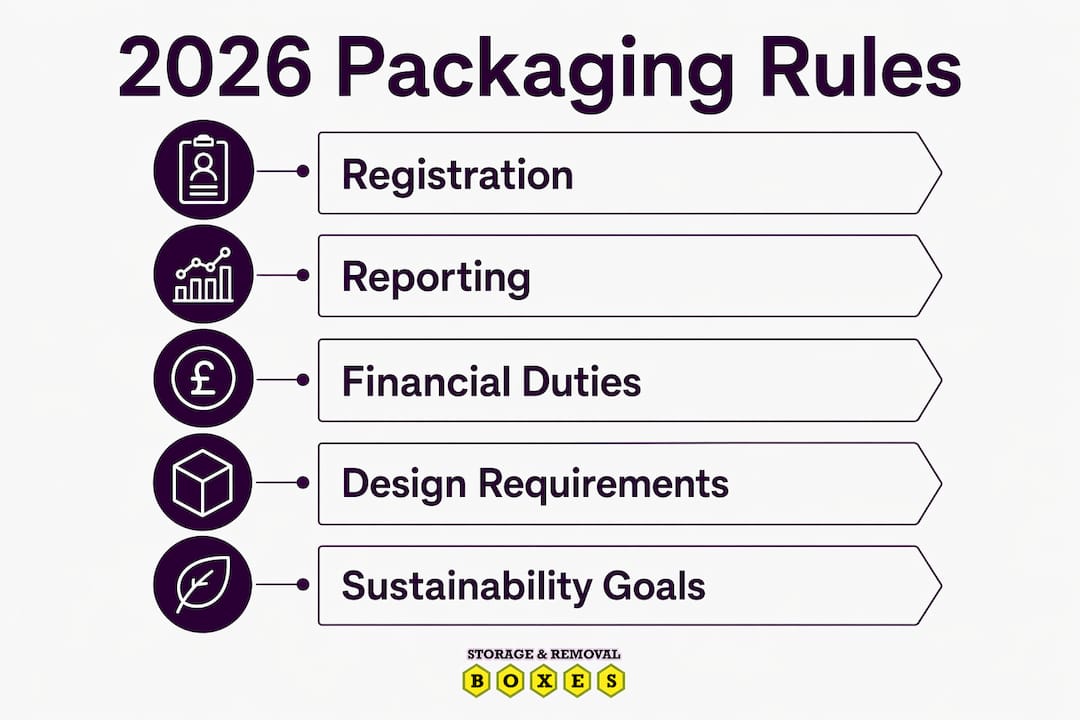
Registration, reporting, and your financial obligations
Compliance with UK packaging laws follows a clear sequence of administrative and financial steps.
- Register with your relevant environmental regulator, such as the Environment Agency, Natural Resources Wales, the Northern Ireland Environment Agency, or the Scottish Environment Protection Agency.
- Report packaging data covering material type, weight, packaging class (primary, secondary, tertiary, or shipment), and nation data showing where packaging is supplied and discarded. Large producers submit data every six months; small producers report annually.
- Pay waste disposal fees for household packaging. Since October 2025, fees are invoiced annually based on material type and tonnage. Plastic attracts £423 per tonne; glass £192 per tonne; paper and card £196 per tonne.
- Purchase PRNs and PERNs. Large producers must buy Packaging Recovery Notes from accredited reprocessors and Packaging Export Recycling Notes from accredited exporters as evidence of recycling. Each note is material-specific and cannot substitute for another material’s obligation.
- Meet recycling targets set for each material through 2027. Recycling targets for plastic and steel are set to increase gradually through 2027, reflecting rising performance goals though exact percentages are not cited here.
- Observe the 2027 labelling deadline. Consumer recycling labels such as “Recycle” or “Do not recycle” become mandatory by April 2027.
Compliance schemes can handle registration, data reporting, and PRN/PERN procurement on your behalf, but cannot pay waste disposal fees or discharge your direct legal liability. Non-compliance can result in fines, compliance orders, and civil sanctions.
Pro Tip: Start collecting packaging data by material type and weight now, even if your reporting deadline is months away. Gaps in historical data are the most common reason businesses miss their first submission.
What does packaging design law require?
Packaging must meet minimum weight and volume for product safety, and heavy metal concentrations of cadmium, mercury, lead, and hexavalent chromium must not exceed 100 parts per million. Recyclable packaging must be designed so a defined percentage of its materials can actually be recycled. Packaging intended for composting must be biodegradable, while packaging designed for energy recovery must contain at least 50% organic combustible materials such as paper or wood. Reusable packaging must withstand multiple uses before meeting end-of-life recovery requirements. For businesses sourcing durable packaging materials, these design criteria directly affect which products you can legally place on the UK market.
How the 2024 rules differ from previous packaging legislation
The original UK packaging regime dated from 1997 and required producers to fund only a share of recycling costs. The 2024 Regulations replace that with full net cost responsibility, meaning obligated businesses now cover the entire lifecycle cost of packaging waste management: collection, sorting, transport, and recycling or disposal. This is a structural shift, not a minor update. The 1997 rules also lacked mandatory consumer labelling requirements; the April 2027 deadline for “Recycle” or “Do not recycle” labels is entirely new. Waste disposal fees invoiced from October 2025 are likewise a new financial mechanism with no equivalent under the old framework. Businesses that assumed their previous compliance arrangements still hold are likely exposed.
How the regulations drive sustainability and corporate responsibility
The 2024 framework is designed to push producers toward sustainable packaging practices by making the environmental cost of poor packaging choices financially visible. Full net cost responsibility means that a business choosing difficult-to-recycle materials pays more in waste disposal fees than one choosing recyclable alternatives. Recycling targets escalate annually through 2027 across all material categories, creating a built-in incentive to reduce packaging weight and improve recyclability. The consumer labelling mandate reinforces this by making recyclability a front-of-pack claim that businesses must be able to substantiate.
How packaging rules interact with other UK environmental legislation
The 2024 Regulations sit within a wider framework of UK environmental law. The Plastic Packaging Tax, introduced under the Plastic Packaging Tax (General) Regulations 2022, applies a charge on plastic packaging with less than 30% recycled content, operating independently of EPR fees. The Deposit Scheme for Drinks Containers (England and Northern Ireland) Regulations 2024 creates a separate return mechanism for eligible drinks containers. The Separation of Waste (England) Regulations 2025 govern how businesses must segregate waste streams, affecting how packaging waste is collected and counted. Understanding industry packing standards alongside these overlapping rules helps businesses avoid gaps in compliance across all relevant obligations.
Key takeaways
The Producer Responsibility Obligations (Packaging and Packaging Waste) Regulations 2024 impose full net cost responsibility on UK businesses supplying or importing over 25 tonnes of packaging with a turnover of £1 million or more.
| Point | Details |
|---|---|
| Obligation thresholds | Applies to businesses with £1m+ turnover and 25+ tonnes of packaging supplied or imported annually. |
| Full net cost model | Producers fund collection, sorting, and recycling costs, not just a share as under the 1997 rules. |
| Waste disposal fees | Large producers pay material-specific fees invoiced from October 2025, e.g. £423 per tonne for plastic. |
| PRNs and PERNs | Large producers must purchase recycling notes per material; excess in one material cannot offset another. |
| April 2027 labelling | Consumer recycling labels become mandatory, requiring packaging design decisions to be made now. |