Why use removal boxes for a safer, easier move in 2026

Moving house ranks among life’s most stressful events, yet many UK homeowners and renters underestimate how much the right packing materials matter. Using purpose-made removal boxes reduces the likelihood of damage during a move by 35% compared to reused containers. Purpose-built removal boxes offer superior protection, organisation and efficiency that standard boxes simply cannot match. This guide explains why investing in proper removal boxes transforms your moving experience from chaotic to controlled.
Table of Contents
- Introduction To Removal Boxes
- Durability And Protection: How Removal Boxes Safeguard Your Belongings
- Efficiency And Organisation: Maximising Space With Removal Boxes
- Environmental Impact: The Sustainable Choice Of Removal Boxes
- Cost And Practicality: Why Removal Boxes Make Financial Sense
- Common Misconceptions: What Most People Get Wrong About Removal Boxes
- Industry Endorsements And Best Practices For Removal Boxes
- Conclusion And Practical Tips For Choosing Removal Boxes
- Choose The Right Removal Boxes For Your 2026 Move
- Frequently Asked Questions
Key takeaways
| Point | Details |
|---|---|
| Protection | Double-walled construction and reinforced features significantly reduce damage to belongings during transport. |
| Efficiency | Standardised sizes improve stacking stability and can speed up packing by nearly 30%. |
| Sustainability | Made from recyclable materials with recycling rates exceeding 80%, reducing environmental impact. |
| Cost savings | Durable construction enables reuse and bulk purchasing reduces per-box costs substantially. |
| Common myths | Not all cardboard boxes offer equal protection; removal boxes meet strict British standards. |
Introduction to removal boxes
Removal boxes represent a specialised category of packaging designed explicitly for the demands of house moves. Unlike flimsy grocery store boxes or generic cardboard containers, removal boxes feature double-walled corrugated cardboard construction that provides exceptional strength and durability.
The fundamental difference lies in engineering and quality control. Removal boxes undergo stricter strength tests and meet British Standards BS EN 13590, unlike generic boxes that lack consistent specifications. This certification ensures each box can withstand the rigours of professional handling, stacking, and transport without compromising structural integrity.
Materials matter significantly. Quality removal boxes use recycled cardboard manufactured to precise thickness and flute specifications, creating layers that absorb impacts and distribute weight evenly. This construction prevents the crushing and corner collapse common with single-wall boxes.
Standardised dimensions distinguish removal boxes from makeshift alternatives:
- Small boxes typically measure 457x330x330mm, ideal for books and heavy items
- Medium boxes around 457x457x508mm suit general household goods
- Large boxes reaching 610x457x457mm accommodate lighter, bulkier items
- Extra-large boxes up to 760x460x460mm handle bedding and lampshades
These consistent sizes enable efficient stacking in removal vans, maximising space utilisation and reducing the number of trips required. Professional removal companies prefer working with standardised boxes because they create stable, secure loads that minimise shifting during transit.
Removal box packs often bundle various sizes together, providing a complete solution tailored to different room types and item categories. This pre-planned approach eliminates guesswork and ensures you have appropriate containers for every possession. Complete removal kits extend this convenience further by including packing tape, bubble wrap, and markers alongside boxes.
Durability and protection: how removal boxes safeguard your belongings
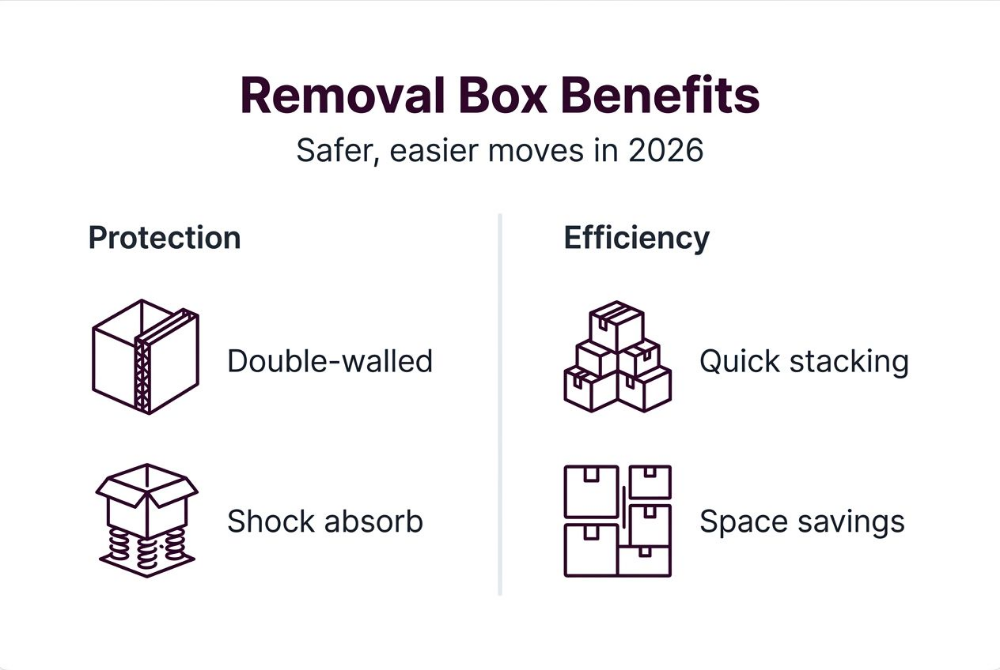
The construction methods behind removal boxes deliver tangible protection advantages that justify their purpose-built design. Double-walled construction and reinforced features significantly reduce damage risk during transport, addressing the primary concern for anyone moving valuable or fragile possessions.
Double-walled cardboard consists of two layers of corrugated material bonded together, creating superior shock absorption compared to single-wall alternatives. When boxes experience impacts from loading, stacking, or vehicle movement, these dual layers distribute force across a wider area rather than concentrating stress at a single point. This engineering principle prevents punctures and crushing that would compromise contents.
Reinforced corners represent another critical design element. Standard boxes often fail at corners where edges meet, creating weak points vulnerable to tearing under weight. Quality removal boxes incorporate additional cardboard flaps or triangular reinforcements at corners, maintaining structural integrity even when stacked five or six boxes high. Bases receive similar treatment, with overlapping flaps that distribute weight evenly and prevent bottom dropout when lifting heavy loads.
Specialised configurations address specific protection needs:
- Wardrobe boxes feature built-in hanging rails for garments
- Dish pack boxes include cell dividers separating fragile items
- Picture boxes offer adjustable lengths for artwork and mirrors
- Book boxes use smaller dimensions to prevent overloading
These purpose-designed features eliminate the need for excessive padding whilst providing targeted protection where items need it most. A dish pack’s cardboard dividers, for instance, prevent plates from sliding and clashing during transport far more effectively than randomly stuffed newspaper.
The protection features of removal boxes work synergistically with proper packing techniques. Combining reinforced construction with appropriate cushioning materials creates comprehensive protection systems that keep belongings safe through every stage of a move.
Pro Tip: Always pack heavier items in smaller boxes to maintain manageable lifting weight whilst preventing box failure from excessive load concentration.
Efficiency and organisation: maximising space with removal boxes
Standardised dimensions transform chaotic packing into systematic organisation. Using standard-sized removal boxes can speed up packing and unpacking by nearly 30% by eliminating size-related decision paralysis and enabling intuitive spatial planning.
Consistent box sizes create predictable stacking patterns that maximise removal van capacity. Professional movers can calculate exactly how many boxes fit in specific van configurations, reducing wasted space and unnecessary trips. This precision contrasts sharply with mismatched boxes that leave awkward gaps and require constant reorganisation to achieve stable loads.
The efficiency benefits extend throughout the moving process:
- Packing becomes faster when you know which box size suits each item category
- Loading proceeds smoothly with uniform boxes that stack reliably
- Unloading simplifies as standardised shapes fit through doorways consistently
- Unpacking accelerates when room labels clearly identify box destinations
Clear labelling systems work best with uniform boxes. When all containers look similar, detailed labels become essential navigation tools rather than optional extras. Writing room names, contents summaries, and handling instructions on multiple sides ensures visibility regardless of stacking orientation.
| Box Size | Best Uses | Typical Items | Stacking Capacity |
|---|---|---|---|
| Small | Heavy, dense items | Books, tools, canned goods | Up to 8 boxes high |
| Medium | General household | Kitchen items, toys, electronics | Up to 6 boxes high |
| Large | Lightweight bulk | Bedding, pillows, lampshades | Up to 4 boxes high |
| Wardrobe | Hanging garments | Clothes on hangers | 2-3 boxes high |
Volume optimisation matters financially. Fewer van trips mean lower fuel costs and reduced labour hours for professional movers. Self-movers benefit equally, as efficient packing minimises the number of hire van days required.
Removal box packs pre-calculate quantities based on property size, removing another layer of planning complexity. A two-bedroom flat pack might include 20 medium boxes, 10 small, and 5 large, providing appropriate distribution without requiring individual purchasing decisions.
Pro Tip: Colour-code boxes by room using marker pens or coloured labels, allowing removal teams to place boxes in correct destinations without reading detailed labels on each container.
Environmental impact: the sustainable choice of removal boxes
Sustainability concerns increasingly influence purchasing decisions, and removal boxes offer compelling environmental advantages over alternatives. Removal boxes have high recyclability rates and reduce waste compared to non-recyclable materials like plastic crates, supporting eco-conscious moving practices.
Cardboard recycling infrastructure across the UK operates efficiently, with collection systems accepting corrugated boxes in standard household recycling. Recycling rates for cardboard packaging exceed 80% nationally, meaning the vast majority of removal boxes enter circular economy loops rather than landfills. This contrasts with plastic storage containers that often end up in general waste when damaged or no longer needed.
Manufacturing processes for quality removal boxes increasingly incorporate recycled content. Many products contain 70-90% recycled cardboard fibres, reducing demand for virgin materials and lowering overall environmental footprint. The production energy required for recycled cardboard is substantially lower than manufacturing plastic alternatives from petroleum-based feedstocks.
Waste reduction extends beyond recyclability:
- Reusable for multiple moves or long-term storage when kept dry
- Biodegradable if disposal becomes necessary, breaking down naturally
- Lightweight construction reduces transport fuel consumption
- Flat-pack storage minimises space requirements between uses
The removal boxes sustainability profile improves further when considering the entire product lifecycle. Manufacturing cardboard requires fewer toxic chemicals than plastic production, and end-of-life disposal creates less environmental harm even when recycling isn’t possible.
| Material | Recyclability | Reusability | Production Impact | Biodegradability |
|---|---|---|---|---|
| Removal boxes | 80%+ recycled | Multiple moves | Lower energy | Yes, 6-12 months |
| Plastic crates | Limited facilities | High durability | Petroleum-based | No, 500+ years |
| Reused grocery boxes | Variable quality | Single use typically | Already produced | Yes, inconsistent |
Choosing cardboard removal boxes over plastic alternatives demonstrates environmental responsibility without sacrificing functionality. The temporary nature of moving makes disposable-but-recyclable boxes more logical than durable plastic that most people store indefinitely or discard after single use.
Cost and practicality: why removal boxes make financial sense
Investing in proper removal boxes delivers measurable financial returns through damage prevention, time savings, and reuse potential. Durable removal boxes lead to fewer replacements, and bulk purchasing offers significant savings that offset initial costs quickly.
Damage prevention provides the most substantial cost benefit. A single broken television, shattered mirror, or cracked heirloom can cost hundreds of pounds to replace. Removal boxes engineered for protection reduce these loss risks substantially compared to makeshift containers. The 35% damage reduction achieved through proper boxes translates directly into preserved item value.
Bulk purchasing transforms per-unit economics favourably:
- Individual boxes might cost £2-3 each
- Ten-box bundles reduce per-box cost by 15-20%
- Complete house packs offer 25-30% savings versus individual purchases
- Commercial quantities for larger moves provide even deeper discounts
Time efficiency contributes indirect financial value. Faster packing means fewer days off work for self-movers or reduced labour hours for professional services. The 30% packing speed improvement from standardised boxes can save several hours on a typical house move, worth £100-200 in labour costs or personal time value.
Reuse potential extends value considerably. Quality removal boxes withstand multiple moves when stored properly in dry conditions. Keeping boxes for future moves, lending to friends or using for long-term storage in lofts or garages multiplies the return on initial investment. Even selling used boxes to others planning moves recovers partial costs.
The removal box packs cost-effectiveness becomes apparent when comparing total moving costs. Spending £50-100 on proper boxes represents just 2-5% of typical removal service costs, yet significantly improves the entire process quality and reduces damage risk worth far more.
Pro Tip: Calculate box quantities by room rather than total items, estimating 5-7 medium boxes per bedroom, 8-10 for kitchens, and 3-5 for bathrooms to avoid shortages mid-pack.
Common misconceptions: what most people get wrong about removal boxes
Several persistent myths about removal boxes lead people toward inadequate solutions that increase damage risk and moving difficulty. Not all boxes have the same strength; some assume plastic crates are always better, which isn’t true, revealing common misunderstandings worth addressing directly.
The cardboard equality myth suggests any cardboard box provides similar protection. In reality, construction quality varies enormously between grocery store boxes, standard shipping containers, and purpose-built removal boxes. Single-wall boxes lack the cushioning and structural integrity needed for stacked transport, whilst removal boxes meeting BS EN 13590 standards undergo specific testing for moving scenarios.
Plastic crate superiority represents another misconception. Whilst plastic offers durability, hard surfaces transmit shocks directly to contents without cardboard’s cushioning properties. Fragile items require additional padding inside plastic crates, negating their apparent simplicity. Weight becomes problematic too as empty plastic crates are heavier than cardboard equivalents, reducing how much you can pack whilst staying within safe lifting limits.
The free box assumption tempts many movers toward supermarket castoffs and online marketplace giveaways. These boxes served different purposes originally, with designs optimised for product display or single-journey shipping rather than multiple handling stages. Previous use weakens cardboard fibres, and unknown contents history might include moisture damage or pest exposure.
Reinforcement feature underestimation causes people to select boxes based solely on external dimensions without considering structural elements:
- Base construction quality determines whether bottoms hold under weight
- Corner reinforcement affects stacking stability and crush resistance
- Handle cutouts reduce structural integrity unless properly positioned
- Wall thickness directly correlates with protection levels
The removal boxes myths persist partly because adequate boxes sometimes survive moves, creating false confidence in substandard solutions. The risk becomes apparent only when damage occurs, making prevention through proper boxes the wiser approach.
Industry endorsements and best practices for removal boxes
Professional removal companies and industry bodies provide authoritative guidance on box selection and usage that homeowners should follow. UK removal companies recommend removal boxes compliant with BS EN 13590 for strength and durability, establishing clear quality benchmarks.
The British Association of Removers emphasises standardised boxes that facilitate efficient van loading and stable stacking during transport. Professional movers prefer working with uniform containers because consistent dimensions enable secure load building that prevents shifting and reduces damage risk. Random box sizes create unstable loads requiring constant readjustment.
Best practice recommendations from industry experts include:
- Use small boxes exclusively for books and heavy items to prevent overloading
- Reserve large boxes for lightweight, bulky items like bedding and soft furnishings
- Apply reinforced or compartmented boxes for all fragile items including glassware and electronics
- Pack boxes to capacity, filling gaps with padding to prevent internal movement
- Keep box weights below 15kg for safe manual handling
- Label boxes on top and at least two sides for visibility when stacked
Fragile item protection requires specialised approaches. Dish pack boxes with built-in dividers prevent plate stacking damage far more effectively than improvised newspaper padding in standard boxes. Similarly, wardrobe boxes with hanging rails protect garments from crushing whilst eliminating folding labour.
Weight distribution principles matter enormously. Professional packers place heavier items at box bottoms and lighter items on top, creating stable centres of gravity that prevent toppling when stacked. They also avoid mixing heavy and light items within single boxes, as this creates unbalanced loads difficult to handle safely.
Quality removal box kits incorporate these professional standards by bundling appropriate box types with necessary packing materials. Following industry-endorsed practices transforms amateur packing into professional-grade protection.
Conclusion and practical tips for choosing removal boxes
Removal boxes deliver measurable advantages across protection, efficiency, sustainability, and cost-effectiveness that justify their purpose-built design. The 35% damage reduction alone makes them worthwhile, whilst time savings, environmental benefits, and reuse potential provide additional value.
Selecting appropriate boxes requires matching sizes and strengths to your specific belongings. Heavy items demand small boxes with reinforced bases, whilst fragile possessions benefit from specialised compartmented designs. General household goods suit medium boxes that balance capacity with manageable weight.
Supplementary materials enhance box effectiveness significantly:
- Bubble wrap cushions fragile items against impacts and vibration
- Packing paper fills gaps preventing internal movement
- Strong packing tape reinforces seams and prevents opening during transit
- Permanent markers enable clear, weather-resistant labelling
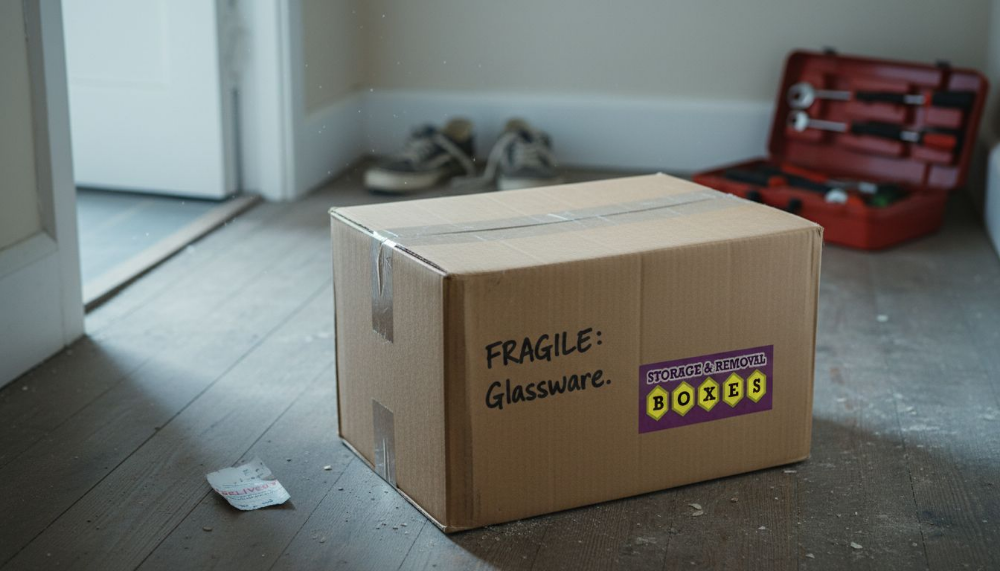
Labelling systems should identify room destinations, general contents, and handling requirements. Writing “Kitchen” and “Fragile - Glassware” on multiple sides ensures visibility regardless of stacking orientation. Number boxes sequentially and maintain inventory lists for valuable items.
Strategic packing sequences improve efficiency. Pack non-essential items first, leaving daily-use belongings until moving day approaches. Group similar items together rather than mixing room contents, simplifying unpacking and room setup at your destination.
Removal box packs eliminate quantity estimation challenges by providing pre-calculated assortments based on property size. These bundles ensure you have appropriate variety without excess or shortage.
Pro Tip: Photograph valuable items before packing and keep essential documents in a separate bag you carry personally rather than packing in boxes that might be misplaced during the move chaos.
Choose the right removal boxes for your 2026 move
Preparing for your move requires reliable, purpose-built packaging that protects belongings whilst streamlining the entire process. Our large double wall removal boxes offer exceptional strength for bulky items, with reinforced construction that withstands the demands of professional and DIY moves alike.

Complete removal box packs provide convenient, cost-effective solutions tailored to property sizes from studio flats to four-bedroom houses. These curated bundles include optimal size distributions that eliminate guesswork whilst offering substantial savings versus individual box purchases. For comprehensive moving preparation, explore our removal box kits that bundle boxes with essential packing materials including bubble wrap, tape, and markers, ensuring you have everything needed for a successful, damage-free move.
Frequently asked questions
How do removal boxes differ from regular cardboard boxes?
Removal boxes use double-walled, stronger cardboard meeting British Standards BS EN 13590, unlike standard single-wall boxes designed for lighter duty. They feature reinforced corners and bases specifically engineered for stacking and repeated handling during moves. Standard boxes lack these protective elements and consistent quality specifications. Learn more about removal boxes differences.
Can removal boxes be reused for future moves or storage?
Yes, durable removal boxes withstand multiple moves when stored properly in dry conditions, adding significant value over time. Their robust construction supports reuse far better than typical cardboard boxes that weaken after single use. Many homeowners keep boxes for years, using them for seasonal storage between moves. Discover reusable removal boxes options.
Are removal boxes suitable for all types of household items?
Removal boxes come in varieties specifically tailored for fragile, bulky, or general household items, ensuring appropriate protection for diverse possessions. Specialised boxes with compartments and extra padding work best for delicate items like glassware and electronics. Standard boxes suit general household goods, whilst reinforced large boxes handle lightweight bulk items safely. Explore removal boxes for fragile items.
How do removal boxes help in reducing the environmental impact of moving?
Made largely from recyclable materials with recycling rates exceeding 80%, removal boxes reduce waste compared to plastic crates that rarely enter recycling streams. Their ability to be reused for multiple moves or storage purposes extends product lifecycles significantly. Cardboard biodegrades naturally if disposal becomes necessary, unlike plastic alternatives that persist for centuries. See removal boxes environmental benefits.