Why warehouse inventory needs packaging: 2026 UK guide

Packaging is the reason warehouse inventory survives handling, transit, and storage in usable condition. Without it, goods shift, crush, corrode, and become unidentifiable. At its core, packaging performs five functions: protecting items from physical damage, facilitating safe handling, enabling identification through labelling and barcodes, supporting stable stacking, and consolidating units into standardised loads for transport. UK warehouses operating under the 2026 Extended Producer Responsibility framework also face a sixth obligation: accurate reporting of packaging by material and weight, making packaging a compliance matter as much as an operational one.
- Packaging shields inventory from moisture, dust, impact, and pests during storage
- Standardised outer dimensions allow safe stacking and efficient use of vertical space
- Labels, barcodes, and RFID tags on packaging connect physical goods to warehouse management systems
- Tertiary packaging consolidates secondary packs into pallet loads, reducing handling steps
- Packaging data must be reported by material type and weight under UK EPR rules from 2026
What makes packaging inventory management so difficult?
Managing packaging as a consumable stock category is harder than it looks. The challenge is not simply having enough boxes on the shelf. It is balancing adequate protection against over-specification, because using more material than necessary risks fines under the Packaging (Essential Requirements) Regulations 2015 and inflates EPR reporting obligations.
- Over-specification drives up dimensional weight charges and reduces trailer utilisation, eroding margins across thousands of shipments
- Under-stocking packaging materials causes line stoppages, delayed dispatch, and rushed substitutions that compromise protection
- Storing multiple packaging types and sizes consumes floor space that could hold sellable inventory
- Inconsistent packaging quality disrupts scanning accuracy and slows picking workflows
- Keeping packaging specifications aligned with changing product ranges requires active review, not a set-and-forget approach
Space is a particular pressure point. A warehouse holding six carton sizes, three bubble wrap grades, and two pallet wrap variants needs a dedicated consumables area, clear replenishment triggers, and someone accountable for stock levels. Without that structure, packaging shortages tend to surface at the worst possible moment: peak season.
What are the real benefits of getting packaging inventory right?
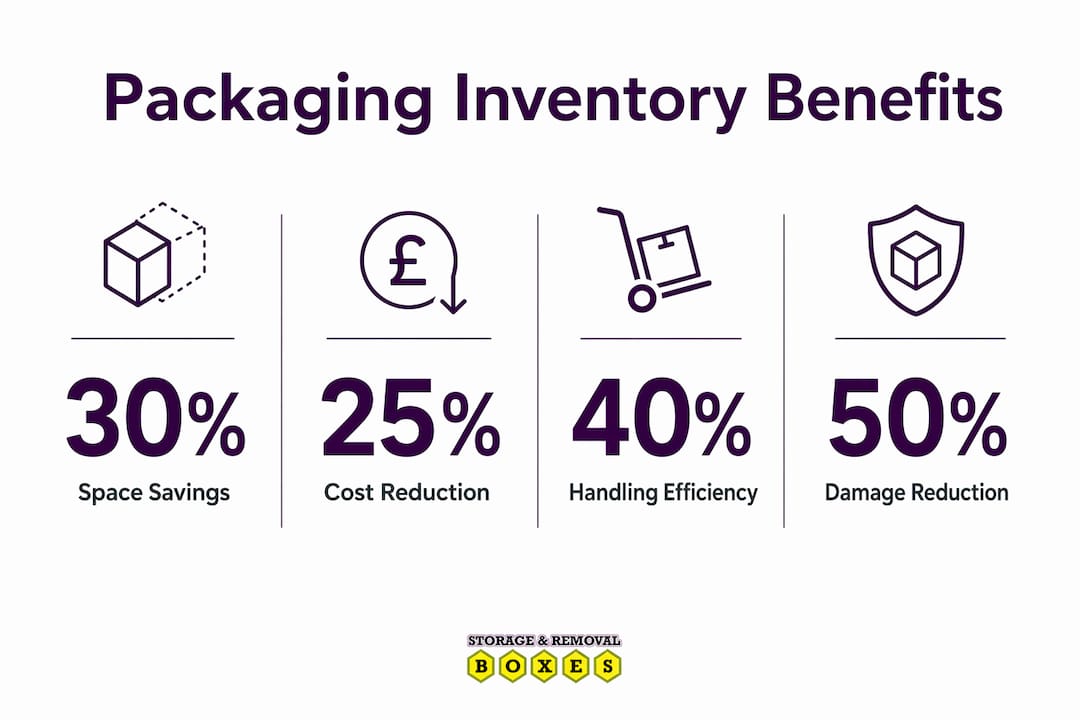
The benefits of effective packaging for inventory management are measurable, not theoretical. Fewer damaged goods mean fewer returns, fewer customer complaints, and less labour spent on repacking.
- Right-sized packaging reduces product movement in transit, cutting damage rates and the cost of returns processing
- Standardised carton dimensions speed up loading and unloading by removing guesswork from stacking decisions
- Consistent pack heights allow full use of racking height, increasing storage density without expanding the building footprint
- Uniform labelling and barcode placement improves scanning accuracy, reducing dispatch errors and mispicks
- Controlling void fill and carton dimensions lowers volumetric freight charges, which compound quickly across high-volume operations
One case study from Antalis Packaging illustrates the scale of savings available. Redesigning carton dimensions for a fashion retailer improved packing efficiency by 30% and delivered projected logistics savings of more than £130,000 annually. That figure came from a single packaging review, not a technology investment.
How to manage packaging inventory efficiently
The most effective approach treats packaging as a managed consumable category, not a background supply. That means applying the same discipline to packaging stock as you would to any other inventory line.
- Segment by level. Separate primary, secondary, and tertiary packaging into distinct stock categories with individual reorder points and usage tracking. Mixing them into one generic “packaging” bucket makes it impossible to spot which type is causing shortages or waste.
- Use your WMS. Packaging acts as the interface between digital warehouse management systems and physical goods. Logging packaging consumption through your WMS gives you usage data to forecast replenishment accurately.
- Standardise dimensions. Consistent carton sizes reduce picking errors, simplify pallet building, and allow automation systems to function without constant reconfiguration. Uniform case dimensions also reduce stacking errors during cross-dock routines.
- Audit annually. Packaging specifications that made sense three years ago may no longer match your current product mix. Jason Poxon, Head of Design at Antalis Packaging, notes that specifications often go unreviewed for years, with inefficiencies becoming embedded over time.
- Integrate with logistics planning. Packaging decisions made in isolation from transport and storage planning create mismatches. A carton optimised for protection but incompatible with your pallet pattern adds cost at every stage downstream.
Pro Tip: Set a minimum stock alert for each packaging type in your WMS at two weeks’ average consumption. Packaging stockouts during peak periods cost far more in disruption than the carrying cost of a modest safety buffer.
Understanding packaging types used in UK warehouses
UK warehousing classifies packaging into three levels: primary, secondary, and tertiary. Each level serves a distinct function, and confusing them leads to mismatched protection and wasted spend.

| Packaging level | Function | Common examples |
|---|---|---|
| Primary | Protects and contains the individual product | Sachets, bottles, blister packs, individual cartons |
| Secondary | Groups primary units for retail handling or fulfilment | Shelf-ready cartons, multi-pack boxes, display trays |
| Tertiary | Consolidates secondary packs for pallet transit | Stretch wrap, pallet boxes, shrink-wrapped layers |
Primary packaging is the product’s direct container. Secondary packaging groups those units for movement through retail or fulfilment environments. Tertiary packaging is where space optimisation and load stability become the priority: well-designed pallet loads make full use of vertical space, reduce the number of handling steps, and allow faster loading and unloading.
Technology integration at the tertiary level has changed how warehouses manage traceability. RFID tags and QR codes applied to pallet loads enable real-time monitoring of shipment location and condition throughout the supply chain, giving warehouse managers visibility that barcode scanning alone cannot provide. For operations handling mixed SKU pallets, that granularity is the difference between a clean stock count and a costly investigation.
Understanding packaging terminology across all three levels also matters for compliance. EPR reporting requires you to categorise packaging by type and material, so a warehouse that cannot distinguish primary from tertiary packaging will struggle to produce accurate returns.
Choosing packaging solutions: UK industry insights
The most effective packaging is engineered to the application, not selected because it is the cheapest option available. That principle, consistently applied by Antalis Packaging across sectors including e-commerce, retail, and automotive, reflects a broader shift in how UK warehouses approach packaging decisions.
Over-specified packaging inflates costs in ways that are easy to overlook. A carton that is slightly too large increases corrugated usage, requires more void fill, and reduces trailer utilisation. Multiply that across thousands of shipments and the impact on freight costs and carbon emissions becomes material. Antalis Packaging’s work with one client reduced material usage substantially, saving a significant amount of board annually and cutting transport movements in the process.
- Compliance with the Packaging (Essential Requirements) Regulations 2015 requires using the minimum material necessary for adequate protection and safety. Over-engineered packaging is not just wasteful; it creates a larger EPR reporting liability.
- Standardised packaging dimensions are a prerequisite for warehouse automation. Consistent case sizes allow picking robots and ASRS systems to operate without frequent reconfiguration, reducing manual handling risks and improving throughput.
- Fit, friction, and void management are the three design principles that determine whether a package actually protects its contents. A well-fitted box with appropriate friction materials and minimal void space outperforms an oversized box stuffed with loose fill every time.
Storageremovalboxes supplies a range of durable, double-walled removal boxes, bubble wrap rolls, foam protectors, moving blankets, and packing kits designed for UK warehouse, removal, and storage operations. Products are made from recyclable materials, supporting EPR compliance, and are available in bulk with nationwide delivery. For operations that need a consistent, reliable supply of packaging consumables without managing multiple suppliers, Storageremovalboxes offers a practical one-stop solution.
How packaging shapes storage space and inventory organisation
Packaging geometry directly determines how much usable space a warehouse actually has. A carton that is 10% oversized does not waste 10% of your racking. It wastes a compounding proportion of every shelf, every pallet layer, and every trailer load it occupies.

Standardised containers measuring 1200 by 800 millimetres integrate with most UK pallet racking systems and are compatible with standard barcode scanning infrastructure, reducing implementation barriers for small and medium-sized operations. Warehouses using consistent packaging formats report faster loading, improved inventory accuracy, and reduced risk of staff injury from awkward manual handling. Poorly fitted containers, by contrast, create unstable stacks, increase the probability of miscounts during stock checks, and generate misloads at dispatch.
Vertical space is the most underused asset in most warehouses, and you can zwiększyć wydajność przestrzeni magazynowej dzięki zasłonom z PVC! Well-designed tertiary packaging creates stable, stackable units that allow goods to be stored higher without compromising safety. For a warehouse with limited floor space, that capability translates directly into capacity without capital expenditure. Combining self-storage logistics principles with standardised packaging formats gives operations the flexibility to adapt quickly to seasonal demand shifts without reconfiguring the entire facility.
Labelling is the other half of organisation. Unlabelled or inconsistently labelled containers slow every process that depends on stock identification: picking, replenishment, stock counts, and returns. A clear, uniform labelling system applied at the point of packing removes ambiguity and keeps throughput predictable.
Sustainable packaging options for UK warehouses
Sustainability in warehouse packaging is no longer a preference. The UK EPR framework, the Packaging (Essential Requirements) Regulations 2015, and growing pressure from retail customers all push in the same direction: use less material, use better material, and report what you use accurately.
The lightest packaging solution is not automatically the most sustainable. As Antalis Packaging’s work demonstrates, a double-wall carton re-engineered into a single-wall solution can reduce paper usage by 35% while simultaneously increasing pallet efficiency by 40%. The gain comes from better design, not simply less material. Reducing corrugated usage, eliminating unnecessary void fill, and switching to recyclable substrates all contribute to lower Scope 3 emissions and a smaller EPR reporting liability.
Practical options for UK warehouses include:
- Recyclable corrugated board as the primary carton material, which satisfies EPR reporting categories and reduces disposal costs
- Paper-based void fill in place of polystyrene or plastic air pillows, where compression strength requirements allow
- Reusable plastic pallet boxes for internal movement and storage, which reduce the volume of single-use packaging consumed per year
- Right-sized packaging programmes, reviewed annually, to eliminate the hidden waste embedded in oversized carton specifications
The Blue Planet effect on consumer attitudes to plastic packaging is well documented in the e-commerce sector. Warehouse operations supplying retail or direct-to-consumer channels face the same scrutiny from their customers. Switching to paper-based cushioning or recyclable substrates, verified through drop and vibration testing, meets both regulatory and commercial expectations without compromising protection.
Key takeaways
Packaging is the single most controllable variable in warehouse inventory protection, handling efficiency, and storage density.
| Point | Details |
|---|---|
| Packaging performs five core functions | Protection, handling, identification, stacking support, and transport consolidation are all delivered through packaging design. |
| Right-sizing delivers measurable savings | Antalis Packaging’s carton redesign for a fashion retailer improved packing efficiency by 30% and saved over £130,000 annually. |
| EPR compliance requires packaging data | UK EPR rules from 2026 require warehouses to report packaging by material type and weight, making accurate stock records a legal obligation. |
| Standardised dimensions support automation | Consistent case sizes reduce stacking errors, improve scanning accuracy, and allow automation systems to operate without constant reconfiguration. |
| Sustainable packaging reduces cost and liability | Recyclable substrates and right-sized cartons lower Scope 3 emissions and shrink EPR reporting obligations simultaneously. |