Your guide to storage solutions UK: 2026 edition

- Storage solutions in the UK include self-storage, mobile pods, garage units, peer-to-peer platforms, and home organisation methods, each suited to different needs. Costs vary depending on unit size, location, and provider, with local independents often offering more affordable rates than major chains. Proper packing and decluttering can significantly reduce storage expenses and avoid unnecessary external storage use.
Storage solutions in the UK are defined as any method, facility, or system used to hold personal or business belongings securely outside the home or within it, ranging from commercial self-storage units at Big Yellow and Safestore to mobile pods, garage containers, and home organisation systems. Choosing the right option depends on access frequency, budget, item type, and how long you need the space. This guide to storage solutions UK covers every major option available in 2026, with real cost data, practical sizing advice, and clear guidance on matching the right solution to your specific situation, whether you are moving house, managing business stock, or protecting fragile items.
What types of storage solutions are available in the UK?
Self-storage is the most widely used form of commercial storage in the UK, offered by national chains including Big Yellow, Safestore, and Access Self Storage, as well as thousands of local independent operators. You rent a private unit within a secure facility, with access typically available seven days a week during operating hours. Most facilities offer CCTV, individual unit alarms, and climate-controlled options for temperature-sensitive items such as antiques, electronics, or wine.

Mobile storage pods work differently. A company delivers a container to your door, you fill it at your own pace, and they collect and store it at a depot. Mobile storage suits customers who need long-term storage with minimal access, since visiting your items requires advance notice and a depot trip. The convenience of doorstep loading trades off against reduced flexibility once the pod is collected.
Garage and container storage is typically offered by smaller operators or farm-based facilities outside urban centres. It suits bulky, robust items such as garden furniture, vehicles, or building materials where climate control and frequent access are not priorities. Costs are generally lower than self-storage, but security standards vary considerably between providers.
Peer-to-peer platforms such as Stashbee connect people with spare space to those needing storage. Peer-to-peer storage offers savings of 40 to 60% compared to traditional commercial self-storage. The trade-off is that security arrangements and access terms depend entirely on the individual host, so you must verify both carefully before committing.
Home organisation is the option most people overlook. Vertical space solutions such as hooks, open shelving, and over-door organisers increase home storage capacity significantly and can eliminate the need for external storage altogether. This is the cheapest storage solution available, because it costs nothing in monthly fees.
- Self-storage: Best for frequent access, business use, and climate-sensitive items
- Mobile pods: Best for long-term, low-access storage during moves or renovations
- Garage and container storage: Best for bulky, robust items on a tight budget
- Peer-to-peer platforms: Best for short-term, affordable storage near your home
- Home organisation: Best for reducing clutter without any ongoing cost
Pro Tip: Before renting any external storage, spend one weekend reorganising your home using vertical space. Many people discover they can reclaim enough room to avoid paying monthly fees entirely.
How much does storage cost in the UK in 2026?
Storage pricing in the UK varies significantly by unit size, location, and provider type. A 25 sq ft unit at a major chain such as Big Yellow or Safestore costs between £30 and £50 per week, while local independent operators typically charge 20 to 40% less for comparable space and security. That difference compounds quickly over several months.
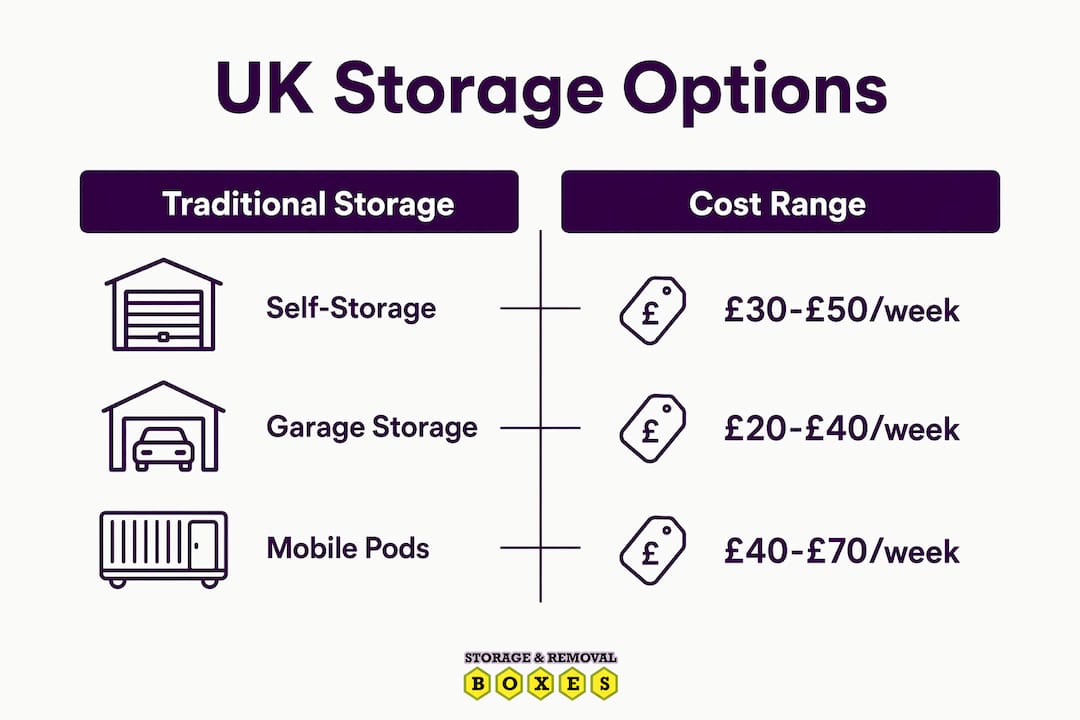
Storage rates in Central London cost 30 to 60% more than the UK national average. A unit that costs £40 per week in Manchester or Birmingham can easily reach £60 to £65 per week in zones 1 to 3 of London. If you are storing in the capital, comparing providers across a wider radius is worth the effort.
The headline rental rate is rarely the total cost. Insurance, padlocks, and admin fees add significantly to the base price, with insurance alone typically running at 10 to 15% of the rental cost. Many chains make their own insurance mandatory, but cheaper third-party policies exist. Always check whether the facility accepts external insurance before signing.
| Cost element | Typical range |
|---|---|
| 25 sq ft unit (chain) | £30 to £50 per week |
| 25 sq ft unit (independent) | £18 to £35 per week |
| Insurance (per month) | 10 to 15% of rental cost |
| Padlock (one-off) | £10 to £25 |
| Administration fee | £15 to £30 one-off |
Introductory offers from major chains often include 50% off for the first eight weeks or a first month for £1. These deals are attractive for short-term needs but long-term users should negotiate stable pricing with independent operators rather than relying on promotional rates that escalate sharply. NHS workers, military personnel, and emergency service staff can often access standing discounts at several national chains, so always ask before booking.
Pro Tip: Ring three local independent storage facilities before booking with a chain. Quote the chain’s introductory rate and ask if they can match it on a longer-term basis. Most will negotiate, and you avoid the price hike when the promotion ends.
Which storage option suits your specific situation?
Access frequency is the primary factor in choosing between self-storage and any other option. If you need to visit your unit weekly, self-storage at a facility with extended hours is the clear choice. If you are storing items for six months during a house move and expect to visit once or twice, a mobile pod or garage unit saves money without meaningful inconvenience.
For business users, self-storage at a facility with 24-hour access suits stock management, document archiving, and equipment storage. Many Safestore and Big Yellow locations offer drive-up units, which makes loading and unloading deliveries practical. A small 50 sq ft unit can hold the equivalent of a small office’s worth of archived files or seasonal retail stock.
Fragile and climate-sensitive items require climate-controlled self-storage. Standard garage and container units expose contents to temperature swings and humidity, which damages electronics, artwork, musical instruments, and wooden furniture over time. The additional cost of a climate-controlled unit is modest compared to the replacement cost of damaged items.
- Moving house: Mobile pod or self-storage with flexible contract terms
- Business stock or documents: Self-storage with 24-hour access and drive-up units
- Fragile or valuable items: Climate-controlled self-storage only
- Seasonal items (garden furniture, sports equipment): Garage or container storage
- Short-term decluttering: Peer-to-peer platforms or home reorganisation first
For home storage, the self-storage explained guide from Storageremovalboxes covers the practical differences between unit types and how to match them to moving scenarios in detail.
How to size, pack, and prepare your storage unit
Self-storage units average 80 sq ft across the UK, with options ranging from 3 sq ft locker-sized spaces up to 5,000 sq ft warehouse units. Most households storing the contents of a one-bedroom flat need 50 to 75 sq ft. Overestimating your size requirement is one of the most common and costly mistakes, so measure your furniture and estimate box counts before booking.
Follow these steps to prepare your unit efficiently:
- Inventory everything before you pack. List items by category and note which you will need to access first. Place frequently needed items near the unit door.
- Use uniform-sized removal boxes. Standard double-walled boxes stack cleanly and maximise vertical space. Odd-shaped bags and soft cases waste floor area and collapse under weight.
- Wrap fragile items individually. Bubble wrap, foam sheets, and packing paper protect ceramics, glassware, and electronics. Never rely on clothing or towels as padding inside a storage unit, since moisture can transfer.
- Label every box on two sides. A label only on the top becomes invisible once boxes are stacked. Side labels let you identify contents without moving anything.
- Review your contract before signing. Check the notice period for ending your rental, the process for upsizing or downsizing, and whether price increases require advance notice. Many chains reserve the right to raise rates with 28 days’ notice.
For moving tips tailored to storage users, Storageremovalboxes has a dedicated 2026 guide covering packing sequences, box selection, and unit layout strategies.
Pro Tip: Disassemble all furniture before it goes into the unit. Bed frames, shelving units, and dining tables take up far less floor space flat-packed, and you will often drop a unit size entirely, saving money every month.
Key takeaways
Choosing the right UK storage solution requires matching access frequency, budget, and item type to the correct facility or method before signing any contract.
| Point | Details |
|---|---|
| Self-storage suits frequent access | Use national chains or local independents for regular visits, business stock, and climate-sensitive items. |
| Independent operators cost less | Local facilities charge 20 to 40% less than major chains for comparable space and security. |
| Total cost exceeds headline rent | Add insurance, padlock, and admin fees to calculate the true monthly outlay before committing. |
| Home organisation reduces external need | Vertical space solutions can eliminate the need for paid storage entirely for many households. |
| Negotiate for long-term stability | Avoid introductory offers that escalate; ask independents for fixed-rate agreements instead. |
Why I think most people rent storage they do not actually need
After years of writing about moving and home organisation, the pattern I see most often is this: people rent storage as a way of postponing a decision. The unit fills with items they feel guilty discarding but never actually use. Six months later, they are paying £40 a week to store a broken exercise bike and three boxes of university textbooks.
The biggest saving in UK storage is not finding a cheaper unit. It is eliminating the need through honest decluttering before you rent anything. Spend a weekend sorting before you spend a month’s rent. You will often find that 60 to 70% of what you planned to store can be donated, sold, or recycled.
When external storage is genuinely necessary, I consistently recommend local independent operators over national chains for anything beyond three months. The pricing is more stable, the staff are more flexible on contract terms, and you are not subject to the automated rate increases that chains apply once your introductory period ends. The trade-off is that some independents have shorter access hours, so confirm this before signing.
One thing I rarely see mentioned: wardrobe boxes are genuinely worth the cost for anyone storing clothes long-term. Folded garments in standard boxes develop permanent creases and attract moisture. Hanging storage protects them properly and makes retrieval far faster.
The readers who get the most value from storage are those who treat it as a short-term tool with a clear exit date, not an indefinite extension of their home.
Pack smarter before your items go into storage
The difference between a well-organised storage unit and a chaotic one comes down almost entirely to how you pack before anything leaves the house. Storageremovalboxes supplies double-walled removal boxes, bubble wrap rolls, foam protectors, and specialist packing materials designed for exactly this purpose, whether you are storing fragile china, bulky furniture, or a full household during a move. Every product is made from recyclable materials and built to handle the weight and stacking demands of a storage unit. Browse the full range of packing materials for safe storage or explore the complete selection of removal and storage boxes to find the right fit for your move.
FAQ
What is the cheapest storage option in the UK?
Peer-to-peer platforms such as Stashbee offer the lowest prices, with savings of 40 to 60% compared to commercial self-storage. Local independent self-storage facilities are the next most affordable option, typically charging 20 to 40% less than national chains.
How do I choose the right storage unit size?
Measure your furniture and estimate your box count before booking. Most one-bedroom flat contents fit in a 50 to 75 sq ft unit. Disassembling furniture before storage often reduces the required unit size by one tier, cutting monthly costs.
Is insurance mandatory for UK self-storage?
Many national chains make their own insurance mandatory, but third-party insurance options are often cheaper. Always check whether the facility accepts external policies before signing, as this can reduce your total monthly cost by 10 to 15%.
How much does self-storage cost per month in the UK?
A 25 sq ft unit at a major chain costs roughly £120 to £200 per month, while local independents charge closer to £70 to £140 for similar space. For a detailed breakdown of monthly storage costs across the UK, including regional variations, Van-247 provides a useful comparison.
When should I use a mobile storage pod instead of self-storage?
Mobile pods suit long-term storage where you need access rarely, such as during a house move or extended renovation. Self-storage is the better choice when you need to visit your items regularly, since pod access requires advance notice and a depot visit.